Epoxy Pipe Lining in Rancho Palos Verdes, CA
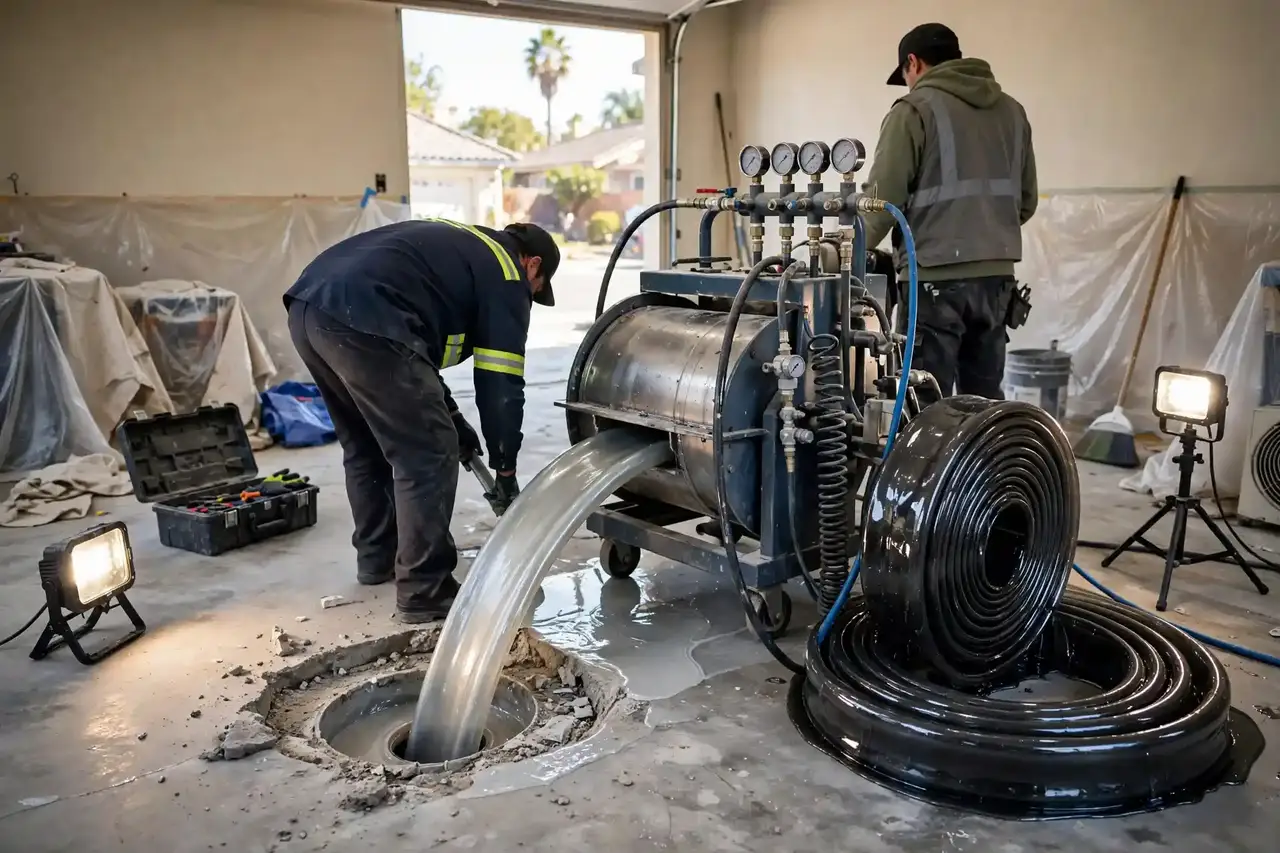
In Short
Epoxy pipe lining renews corroded under-slab water lines from the inside — a resin coating cures into a new pipe within the old one, sealing pinholes without demolition. In Rancho Palos Verdes, CA, the first step is a call to (833) 713-2101, and we will connect you with an independent local specialist for assessment.
How Epoxy Pipe Lining Works
Epoxy lining rehabilitates a deteriorated pipe without removing it. The concept is straightforward; the execution is exacting:
- Inspection. A camera surveys the pipe interior, confirming it is structurally sound enough to host a liner — lining a collapsed or channel-worn pipe is not an option.
- Cleaning. The interior is descaled to bare material using abrasive cleaning — chain flails or grit systems that strip corrosion, scale, and tubercles. Liner bond depends entirely on this step.
- Drying. The line is dried completely; moisture compromises resin adhesion and cure.
- Resin application. Two-part epoxy resin is applied to the interior — by spray, brush, or pull-through systems depending on the pipe diameter and the system specified — building a continuous coating of specified thickness.
- Curing. The resin cures per the manufacturer's schedule — ambient, heated, or staged cure — forming a hard, jointless, corrosion-proof pipe within the old one.
- Verification. A final camera pass confirms continuous coverage, and the line is pressure-tested before being returned to service.
The result: pinholes sealed, interior corrosion halted, and a smooth bore that often flows better than the scaled pipe it replaced — all with the slab and floors untouched. If your copper is pitted but structurally intact, lining deserves a serious look. Ask a Pro at (833) 713-2101 to discuss candidacy.
Good Candidates — and Poor Ones
Lining is a precision tool, not a universal answer. Candidacy is everything:
- Ideal: copper or other metallic pipe with interior pitting and pinhole history but sound structure; long runs under expensive flooring; accessible isolation points at both ends.
- Workable: moderate scaling and tuberculation that cleaning can remove; multiple pinholes along a run (lining seals them all at once); pipe with bends that would complicate spot repairs.
- Poor: collapsed or ovalized sections; severe channeling where the pipe bottom is worn through; active large breaks; pipe with standing bellies that will not drain for the dry-cure steps.
- Disqualified: pipe the camera cannot pass; sections with major offsets; systems that cannot be isolated and dried.
The camera inspection is the gatekeeper — insist on seeing the footage and the candidacy reasoning, not just a yes-or-no. A professional who declines to line your pipe after inspecting has saved you from an expensive failure. For an honest candidacy assessment, Call Now at (833) 713-2101.
The Lining Process in Detail
What actually happens during the work, in order:
- Isolation and bypass planning. The target run is valved off. Because lining takes the line out of service for the duration, the plan covers which fixtures are affected and for how long.
- Camera baseline. Full-length footage documents pre-existing condition — your before record.
- Abrasive cleaning. Descaling tools strip the interior to clean metal. This is loud, dusty-at-the-access-point work, but it never enters your living space — it happens at the pipe access points.
- Drying and verification. Heated air dries the line; a camera pass confirms a clean, dry host surface ready for resin.
- Resin application. The epoxy system is applied per specification — thickness, coverage, and method matched to the pipe diameter and condition.
- Controlled cure. Temperature and time follow the resin schedule. This step is not rushed; premature pressurization is the classic lining failure.
- Final camera and pressure test. Continuous liner, no holidays or thin spots, holding test pressure — documented on video and gauge.
- Reinstatement. Connections at fixtures and branches are reopened and verified flowing; the system is disinfected and flushed per potable-water practice before use.
Thorough lining is a multi-day process, not a spray-and-go visit. Anyone promising completion in hours is describing a different (and thinner) procedure. Book Service at (833) 713-2101 for the real process.
Materials and Equipment
- Two-part epoxy resins. Formulated for potable-water contact, meeting NSF/ANSI 61 requirements for drinking-water system components — the product standard that matters for a lined supply line.
- Application rigs. Spray, brush-spin, or pull-through systems matched to pipe diameter; the method is specified, not improvised.
- Abrasive cleaning trains. Chain flails, carbide descalers, and grit systems that take the host pipe to bare metal without destroying it.
- Drying systems. Heated, filtered air that brings the line to the dryness the resin chemistry requires.
- Inspection cameras. Used at least three times per job: baseline, post-cleaning, and post-cure — the visual record of each phase.
- Cure monitoring. Temperature logging during cure where the system requires it, proving the schedule was followed.
- Pressure test equipment. Calibrated gauges verifying the rehabilitated line holds before reinstatement.
Ask which resin system will be used and look up its potable-water listing yourself — reputable products carry it openly. When you Contact Us Now at (833) 713-2101, that is a fair question to put to the specialist.
Safety, Ventilation, and Water Quality
- Ventilation during application. Uncured epoxy components have strong fumes. The work area is ventilated, and the application happens at pipe access points — not open inside living rooms. Occupants with respiratory sensitivities should discuss timing with the professional.
- Full cure before use. The line stays out of service until the resin schedule is complete. Drinking from a partially cured liner is not a risk a professional process allows.
- Potable-water-listed resins only. Supply-line lining uses resins listed to NSF/ANSI 61 for drinking-water contact. This is a product certification question — verify the product, not the company.
- Flush and disinfection. After cure, the line is flushed and disinfected per standard potable practice before fixtures are used.
- Isolation discipline. The lined run is positively isolated from the rest of the system during resin work so no uncured material migrates to fixtures.
- Dust control at access points. Abrasive cleaning generates dust at the pipe openings; containment keeps it out of the home.
Done to specification, a lined potable line is safe by design and verified by testing — the safety lives in the procedure, which is why the procedure should be documented. For lining done to specification, Call Now at (833) 713-2101.
Epoxy Lining for Rancho Palos Verdes Homes
- Mid-century copper, interior-corroded. The Peninsula's 1950s–1970s copper is the textbook lining candidate: pitted inside from decades of water chemistry, but often structurally sound enough to host a liner.
- Floors that justify it. Where travertine, hardwood, or stone make traditional access punishing, lining's zero-demolition profile changes the economics completely.
- Long runs, many pinholes. Lining seals an entire run at once — for pipe with pitting along its length, that beats chasing individual pinholes one repair at a time.
- Water chemistry consideration. Moderately hard local water with chloramine treatment is exactly what pits copper from the inside; the epoxy barrier isolates the water from the metal permanently.
- Hillside and movement areas. A continuous jointless liner tolerates minor ground movement better than a run of rigid repaired joints — relevant near Portuguese Bend and other shifting zones.
- Occupied-home advantage. No slab demolition means the household keeps functioning; the main imposition is the planned water outage during lining and cure.
Lining is not the cheapest option on paper — it is often the cheapest option once flooring restoration is counted honestly. Get the candidacy assessment first; the economics follow. Ask a Pro at (833) 713-2101.
→ trenchless repair methods compared
→ copper pipe repair for pinhole leaks
→ rerouting as an alternative approach
Suspect a Slab Leak? Talk to a Specialist Today
One call connects you with a local slab leak professional serving Rancho Palos Verdes, CA — day or night.
Call (833) 713-2101