Slab Leak Pipe Rerouting in Rancho Palos Verdes, CA
In Short
Slab leak pipe rerouting abandons the failed under-slab water line and runs a new line overhead through walls or attic — no concrete demolition, no torn-up floors. In Rancho Palos Verdes, CA, the first step is a call to (833) 713-2101, and we will connect you with an independent local specialist to map a route.
What Pipe Rerouting Means
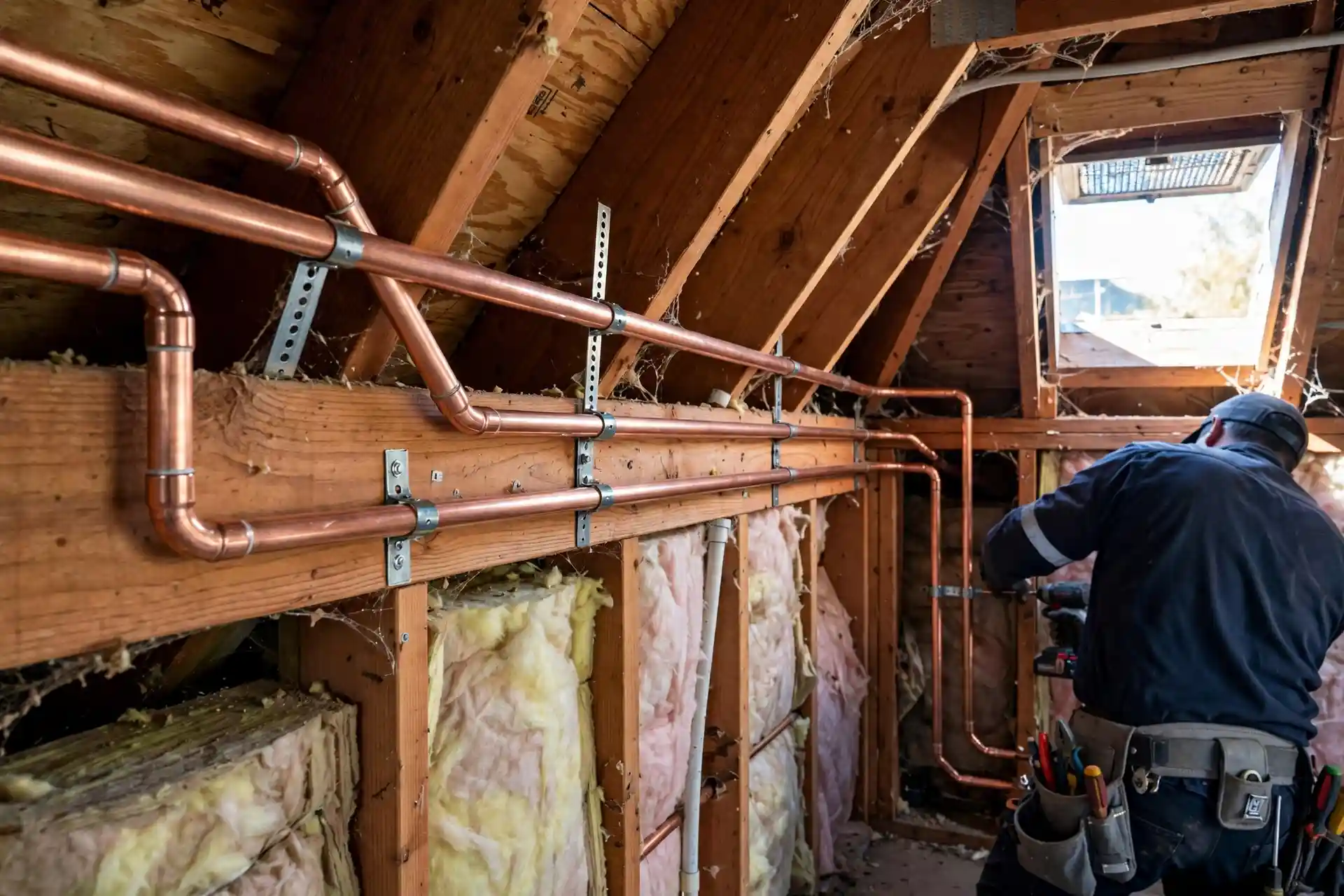
Rerouting solves a slab leak by leaving the slab alone. Instead of chasing the failed pipe through concrete, the leaking under-slab line is permanently abandoned — capped at both ends, drained, and left in place — while a brand-new water line is run along an overhead path: through wall cavities, above ceilings, or through the attic, from the supply source to the fixtures the old line served.
The result is new pipe, new joints, and zero demolition of floors or slab. The old line simply stops being part of your plumbing system. Because the new run is accessible in walls and attic rather than buried, any future issue is a drywall repair rather than a concrete excavation — a structural advantage that outlasts the immediate fix.
Rerouting is not a patch or a compromise. It is a complete replacement of the failed run, just routed where it can be installed cleanly and serviced later. For homes with aging under-slab copper, it is frequently the most rational long-term answer. To find out whether your layout suits it, Ask a Pro at (833) 713-2101.
When Rerouting Beats Breaking the Slab
- Recurring pinhole leaks. One repair in 60-year-old copper is maintenance; the second is a pattern. Rerouting ends the cycle instead of scheduling the next repair.
- Irreplaceable flooring. Travertine, hardwood, or discontinued tile over the pipe path make every slab opening a restoration crisis. Rerouting sidesteps the problem entirely.
- Post-tension slabs. Where tensioned cables run through the slab, cutting is restricted or prohibited — rerouting is the default solution, not the alternative.
- Fragile remaining pipe. When inspection shows the whole run is thinned and pitted, spot-repairing one hole leaves dozens of future holes in the ground. A new overhead run replaces the run, not the hole.
- Difficult interior access. Pipe running under built-in cabinetry, stonework, or finished spaces where demolition would destroy more than plumbing.
- Hot water lines. Hot-side failures are prime reroute candidates: the new insulated overhead line escapes both the corrosion environment and the thermal-cycling stress of burial.
- Speed and livability. No concrete curing, no demolition dust through the house, no rooms sealed off — the household keeps functioning around the work.
The honest counter-cases: very long or convoluted routes can cost more in labor than a simple spot repair, and some layouts lack clean overhead paths. A route survey — not a guess — settles it. Call Now at (833) 713-2101 to get that survey.
The Rerouting Process, Step by Step
- Route survey. The specialist maps the failed line's fixtures, then walks the overhead path: attic access, wall cavity availability, framing to drill or avoid, and the tie-in points at both ends.
- System shutdown and drain-down. Water is shut off and the affected branch drained. The failed under-slab line is capped at both ends so it can never re-pressurize.
- Path preparation. Small, surgical drywall openings are cut where the new line enters and exits wall cavities — a few inches, not rooms. Attic access is established.
- Pipe installation. The new line — typically PEX-A or copper per the professional's specification — is run along the surveyed path, supported at proper intervals with hangers and straps, with protective plates wherever it passes through framing.
- Insulation. Hot lines are insulated along the full run; in unconditioned attics, freeze and heat protection are specified for the local climate exposure.
- Connections. The new run ties into the supply at the source end and to each fixture branch at the far end, with proper valves for future isolation — an upgrade over many original installations that lacked them.
- Pressure test. The complete new run is pressurized and held before any drywall closes. Only a passing test finishes the plumbing.
- Close-up. Drywall openings are patched; the abandoned under-slab line stays buried and inert. Touch-up paint is typically the homeowner's finishing step.
Most reroutes complete in one to two days. The disruption profile — some attic noise, small drywall patches — is modest compared with any slab-opening alternative. Book Service at (833) 713-2101 to get a route mapped for your home.
Materials and Equipment
- PEX-A tubing. The most common reroute material: flexible enough to fish through cavities with minimal openings, immune to interior corrosion, and tolerant of building movement. Fewer fittings mean fewer future leak points.
- Copper. Specified where the professional judges rigid pipe preferable — exposed runs, high-heat proximity, or matching existing system characteristics.
- Proper supports. Hangers, straps, and standoffs at specified intervals — unsupported pipe sags, stresses joints, and eventually fails. Support quality is a workmanship tell.
- Nail plates and bushings. Steel protection wherever pipe passes through framing, preventing the drywall-screw puncture that causes a percentage of all reroute callbacks.
- Insulation. Closed-cell insulation on hot lines along the full run; appropriate protection for any line in unconditioned space.
- Isolation valves. Quarter-turn ball valves at logical points — a lasting improvement that makes any future work a valve-turn instead of a house-wide shutdown.
- Pressure test rigs. The new run is proven at test pressure before close-up — the same standard as any buried repair.
Material and detailing choices are where reroute quality lives — two reroutes can look identical on day one and perform very differently by year ten. When you Contact Us Now at (833) 713-2101, ask what material and support schedule the specialist specifies, and why.
Safety and Workmanship Precautions
- Structural framing. Holes through studs and joists follow notching-and-boring rules — the professional knows where pipe can pass and where it cannot. Compromised framing is not an acceptable side effect of plumbing.
- Attic conditions. Peninsula attics get extremely hot in summer and cramped always. Work is planned for safe conditions: hydration, lighting, walk boards on joists — never balancing on drywall.
- Fire blocking. Where the new run penetrates rated assemblies or floor/ceiling separations, fire blocking is restored. A pipe chase is not a chimney.
- Abandoned line discipline. The old under-slab line is positively capped at both ends and verified depressurized — an abandoned line that can re-pressurize is a future leak, not a retired one.
- Electrical separation. New plumbing routes maintain proper separation from electrical wiring; where they must cross, protection and common-sense routing apply.
- Insulation completeness. Partial insulation on a hot run is nearly as bad as none — heat loss, condensation risk, and expansion noise all concentrate at the gaps. Full-run coverage is the standard.
None of this is exotic — it is simply what careful reroute work includes. If a proposal skips the route survey or the pressure test, it is not a reroute proposal worth accepting. For work that includes all of it, Call Now at (833) 713-2101.
Rerouting in Rancho Palos Verdes Homes
- Ranch architecture is ideal. The dominant local form — single-story ranch homes with accessible attics — is the easiest reroute geometry there is: straight overhead runs, simple tie-ins, minimal wall work.
- The standard answer for recurring copper pinholes. Peninsula specialists propose reroutes constantly for 1950s–1970s copper with leak history — it is the mainstream solution here, not an exotic one.
- Attic heat planning. Summer attic temperatures on the Peninsula demand proper insulation and expansion-tolerant strapping on new hot runs — details a local specialist specifies as routine.
- Hillside and split-level variations. Stepped floor plans complicate routes slightly; the survey accounts for elevation changes and longer runs, sometimes staging the reroute in phases.
- Preserving high-value interiors. Where interiors feature custom finishes, the reroute's small drywall patches — easily refinished — compare overwhelmingly favorably with slab demolition through those same finishes.
- Earthquake country detailing. Flexible PEX with proper supports tolerates seismic movement better than rigid buried copper — a genuine secondary benefit in Southern California.
If your home is a mid-century ranch with copper leak history, rerouting is probably already the answer your neighbors chose. Get the route surveyed for your specific layout — Ask a Pro at (833) 713-2101.
→ trenchless options compared with rerouting
→ tunneling under the slab as another option
→ hot water line failures that suit rerouting
Suspect a Slab Leak? Talk to a Specialist Today
One call connects you with a local slab leak professional serving Rancho Palos Verdes, CA — day or night.
Call (833) 713-2101