Commercial Slab Leak Repair in Rancho Palos Verdes, CA
In Short
Commercial slab leak repair serves offices, retail spaces, restaurants, and multi-tenant buildings with under-slab plumbing failures — planned around your operations to limit downtime. In Rancho Palos Verdes, CA, the first step is a call to (833) 713-2101, and we will connect you with an independent local professional experienced in commercial work.
How Slab Leaks Show Up in Commercial Buildings
Commercial slab leaks rarely announce themselves to the owner first — they surface as operational problems:
- Unexplained water cost spikes across the building meter, sometimes discovered by the bookkeeper before anyone sees water.
- Warm or damp restroom and break-room floors — the most common commercial slab leak locations, given fixture density.
- Musty odors in storage or back-of-house areas where slow leaks go unnoticed behind shelving.
- Slab heaving or cracked flooring in warehouses and retail spaces, where expansive soil plus chronic moisture lifts the slab.
- Recurring drain backups paired with wetness — which can indicate a drain line failure under the slab rather than a supply leak, a different repair path.
- Tenant complaints in multi-tenant buildings: one suite's leak becomes everyone's problem when water migrates.
Commercial buildings also hide leaks longer. Larger slabs, more pipe, drop ceilings that conceal the first signs, and nobody walking the back rooms daily all delay discovery — which is why the water bill deserves the same attention in a commercial property as it gets in a home. If yours has jumped, Ask a Pro at (833) 713-2101.
Why Commercial Slab Leaks Are a Different Job
The pipe is the same; everything around it is different:
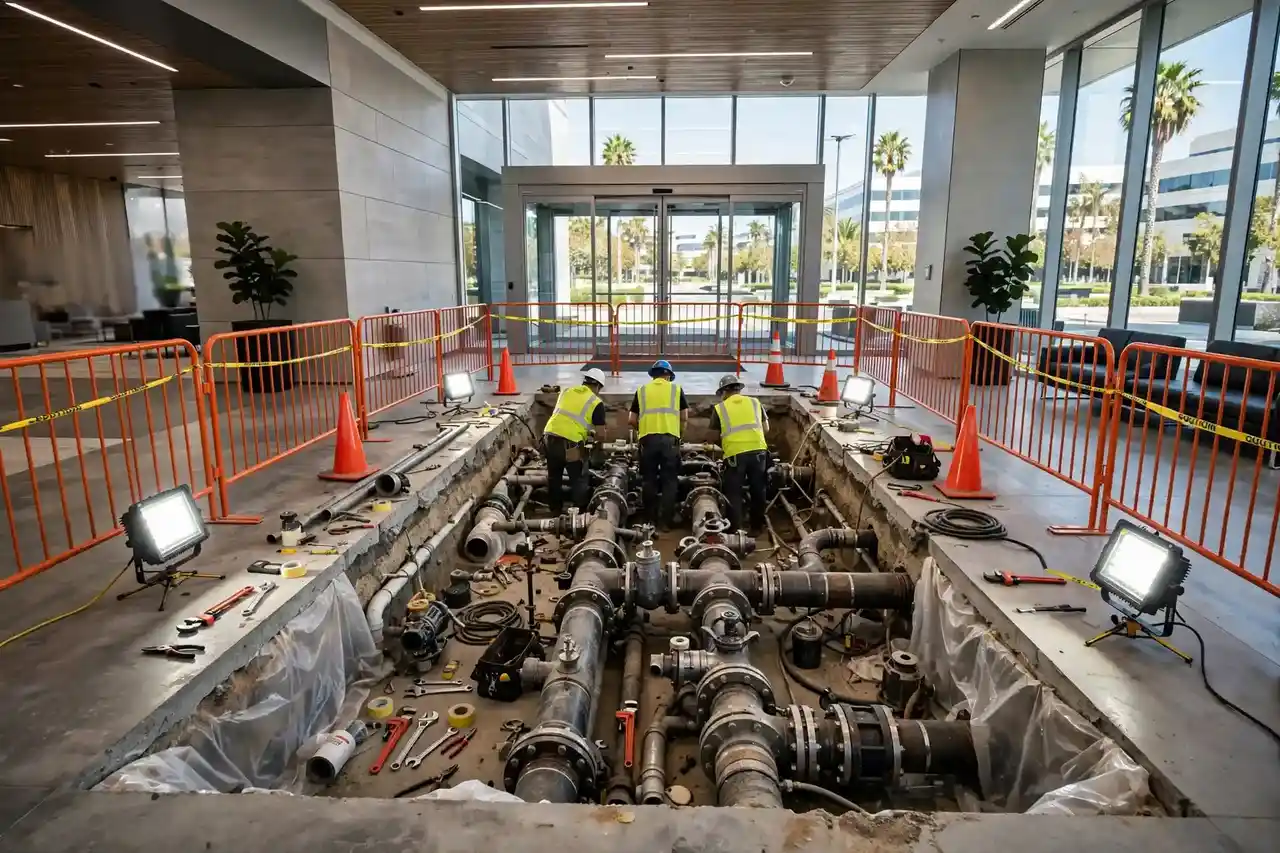
- Occupancy. People work, shop, and eat in the building during the repair. Work zones must be barricaded, dust-contained, and safe for the public — not just the crew.
- Operating hours. Detection and noisy work are typically scheduled for off-hours, early mornings, or weekends to avoid disrupting business. Planning the schedule is part of the job, not an afterthought.
- Health and sanitation rules. In restaurants and food-handling spaces, any work affecting water supply or creating dust must be coordinated around health-code requirements — repairs are sequenced so food areas stay compliant.
- Larger and more complex systems. Bigger pipe diameters, recirculation loops, multiple water heaters, and as-built drawings that may or may not match reality.
- Multiple stakeholders. Owners, property managers, and tenants all need information at different levels of detail. Clear written findings prevent the misunderstandings that derail commercial jobs.
- Documentation burden. Insurance claims, CAM reconciliations, and property records all demand thorough written documentation — photos, moisture readings, and reports, not verbal summaries.
A residential plumber with a jackhammer is not a commercial slab strategy. The independent professionals we connect you with for commercial work plan around operations first and pipe second. Call Now at (833) 713-2101 to discuss your building.
The Commercial Repair Process, Step by Step
- Site survey and records review. Available as-builts, meter history, and a walkthrough establish the pipe layout and the leak's likely zone before instruments come out.
- Off-hours detection. Electronic location — acoustic, thermal, tracer — is scheduled when the building is quiet, which also happens to be when acoustic methods work best.
- Stakeholder briefing. The written findings go to the decision-maker with a repair plan, schedule options, and the operational impact of each: which areas close, for how long, and what stays running.
- Isolation zoning. The failed branch is valved off so the rest of the building keeps water. In buildings without adequate isolation valves, installing them becomes part of the job — and a lasting improvement.
- Method selection for minimal disruption. Trenchless methods, tunneling, or overhead rerouting are weighed specifically against downtime: the cheapest pipe fix is not the cheapest job if it closes a restaurant for a week.
- Contained execution. Dust barriers, HEPA filtration, barricaded work zones, and off-hours noisy work keep the business running around the repair.
- Testing, documentation, and closeout. Pressure-tested repairs, a complete photo and readings file for insurance and property records, and a written summary for the owner or manager.
Notice how much of this is planning and communication — that is what commercial work actually is. To get that kind of planning for your property, Book Service at (833) 713-2101.
Equipment and Materials for Commercial Slab Work
- Commercial-grade detection instruments. The same acoustic, thermal, and tracer technology as residential location, scaled to larger slabs and longer pipe runs — with correlators doing proportionally more of the work.
- Dust and noise containment. Barricade systems, negative-air containment, and HEPA filtration that keep a work zone from becoming a building-wide event.
- Core drilling and controlled demolition. Precision openings sized to the repair, with slurry control and debris management suited to occupied buildings.
- Commercial pipe materials. Larger-diameter copper, and where appropriate, materials matched to the building's existing system and local code requirements for commercial occupancies.
- Temporary water provisions. Bypass piping and temporary connections that keep restrooms and critical operations running while a branch is down.
- Documentation tools. Calibrated moisture meters, thermal cameras, and reporting that produce the written record insurers and property managers require.
Equipment is only half the commercial equation — the other half is a crew disciplined enough to work clean in an occupied building. When you Contact Us Now at (833) 713-2101, describe your occupancy and hours; the professional matched to your job will plan around them.
Safety and Operational Precautions
- Public protection. Work zones in customer or employee areas are barricaded with signage; trip, slip, and overhead hazards are managed for people who have no reason to expect construction.
- Water supply integrity. Isolation is verified branch by branch — shutting the wrong valve in a commercial building can kill fire suppression or critical equipment. Verification is procedural, not assumed.
- Food-service coordination. In restaurants, work affecting potable water is sequenced and communicated so health-code compliance never lapses; dust-generating work stays physically separated from food areas.
- Fire watch. Any soldering or hot work in a commercial structure follows fire-watch protocol: shields, extinguishers, and post-work inspection.
- Utility locates. Before any exterior excavation or tunneling, underground utilities are located and marked — commercial sites often have denser utility congestion than homes.
- Accessibility. Egress paths and accessible routes are maintained throughout the work; a repair that blocks the accessible entrance is a repair done wrong.
Commercial safety is about the building's people as much as the crew. If your property needs slab work with operations protected, Call Now at (833) 713-2101.
Commercial Slab Work on the Palos Verdes Peninsula
- Peninsula commercial corridors. The commercial stock along Western Avenue, Pacific Coast Highway, and the Peninsula Center area includes mid-century buildings with original under-slab plumbing now at or past typical service life.
- Hillside commercial pads. Graded pads for commercial buildings on slopes combine the soil-movement stresses homes face with heavier structural loads — pipe stress here deserves serious assessment, not quick patches.
- Restaurants and water use. Food establishments run high hot-water volumes through aging lines; hot-side failures under restaurant slabs are a recurring local pattern, and downtime costs are measured in lost service, not just repair scope.
- Older office and medical buildings. Long, low commercial structures from the 1960s–1970s share the residential era's copper-under-slab construction — and its aging timeline.
- Property-manager realities. Many Peninsula commercial properties are professionally managed, which means the decision-maker needs written findings, scheduled options, and documentation suitable for ownership reporting — all standard in a properly run commercial job.
- Parking and access. Slab access in commercial buildings often means working around parking, deliveries, and customer flow; staging and access planning are part of every competent proposal.
Local commercial buildings fail in local patterns, and the fix has to fit both the pipe and the business. Ask a Pro at (833) 713-2101 to start with a site survey.
→ electronic leak location for large commercial slabs
→ trenchless methods that minimize business disruption
→ documenting the loss for an insurance claim
Suspect a Slab Leak? Talk to a Specialist Today
One call connects you with a local slab leak professional serving Rancho Palos Verdes, CA — day or night.
Call (833) 713-2101