Trenchless Slab Leak Repair in Rancho Palos Verdes, CA
In Short
Trenchless slab leak repair fixes or replaces failing under-slab water lines with minimal concrete demolition — often through small access points instead of torn-up floors. In Rancho Palos Verdes, CA, the first step is a call to (833) 713-2101, and we will connect you with an independent local specialist to assess whether trenchless fits your home.
What Trenchless Slab Repair Actually Means
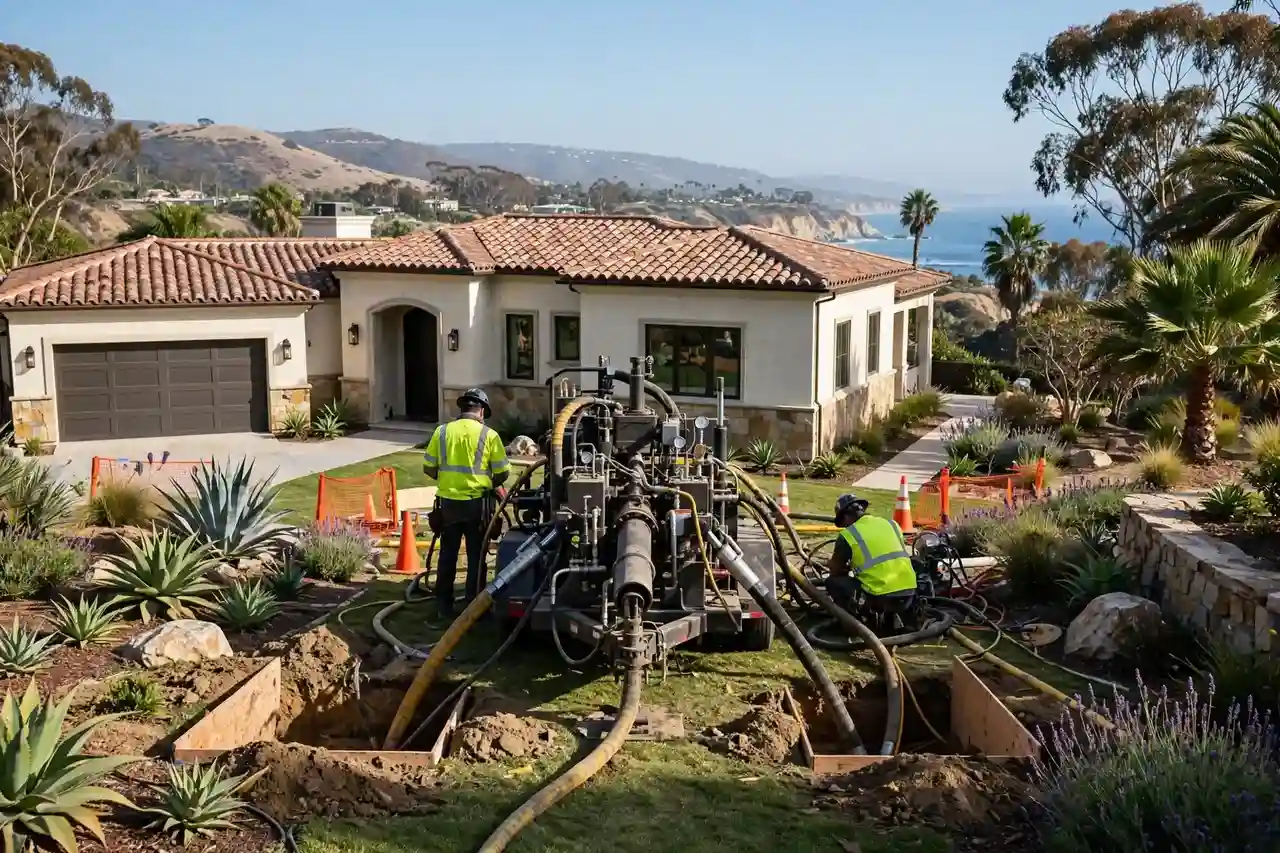
"Trenchless" does not mean "no digging at all" — it means dramatically less of it. Instead of opening a trench through your slab along the entire pipe run, trenchless methods rehabilitate or replace the pipe through small access points:
- Pipe bursting. A bursting head is pulled through the old line, fracturing it outward while trailing a new pipe into the same path. The old pipe becomes the conduit for its own replacement.
- Pipe lining (cured-in-place). A resin-saturated liner is installed inside the existing pipe and cured to form a new pipe within the old one — sealing pinholes and stopping interior corrosion without removing anything.
- Directional rerouting. A new line is bored or fished through walls, attics, or exterior paths to bypass the failed under-slab section entirely — technically a reroute, often grouped with trenchless because the slab stays intact.
What these share: your floors stay largely undisturbed, the work footprint shrinks from rooms to access points, and restoration costs — often the most expensive part of a traditional slab job in a finished home — drop sharply. The trade-off is candidacy: not every pipe qualifies, which is why assessment comes before promises. To find out whether yours does, Ask a Pro at (833) 713-2101.
When Trenchless Is the Right Choice
Trenchless methods earn their keep in specific situations:
- High-value or irreplaceable flooring. Travertine, hardwood, or discontinued tile that cannot be matched — the floors that make traditional slab openings punishingly expensive to restore.
- Long runs with a single failure zone. A pinhole midway along a 60-foot run is an ideal bursting or lining candidate; opening the whole run traditionally is disproportionate.
- Post-tension slabs. Slabs with tensioned cables cannot be cut casually — severing a cable is a structural event. Trenchless avoids the slab interior entirely.
- Limited interior access. Built-in cabinetry, heavy stonework, or finished basements over the pipe path make traditional access destructive beyond the plumbing itself.
- Multiple bends and offsets. Lining navigates bends that would require several separate slab openings traditionally.
- Occupied homes that must stay livable. Less demolition means less dust, less noise, and fewer rooms out of commission.
Conversely, collapsed pipe, severe offset joints, or pipe so deteriorated it cannot host a liner push the decision back toward traditional repair, tunneling, or rerouting. An honest assessment tells you which category you are in before you commit. Call Now at (833) 713-2101 for that assessment.
The Trenchless Process, Step by Step
- Camera inspection. A push camera travels the line, recording its interior condition: corrosion level, offsets, collapses, and the exact failure point. This footage determines candidacy — it is the most important step.
- Electronic location. The failure is pinpointed acoustically or thermally and the pipe path is mapped, so access points land exactly where needed.
- Cleaning and preparation. The line is descaled and cleared — bursting needs a clear path for the head, lining needs a clean surface for resin bond.
- Access points. Small pits or openings are established at the entry and exit — often outside the home or in a utility area, not in the living room.
- Installation. The bursting head pulls the new pipe through, or the liner is installed and cured per the resin system's procedure. Progress is monitored, not assumed.
- Connections. The new pipe is tied into the existing system at both ends with proper fittings — the transitions are the critical craftsmanship of the job.
- Testing and restoration. The rehabilitated line is pressure-tested and camera-verified. Access points are backfilled and patched — a fraction of the restoration a traditional opening requires.
Each step is documented — you should see the camera footage, the test results, and the finished connections. Book Service at (833) 713-2101 to start with inspection and location.
Equipment and Materials in Trenchless Work
- Push cameras and locators. High-resolution cameras with on-board locators map interior condition and exact position simultaneously.
- Descaling equipment. Chain flails, abrasive systems, or hydro-jetting that clean the host pipe to bare material for lining bond or bursting passage.
- Bursting heads and hydraulic winches. Sized to the pipe diameter — the head fractures the old line while the winch pulls the replacement through in one continuous motion.
- Liner and resin systems. Felt or fiberglass liners saturated with two-part epoxy resins, installed by inversion or pull-in and cured by ambient, hot-water, or steam cure per specification.
- Replacement pipe. Typically HDPE or PEX for bursting — continuous, joint-free runs that eliminate the fitting failures of the original installation.
- Pressure and camera verification. Post-installation pressure testing plus a final camera pass proving full-bore, continuous rehabilitation.
The equipment is specialized enough that trenchless is a distinct discipline — confirm the professional actually performs the method proposed, not just subcontracts it sight unseen. When you Contact Us Now at (833) 713-2101, ask directly about their trenchless experience with under-slab water lines.
Safety and Honest Limitations
- Utility locates first. Any exterior access pit or boring path gets underground utilities located and marked before excavation — gas, electric, and communications share the ground with your water line.
- Not every pipe qualifies. Collapsed sections, severe bellies holding water, or pipe degraded beyond structural integrity cannot be bursted or lined reliably. A camera inspection that says "no" is doing its job.
- Diameter reduction with lining. A liner inside the old pipe slightly reduces internal diameter. On already-marginal pipe sizing this can affect fixture performance — it should be evaluated, not ignored.
- Cure discipline. Liner resins must cure fully per specification before the line is pressurized. Rushing the cure is the classic lining failure mode, and it is entirely preventable.
- Connection quality. The transitions at both ends are hand-built fittings — the most skilled-labor part of an otherwise machine-driven process. Inspect them in the documentation.
- Soil conditions. Bursting displaces soil outward; in rocky ground or immediately adjacent to other utilities, that displacement must be evaluated rather than assumed harmless.
Trenchless done right is excellent; trenchless sold where it does not belong is expensive disappointment. The difference is the assessment. For a candid one, Call Now at (833) 713-2101.
Trenchless Options in Rancho Palos Verdes Homes
- Finishes worth preserving. The Peninsula's travertine entries, hardwood living areas, and stone floors are precisely the finishes that make traditional slab openings so costly to restore — trenchless's strongest local argument.
- Long mid-century runs. Sprawling ranch layouts put long copper runs under the slab; a single pinhole midway along one is the textbook bursting or lining scenario.
- Hillside access patterns. Many RPV lots offer workable exterior access on the downhill side, giving trenchless access points a natural home outside the living space.
- Post-tension awareness. Some newer Peninsula construction uses post-tension slabs, where cutting is restricted — trenchless or reroute become the default rather than the alternative.
- Soil movement and joint-free pipe. In movement-prone areas near Portuguese Bend, a continuous joint-free replacement pipe tolerates ground shifting better than a repaired run full of rigid joints — a genuine engineering advantage, not marketing.
- Occupied-home livability. With access points outside and minimal interior work, households with children, home offices, or health sensitivities stay functional during the job.
Whether trenchless fits your specific pipe is a camera-and-location question, not a phone question — but the phone question starts the process. Ask a Pro at (833) 713-2101.
→ rerouting the line overhead instead
→ tunneling under the slab as another low-demolition option
Suspect a Slab Leak? Talk to a Specialist Today
One call connects you with a local slab leak professional serving Rancho Palos Verdes, CA — day or night.
Call (833) 713-2101