Electronic Slab Leak Location in Rancho Palos Verdes, CA
In Short
Electronic slab leak location uses acoustic sensors, thermal imaging, and tracer gas to pinpoint a hidden leak to within inches — without exploratory demolition. In Rancho Palos Verdes, CA, your first step is a brief call: describe the symptoms, and we will connect you with an independent local specialist equipped for precision location.
What Electronic Location Means — and Why Precision Matters
General detection answers the question "is there a slab leak?" Electronic location answers the harder question: "exactly where?" Using instruments that hear, see, and measure what is happening beneath the concrete, a specialist narrows the leak to a marked spot — often within inches — before any floor is disturbed.
Precision matters because concrete work is the most expensive part of a slab leak repair. Every extra square foot of slab opened is extra demolition, extra dust, and extra restoration of flooring that in Rancho Palos Verdes homes is frequently travertine, hardwood, or stone. A location accurate to inches means the repair opening is minimal. A location accurate to "somewhere in this room" means tearing up far more than necessary.
Electronic location is also what separates professional practice from guesswork. An experienced ear and a moisture meter can suggest a neighborhood; acoustic correlators, thermal cameras, and tracer gas confirm an address. When a repair quote is based on a marked, verified location, you are comparing real scopes of work — not contingencies for "we'll open it up and see." If you want that level of certainty, Ask a Pro at (833) 713-2101 and get connected with an independent specialist who locates electronically before anyone picks up a saw.
The Location Process, Step by Step
- Symptom intake. Your call covers what you have observed — sounds, warm spots, bill history, home age. This focuses the survey instead of scanning the whole slab blindly.
- Leak confirmation. The meter test and main-shutoff isolation confirm water is actually escaping, and hot-versus-cold isolation at the water heater identifies which system is losing pressure.
- Pipe path mapping. An electromagnetic locator traces metallic pipe routes under the slab so the survey follows the real plumbing layout, not assumptions.
- Acoustic grid survey. Ground microphones take readings on a grid over the suspected area. The leak's hiss is loudest directly above the breach; readings get quieter with distance, triangulating the point.
- Thermal cross-check. An infrared camera scans for temperature anomalies — hot line leaks paint a warm trail through the flooring that should agree with the acoustic finding.
- Tracer or pressure verification. On stubborn cases, a safe hydrogen-nitrogen tracer gas is introduced into the isolated line; the gas escapes at the breach and is sniffed out at the surface, or a pressure-decay test confirms the branch.
- Marking and documentation. The verified point is marked on the floor with paint or tape, photographed, and written into a findings report with the methods used — the document your repair quotes and any insurance claim will rest on.
Each step constrains the last. By the time a mark goes on your floor, two or more independent methods have agreed on it. That redundancy is the whole value of electronic location. Book Service at (833) 713-2101 to start the process.
The Technology: Acoustic, Thermal, and Tracer Methods
Three families of technology do the heavy lifting in electronic location. Understanding them helps you judge whether the specialist at your door is thorough:
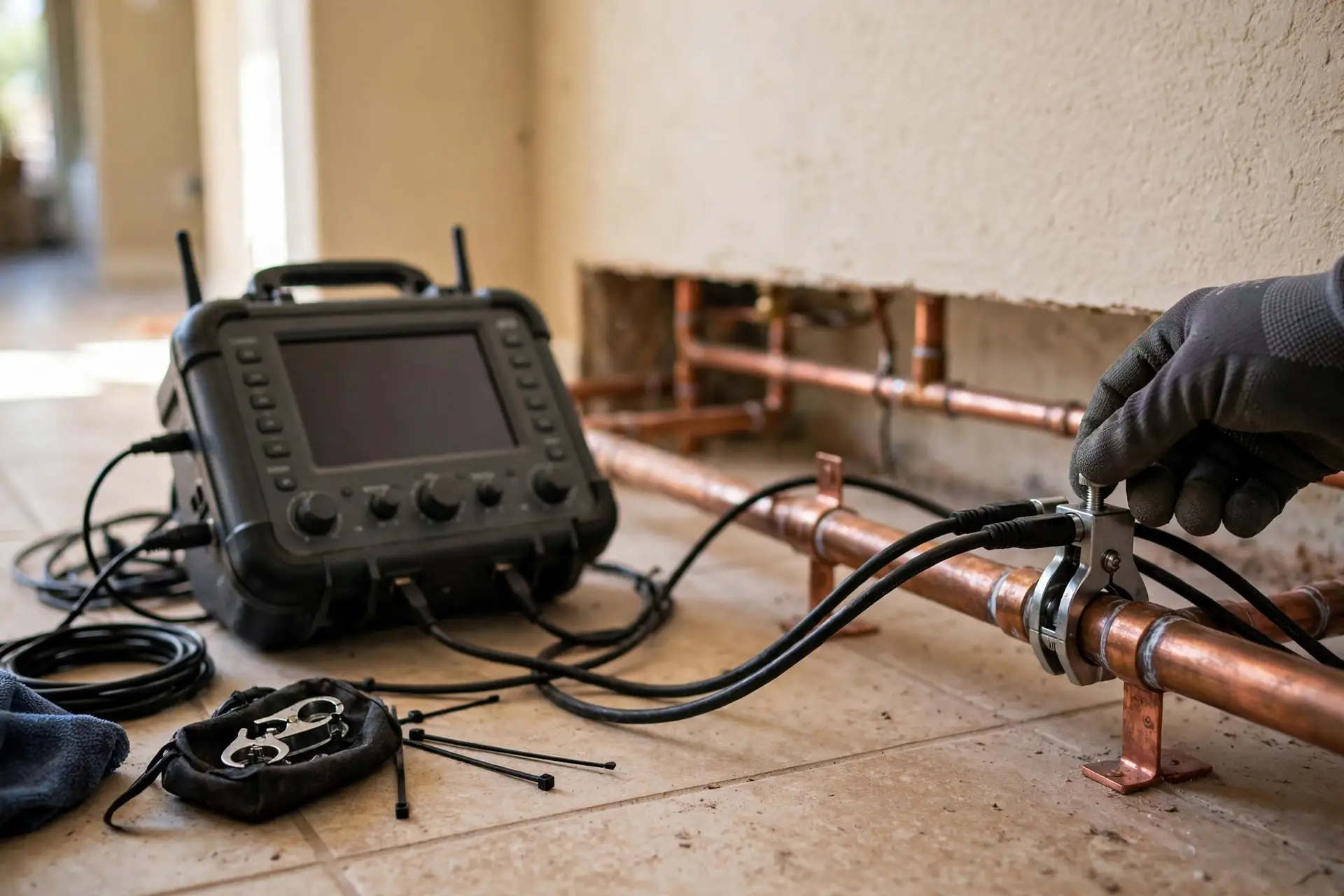
- Acoustic listening. Pressurized water escaping through a pinhole or crack creates a high-frequency hiss that travels through pipe and surrounding soil. Ground microphones coupled with electronic amplifiers and filters isolate that signature from background noise. Correlators take it further: sensors at two known points measure the tiny time difference in the noise's arrival, and the instrument computes the leak's position between them mathematically.
- Thermal infrared imaging. A thermal camera renders surface temperatures as a color map. Hot water escaping under the slab warms the concrete and flooring above it, creating a visible plume that traces the leaking line. It works best on hot-side leaks and on flooring that conducts heat evenly, like tile and stone.
- Tracer gas detection. The isolated line is drained and filled with a non-toxic, non-flammable blend of hydrogen and nitrogen. The tiny hydrogen molecules escape at the breach, rise through concrete pores, and are detected at the surface by a sniffer sensitive to parts per million. It is exceptionally precise on lines where acoustic methods struggle.
- Supporting instruments. Pressure-decay rigs prove which branch leaks; moisture meters map how far water has migrated (which is not always the leak point); electromagnetic locators keep the survey on the true pipe path.
A competent location visit uses at least two of these in agreement. One-method marks are how wrong holes get cut. When you Call Now at (833) 713-2101, you are connected with an independent local professional — ask them which methods they will use before they start.
Accuracy, Safety, and Honest Limitations
Electronic location is the most accurate non-invasive method available, but it is worth knowing both its strengths and its limits:
- Typical accuracy. On a straightforward pressurized supply leak, acoustic and tracer methods routinely mark within inches of the breach. Thermal imaging is slightly broader — it shows the warm zone, which the acoustic reading then tightens.
- Completely non-invasive. Nothing is drilled, cut, or demolished during location. The loudest thing in your house will be the technician's equipment case opening.
- False positives exist. Drain noise, recirculation pumps, water softener regeneration, and even a running pool pump can mimic leak sounds. A careful technician surveys with these off or accounts for them — and verifies with a second method rather than marking the first loud spot.
- Difficult cases. Very small seeps under low pressure are quieter and harder to hear; multiple leaks on one line can confuse triangulation; and deep footings or thickened slab edges attenuate signals. This is where tracer gas earns its keep.
- Verification before concrete work. The professional standard is simple: no saw touches the slab until the location is confirmed by more than one method and documented in writing. Hold any repair process to that standard.
Knowing these limits protects you from both under-thorough and over-confident operators. For a location visit done to the professional standard, Contact Us Now at (833) 713-2101.
Electronic Location in Rancho Palos Verdes Homes
Local building stock shapes how electronic location plays out on the Peninsula:
- Tile and stone floors help thermal work. Travertine, ceramic, and stone — common in RPV homes — conduct heat evenly, giving thermal cameras clean, readable images of hot-side leaks.
- 1950s–1970s copper is acoustically cooperative. Rigid copper transmits leak noise well along the pipe, which makes correlator math reliable on the era's typical long, straight runs.
- Quiet neighborhoods aid listening. Many RPV streets are quiet during the workday, lowering ambient noise that competes with leak signatures — a genuine practical advantage for acoustic surveys.
- Hillside slabs add complexity. Stepped foundations, thickened edges, and retaining-adjacent footings on hillside lots can attenuate signals and complicate pipe-path mapping. Expect the technician to spend extra time on the locator in these homes.
- Long ranch layouts mean long surveys. Sprawling single-story floor plans translate to more grid points and a longer acoustic survey — thoroughness here is a feature, not dawdling.
- Soil movement areas. Near Portuguese Bend and other movement-prone zones, stressed pipe may have more than one compromised point. A complete survey checks the full run, not just the first loud spot.
An independent specialist who works these neighborhoods regularly already knows these patterns. Call Now at (833) 713-2101 to get connected with one.
→ general slab leak detection and warning signs
→ what to do in a slab leak emergency
→ trenchless repair options after location
Suspect a Slab Leak? Talk to a Specialist Today
One call connects you with a local slab leak professional serving Rancho Palos Verdes, CA — day or night.
Call (833) 713-2101