Emergency Slab Leak Repair in Rancho Palos Verdes, CA
In Short
Emergency slab leak repair addresses active, damaging under-slab water failures — flooding, burst pipes, and leaks you cannot stop. In Rancho Palos Verdes, CA, the first step is immediate: shut your main water valve if you safely can, then call (833) 713-2101 and we will connect you with an independent local professional for urgent help.
What Counts as a Slab Leak Emergency
Not every slab leak is an emergency — a slowly rising water bill can wait for a scheduled detection visit. These situations cannot:
- Water actively surfacing through floors. Water pooling on tile, seeping up through grout lines, or soaking carpet means a pressurized line is open under your slab right now.
- A burst or split pipe. A sudden loss of pressure across the house, or the sound of rushing water inside walls or floors, signals a major breach rather than a pinhole.
- A water heater draining itself. If the heater runs constantly and hot water never arrives, the hot line may be hemorrhaging under the slab.
- You cannot stop the flow. A seized or buried main shutoff valve turns even a moderate leak into an emergency, because every minute adds gallons.
- Water near electricity. Water reaching outlets, appliances, the panel, or light fixtures is an electrical hazard first and a plumbing problem second.
- Sewage-like odor with wetness. This can indicate a drain line failure rather than a supply leak — still urgent, but handled differently, so describe it accurately on the call.
In any of these cases, speed matters more than diagnosis. Stop the water first (guidance below), then Call Now at (833) 713-2101. You will be connected with an independent local professional who handles urgent slab situations.
First Steps to Take Before Help Arrives
- Shut the house main valve. This is the single most important step. The valve is commonly near the front hose bib, in the garage, or in a ground box near the sidewalk. Turn it clockwise until it stops. If it is seized, do not force it to breaking — note that for the technician.
- Shut off the water heater. Close the cold-water inlet valve on top of the heater. For gas heaters, turn the gas control to pilot or off; for electric, switch off the breaker. A heater firing with no water inside can be damaged or dangerous.
- Kill power to wet areas. If water is near outlets or appliances, switch off those breakers. Do not touch electrical devices while standing in water.
- Protect belongings. Move furniture, rugs, electronics, and boxes off wet flooring and out of the affected rooms. Water migrates fast under flooring.
- Document the scene. Take phone photos and a short video of the water, the affected rooms, and the meter if it is accessible. This takes a minute and pays off enormously for insurance.
- Do not start demolishing. Pulling up flooring or breaking concrete yourself in a panic almost always makes the professional repair harder and more expensive.
- Call. Call Now at (833) 713-2101 — describe the water, what you shut off, and whether you succeeded. The more precise your report, the better the urgent response can be planned.
How Emergency Slab Repair Works, Step by Step
An emergency visit has a different priority order than a scheduled one: stop the damage first, diagnose second, repair third.
- Triage on the call. You will be asked whether water is still flowing, whether you reached the shutoff, and whether water is near anything electrical. This determines what the responder brings and does first on arrival.
- Water stoppage. If you could not shut the main, the responder will — including at the street box if necessary. Verifying the flow has actually stopped comes before anything else.
- Rapid assessment. Meter behavior, hot-versus-cold isolation, and a focused acoustic check identify the failed line. In an emergency this is compressed but not skipped — repairing the wrong line wastes the urgency.
- Temporary control. Where a permanent fix cannot be completed immediately (for example, a repair needing a part or a reroute needing daylight planning), the line is capped or isolated so the rest of the house has water while the failed branch stays dead.
- Permanent repair. Depending on the failure, this may be a spot repair through a small slab opening, a reroute of the failed line, or a scheduled return for tunneling or lining — with the immediate damage stopped either way.
- Damage documentation. Moisture readings and photos taken during the visit support any homeowners insurance claim for the resulting water damage.
- Next-step plan. You leave with a clear written picture: what failed, what was done, what remains, and what it will take — no open-ended "we'll see."
Emergency work costs more in disruption than in complexity — the repair techniques are the same ones used on scheduled jobs. To get urgent help moving, Ask a Pro at (833) 713-2101.
Equipment Used in Emergency Slab Work
Emergency response kits prioritize stopping water and stabilizing the scene, then transitioning to proper repair tools:
- Shutoff tools. Meter keys, valve wrenches, and curb-box tools for street-side shutoffs when the house valve is seized or inaccessible.
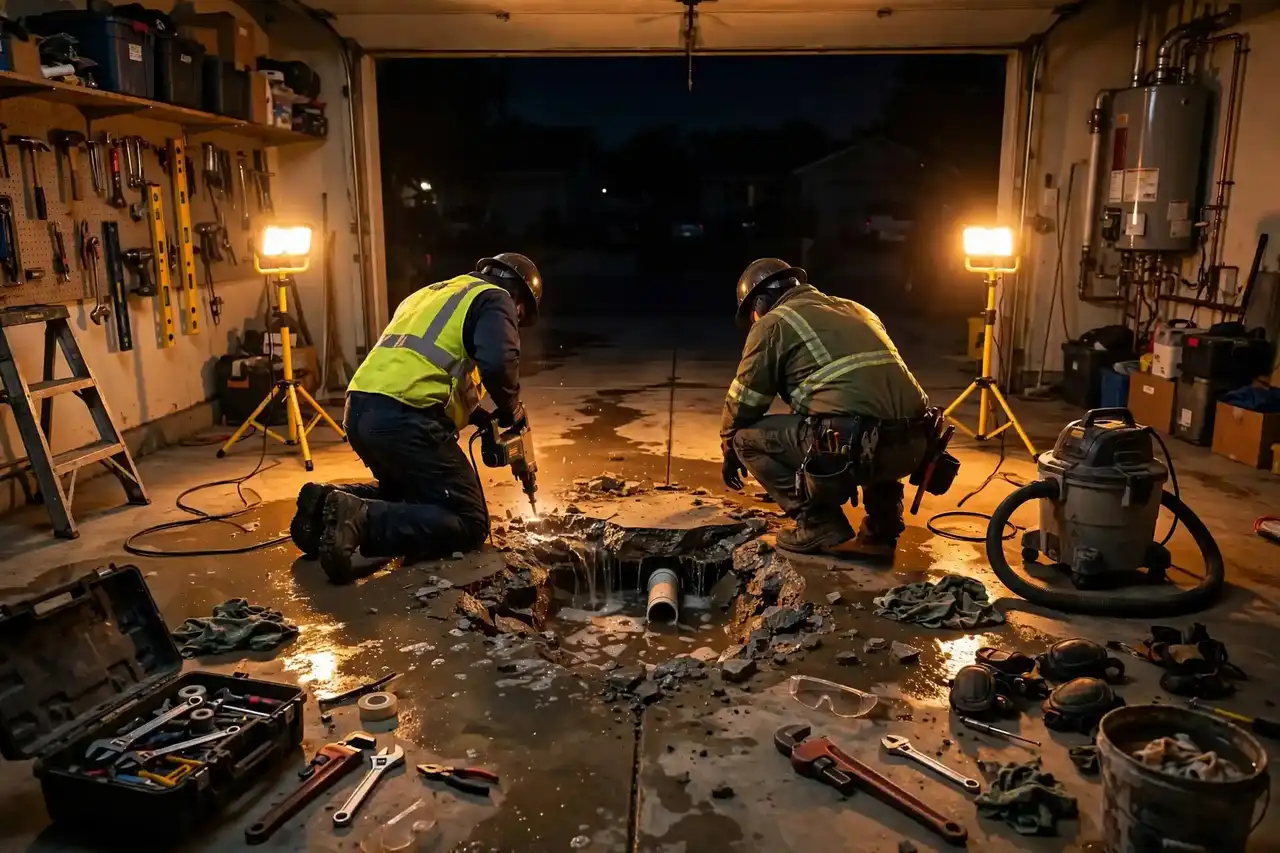
- Water extraction. Wet vacuums and pumps to remove standing water from floors so assessment and repair can proceed.
- Moisture meters and thermal cameras. Rapid mapping of how far water has traveled under flooring and into walls — essential for both repair planning and insurance documentation.
- Pipe isolation gear. Caps, plugs, and valves to dead-end the failed branch while restoring water to the rest of the house.
- Concrete opening tools. Wet saws and rotary hammers for controlled slab openings, with dust control — even in a hurry, the opening should be no larger than the repair needs.
- Repair fittings. Press-fit and sweat copper fittings, PEX and couplings, and repair clamps for temporary or permanent restoration of the failed section.
- Pressure test rigs. The repaired line is pressure-tested before the slab is patched — emergency or not, untested repairs are not finished repairs.
The mark of a professional emergency response is that the hurried part is the arrival, not the workmanship. If you need that kind of response, Book Service at (833) 713-2101.
Safety During a Slab Leak Emergency
- Electricity and water. Treat any water near outlets, switches, appliances, or the panel as an electrocution risk. Switch off breakers from a dry position, and keep everyone — including pets — out of standing water until power to the area is off.
- Scalding. A failed hot line can push 130°F-plus water through floors. Keep bare feet and children away from hot wet areas, and do not try to mop it with bare hands.
- Gas water heaters. If the heater area is flooding, shut the gas control to pilot or off, but do not attempt to relight anything yourself afterward — that is work for the professional on site.
- Slip and structural caution. Wet tile and stone are treacherous; saturated drywall can collapse. Keep the affected rooms clear until assessed.
- Contamination. If the water smells of sewage, treat it as contaminated: avoid contact, keep children and pets away, and tell the responder immediately so drain-line protocols are used.
- Mold timeline. Mold can begin colonizing damp materials within 24 to 48 hours. Stopping the water is step one; drying the structure is step two — ask the responder about drying, not just the pipe.
Your safety outranks your flooring in every emergency decision. When the scene is stable and you need professional help, Contact Us Now at (833) 713-2101.
Emergency Realities in Rancho Palos Verdes
- Long service lines. Many RPV homes sit well back from the street on large lots, so the service line from the meter is long — a failure there can waste enormous volumes before it is noticed, and the street-side shutoff may be the only quick stop.
- Seized valves in older homes. Original gate valves from the 1950s–1970s are frequently frozen open. If yours has never been exercised, assume it may not work in an emergency — mention this on the call.
- Hillside drainage. On sloped lots, escaped water follows gravity — into lower rooms, garages, or against retaining walls. Note where water is traveling, not just where it surfaces.
- Slab-on-grade construction. With no crawlspace or basement to intercept it, a pressurized leak's first visible sign is often water already inside the living space. There is no buffer — fast shutoff matters more here than in raised-foundation homes.
- Water heater placement. Heaters commonly sit in garages. A garage-floor leak near the heater points strongly at the hot side; check whether the heater is running constantly before the responder arrives.
- Neighborhood water pressure. Elevated areas of the Peninsula can see higher static pressure, which turns a pinhole into a faster flood. A pressure reading during the visit often informs the repair plan.
None of these change the first steps — shut the water, stay safe, call. An independent local professional who knows these houses will take it from there. Call Now at (833) 713-2101.
→ how professionals detect slab leaks
→ documenting damage for your insurance claim
→ rerouting the failed line instead of breaking the slab
Suspect a Slab Leak? Talk to a Specialist Today
One call connects you with a local slab leak professional serving Rancho Palos Verdes, CA — day or night.
Call (833) 713-2101