Slab Leak Insurance Claim Help in Rancho Palos Verdes, CA
In Short
Slab leak insurance claim help means professional documentation of your leak and the damage it caused — the evidence your homeowners claim rests on. In Rancho Palos Verdes, CA, the first step is a call to (833) 713-2101: describe the situation, and we will connect you with an independent local professional who documents thoroughly.
How Slab Leaks and Homeowners Insurance Interact
Homeowners insurance and slab leaks have a relationship defined by one distinction: sudden water damage versus gradual deterioration. Understanding it before you file shapes everything:
- Resulting water damage is often covered. When a pipe suddenly bursts or fails, most policies cover the damage the water causes — ruined flooring, wet drywall, damaged belongings — under the sudden-and-accidental provisions.
- The pipe repair itself often is not. Fixing the failed pipe is frequently classified as wear-and-tear maintenance and excluded, even when the water damage around it is covered. This surprises many homeowners.
- Long-term leaks face exclusions. A pinhole that seeped for months or years before discovery may be treated as gradual deterioration or neglect — commonly excluded. The timeline of discovery matters enormously.
- Leak location coverage varies. Some policies include limited coverage for accessing the leak — tearing out and replacing the slab section needed to reach the pipe — while others do not. This is policy-specific language worth reading.
- Mold has its own limits. Mold remediation coverage is often sublimited or excluded; prompt mitigation after discovery protects both the home and the claim.
- Every policy is its own contract. Endorsements, exclusions, and definitions differ between carriers and policy forms. General guidance — including this page — never substitutes for reading your policy or asking your agent about your specific facts.
The practical upshot: document everything as if you will file, even before you decide whether to file. Documentation costs nothing and is irreplaceable later. For professional-grade documentation of your leak, Call Now at (833) 713-2101.
What to Document From Day One
Claims are won on evidence. From the moment you suspect a slab leak, build this file:
- Photos and video, immediately. The water itself, affected rooms from multiple angles, damaged belongings, the water meter, and the shutoff. Date-stamped phone photos are perfectly valid evidence.
- A written timeline. When you first noticed each symptom — the bill increase, the sound, the warm spot, the visible water. Contemporaneous notes beat reconstructed memory.
- Water bills. Several cycles showing the usage spike establish the leak's timeframe objectively — useful against gradual-deterioration arguments.
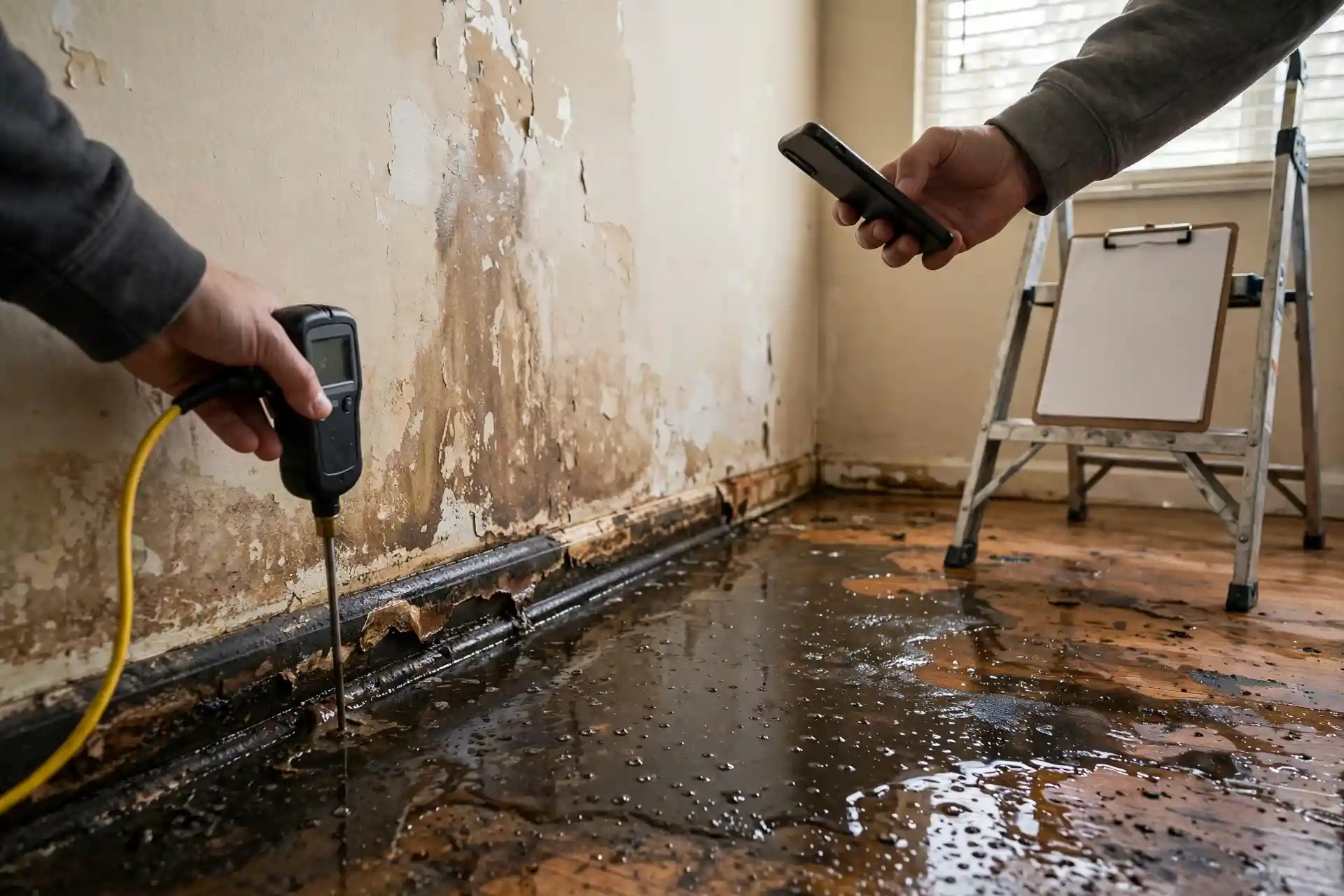
- Professional findings. The detection report: confirmed leak location, methods used, moisture readings, thermal images. This is the technical backbone no adjuster can dismiss as homeowner speculation.
- Moisture mapping. Meter readings showing the extent of water migration through flooring and walls — proving the damage footprint is leak-caused, not pre-existing.
- Every receipt. Detection, emergency mitigation, drying equipment rental, temporary housing if needed — claimable expenses need paper trails.
- Damaged materials, preserved. Do not discard ruined flooring, drywall, or belongings until the adjuster has inspected them or explicitly releases them in writing.
- All correspondence. Every call and email with the insurer, logged with dates and names.
Start this file before the professional arrives — your early photos capture conditions no one can reconstruct later. Then let the professional's documentation complete it. Ask a Pro at (833) 713-2101 to get that professional layer added.
The Claim Support Process, Step by Step
- Mitigate first. Stop the water, protect belongings, begin drying. Policies impose a duty to mitigate — letting damage spread while you research claims can reduce your recovery.
- Professional assessment and documentation. The independent specialist confirms the leak, maps the damage with instruments, and produces the written findings report with photos and readings.
- Review your policy. Read the water-damage provisions, exclusions, and duties-after-loss section before calling the insurer — or have your agent walk through them with your facts.
- File the claim. Report promptly; most policies require prompt notice. Stick to facts: what happened, when discovered, what was damaged, what was done.
- Adjuster visit preparation. Have your documentation file organized: timeline, photos, bills, professional report, receipts. Walk the adjuster through the evidence rather than narrating opinions.
- Supplemental documentation. If the adjuster requests more — additional photos, a second moisture reading after drying, contractor estimates for restoration — provide it promptly and in writing.
- Review the settlement. Compare the adjuster's scope with your documentation. Gaps between documented damage and the offered scope are negotiated with evidence, not argument.
- Keep records through restoration. The file stays open until repairs are complete and paid — final invoices close the loop.
We connect you with the plumbing professional whose documentation anchors this process; the claim itself remains yours to file and manage. That division is worth understanding clearly — see the honest-expectations section below. To start the documentation, Book Service at (833) 713-2101.
Documentation Tools Professionals Use
- Calibrated moisture meters. Pin and pinless readings that quantify moisture content in flooring, drywall, and framing — numbers, not impressions.
- Thermal imaging. Infrared scans showing the full extent of water migration, including areas that feel dry to the touch but are wet inside.
- Detection reports. The written record of the confirmed leak: location marked, methods used (acoustic, thermal, tracer), and the diagnostic sequence that ruled out other causes.
- Dated photography. Systematic photo documentation of conditions at discovery, during repair, and after — the visual timeline of the loss.
- Pressure test records. Proof of the failure and of the completed repair, with gauge readings.
- Written timelines. The professional's contemporaneous notes on what was found and when, corroborating your own.
- Restoration scopes. Itemized descriptions of damaged materials requiring replacement — the bridge between the plumbing event and the restoration claim.
This is the difference between "my floor got wet" and a documented water-loss event with instrumental evidence. Adjusters work from evidence; give them a complete file. Contact Us Now at (833) 713-2101 to get that file started.
Honest Expectations and Precautions
- We document; the insurer decides. No plumbing professional — and no referral service — can promise coverage, approve a claim, or predict your settlement. Coverage is determined by your policy language and your adjuster. Anyone guaranteeing an outcome is selling something.
- Do not delay mitigation for paperwork. Stopping the water and starting drying always outrank perfect documentation. Photograph first, then act — the duty to mitigate is a policy obligation.
- Do not discard evidence early. Ruined materials stay until the adjuster inspects or releases them in writing. Premature disposal creates gaps no photo fully fills.
- Be factual with the insurer. Report what happened and when. Do not speculate about causes, timelines you are unsure of, or coverage you have not verified — speculation in the claim record rarely helps.
- Small claims deserve math. Compare the likely recovery against your deductible and the long-term cost of a claim on your record. Sometimes paying out of pocket for a modest loss is the rational choice — your agent can discuss this frankly.
- Get restoration estimates in writing. Verbal numbers do not negotiate. Written scopes from restoration contractors let you compare the adjuster's figures against reality.
- Keep the file complete through the end. Claims close when restoration is done and paid, not when the adjuster first visits. Incomplete follow-through is where valid claims lose value.
Straight talk about claims is more valuable than optimistic talk. If you want the documentation done right from the start, Call Now at (833) 713-2101.
Claim Realities in Rancho Palos Verdes
- High-value finishes raise documentation stakes. Travertine, hardwood, and stone floors cost far more to restore than basic flooring — thorough moisture mapping and photo documentation protect the full scope of that restoration in the claim.
- Aging copper and the wear question. With 1950s–1970s copper across the Peninsula, insurers scrutinize whether a failure was sudden or gradual. Your timeline documentation and water-bill history are the evidence that answers it.
- Hillside water complicates causation. Where soil movement or hillside drainage contributed, causation gets layered — professional assessment distinguishing the plumbing failure from ground conditions keeps the claim factually clean.
- Winter storm overlap. Leaks discovered during rainy season need clear documentation separating plumbing water from rainwater intrusion — different coverage provisions may apply to each.
- Mitigation access. Prompt professional response limits the damage footprint, and the mitigation invoices themselves are typically claimable — another reason not to delay the call.
- Local adjuster familiarity. Peninsula claims are common enough that adjusters know the housing stock; a professional, complete file matches the standard they expect and moves faster than a thin one.
Local patterns, documented properly, make for stronger claims. Start building your file with professional evidence — Ask a Pro at (833) 713-2101.
→ how slab leaks are detected and documented
→ what to do when water is actively flooding
→ foundation water intrusion versus pipe leaks
Suspect a Slab Leak? Talk to a Specialist Today
One call connects you with a local slab leak professional serving Rancho Palos Verdes, CA — day or night.
Call (833) 713-2101