Under-Slab Tunneling in Palos Verdes Estates, CA 90274
If you need under-slab tunneling in Palos Verdes Estates 90274, start with a call to (833) 713-2101.
In Short
If you need under-slab tunneling in Palos Verdes Estates 90274, start with a call to (833) 713-2101. Slab Leak Repair Experts connects Malaga Cove and Lunada Bay homeowners with local specialists; we confirm the 90274 ZIP, review your symptoms, and the first step is a no-obligation phone assessment of your symptoms, floor layout, and exterior access.
Palos Verdes Estates 90274 Ground, Pipes and Homes: What It Means for Under-Slab Tunneling
Every 90274 tunneling plan starts from the same local facts. Master-planned from 1923; Malaga Cove homes in Spanish and Mediterranean Revival styles are mostly 1920s-1930s, while the Lunada Bay, Montemalaga and Valmonte tracts are largely 1940s-1960s. Beneath those slabs runs 1920s-40s stock carries galvanized steel supply and cast-iron drains, many still original or partially updated; 1950s-60s homes carry copper. Slab prevalence is Mixed - pre-war homes often have raised foundations; postwar tract homes are slab-on-grade. That combination - mid-century copper at failure age under slab - is exactly the profile tunneling was designed for, provided detection confirms a repairable single-point failure.
In Palos Verdes Estates 90274, under-slab tunneling runs into the bluff. Steep terraced lots in Malaga Cove and Lunada Bay leave little room for an exterior access pit, so the tunnel plan starts with access: where can equipment stage, and can a pit be dug without undermining a terrace wall? That constraint is exactly why detection precision matters so much here - a tunnel is only as good as its target, and digging is expensive on these terraces. Where access works, tunneling is the kindest option for vintage homes: 1920s-40s interiors with original tile and hardwood would cost a fortune to restore after jackhammering, and a tunnel from the side leaves them alone. Bluff-edge moisture gets ruled out first, since it mimics leak symptoms without needing any pipe repair at all.
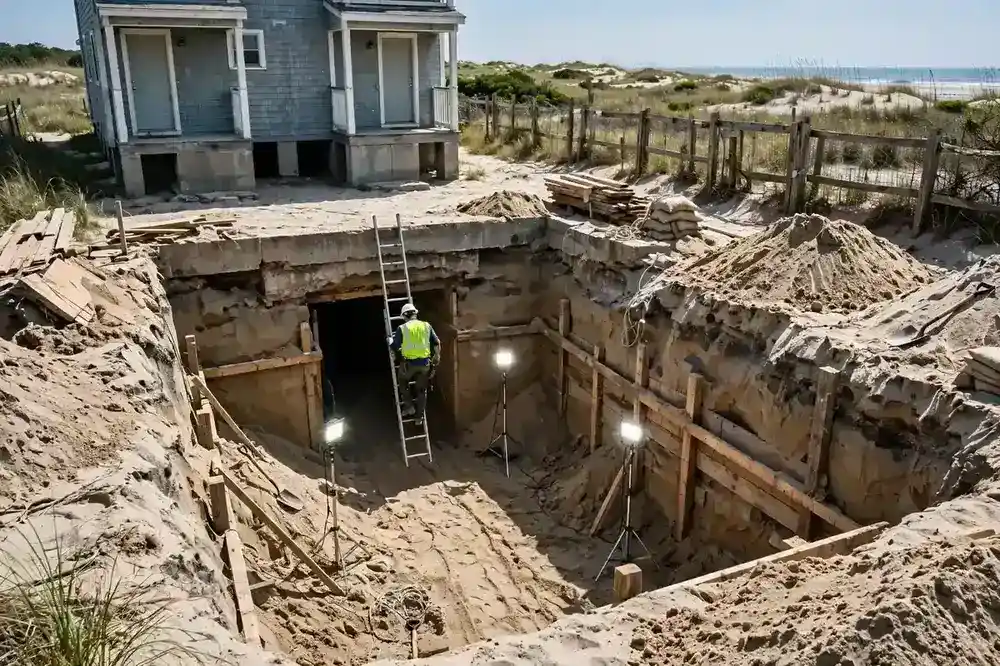
Under-slab tunneling reaches a leaking pipe by digging a small horizontal tunnel beneath the foundation from outside the home, instead of jackhammering through interior floors. The leaking section is repaired or replaced from below, the tunnel is backfilled and compacted, and your tile, hardwood or stone floors stay intact. What makes tunneling attractive in Palos Verdes Estates is what it doesn't touch: no jackhammer through the living room, no demolition of finishes that would cost more to restore than the pipe repair itself. On terraced bluff lots, exterior access for equipment is limited, which pushes repair planning toward the least invasive method that still reaches the leak.
The decision framework for Palos Verdes Estates 90274 homeowners is straightforward: confirm the slab, confirm the pipe material, confirm the leak location electronically, confirm exterior access - then choose tunneling when the floors are worth preserving and the rest of the line still has life. When any of those confirmations fails, the honest recommendation changes: reroute, spot repair, or a different investigation entirely. A specialist who walks through those gates with you on the first call is the one to trust.
Signs Your Palos Verdes Estates Home May Need Under-Slab Tunneling
Tunneling is usually discussed after electronic detection pinpoints a leak under the slab: a warm spot on the floor, the sound of running water with fixtures off, a water bill that jumped, or a hot-water line that never seems to rest. It is the preferred path when interior floors are expensive to restore - tile, hardwood, polished concrete - or when the leak sits far from any practical interior access point. In Palos Verdes Estates 90274, homeowners also watch for the local tells: Vintage 1920s-40s plumbing is 90-100 years old wherever it survives, past end of life; homes that were re-piped onto or under slabs now carry aging copper. When any of those appear, the next step is detection - tunneling is prescribed after locating, never before.
How Under-Slab Tunneling Works on a Palos Verdes Estates Property
First the leak is located electronically to within inches. Then a small exterior access pit is dug at the foundation edge and a hand-dug tunnel is advanced under the slab to the leak point, typically just tall enough to work in. The damaged pipe section is cut out and replaced, the repair is pressure-tested, and the tunnel is backfilled in lifts and compacted to support the slab again. On a Palos Verdes Estates 90274 property, the crew serving Malaga Cove and Lunada Bay stages along Palos Verdes Drive West and North plus Via Chico and works the plan around the lot: On terraced bluff lots, exterior access for equipment is limited, which pushes repair planning toward the least invasive method that still reaches the leak. The homeowner's role is simple - clear the work area, keep pets and kids clear of the pit, and let the crew work.
Why Palos Verdes Estates's Ground and Housing Stock Shape Under-Slab Tunneling
Palos Verdes Estates 90274 sits on Monterey shale bedrock with coastal-bluff terrace soils; steep bluff lots in Malaga Cove and Lunada Bay with terraced drainage, and bluff edges subject to erosion. Coastal Mediterranean climate with a marine layer in summer and winter rain November through March; fog drip keeps bluff soils damp year-round. Homes here: Master-planned from 1923; Malaga Cove homes in Spanish and Mediterranean Revival styles are mostly 1920s-1930s, while the Lunada Bay, Montemalaga and Valmonte tracts are largely 1940s-1960s. Pipe underneath: 1920s-40s stock carries galvanized steel supply and cast-iron drains, many still original or partially updated; 1950s-60s homes carry copper. Slab-on-grade prevalence is Mixed - pre-war homes often have raised foundations; postwar tract homes are slab-on-grade. The key local fact for under-slab tunneling: Vintage 1920s-40s plumbing is 90-100 years old wherever it survives, past end of life; homes that were re-piped onto or under slabs now carry aging copper. Steep bluff-side lots make excavation access hard, so detection precision matters because digging is expensive on terraces. Bluff-edge moisture can mimic slab-leak symptoms. On the ground that means: On terraced bluff lots, exterior access for equipment is limited, which pushes repair planning toward the least invasive method that still reaches the leak. And for reference: Many 1920s-30s estates have been partially re-piped over the decades, so a single home can carry two or three generations of pipe material that must be mapped before any slab work.
Tunneling vs. Breaking the Slab vs. Rerouting in Palos Verdes Estates
Tunneling, breaking the slab, and rerouting each have a Palos Verdes Estates use case. Breaking the slab (interior spot repair) is fastest when the leak sits under an unfinished or easily restored floor - a garage or utility room - because the restoration cost is minimal. Tunneling wins when interior floors are expensive: tile, hardwood, or stone you'd rather not demolish, with workable exterior access. Rerouting - abandoning the under-slab line for a new overhead run - wins when the pipe is systemically tired: 1950s-70s copper with multiple pinholes, or 1920s-40s stock carries galvanized steel supply and cast-iron drains, many still original or partially updated, where fixing one spot just schedules the next leak. In 90274, the assessment weighs all three against your floors, your pipe's age, and your lot's access - and recommends the one that fits, not the one that's habit.
What Happens When You Call (833) 713-2101
Calling (833) 713-2101 connects you to a real conversation, not a phone tree. We confirm Palos Verdes Estates 90274, review what's happening at your home near Malaga Cove and Lunada Bay, and connect you - through Slab Leak Repair Experts' referral network - with a local specialist in under-slab tunneling. You'll know the next step before you hang up, whether that's a detection visit, a documentation checklist, or simply a better understanding of your options. Get answers at (833) 713-2101: (833) 713-2101.
Suspect a Slab Leak? Talk to a Specialist Today
One call connects you with a local slab leak professional serving Rancho Palos Verdes, CA — day or night.
Call (833) 713-2101Frequently Asked Questions
How is the leak located before anyone digs a tunnel in Palos Verdes Estates?
Tunneling is prescribed after electronic location, never before. The sequence is: meter testing to confirm water loss, pressure isolation to identify the failed line, then acoustic and thermal instruments to pinpoint the leak - typically within inches. In 90274, that precision matters even more because Vintage 1920s-40s plumbing is 90-100 years old wherever it survives, past end of life; homes that were re-piped onto or under slabs now carry aging copper. Only when the location is certain does the tunnel plan get drawn.
What if the tunnel reveals the pipe is worse than expected?
This happens, especially with 1920s-40s stock carries galvanized steel supply and cast-iron drains, many still original or partially updated; 1950s-60s homes carry copper. in 90274. A good tunnel plan includes a decision point: if the exposed line shows systemic corrosion or multiple thin spots, the specialist stops and talks to you before proceeding - because tunneling to save one section of a dying line is poor value next to rerouting. That conversation is part of an honest assessment, and it's why the pipe's generation and age are evaluated before the method is chosen, not during.
What should I ask a tunneling specialist before approving the work in 90274?
Ask these five: Has the leak been electronically located, or are we digging on a guess? Is there workable exterior access for a pit on my lot? What does my soil mean for the tunnel plan - shoring, dewatering? What happens if the exposed pipe is worse than expected? And how does the total compare with rerouting, given my pipe's age (1920s-40s stock carries galvanized steel supply and cast-iron drains, many still original or partially updated; 1950s-60s homes carry copper.)? In Palos Verdes Estates, the specialist who welcomes those questions is the one to hire.
How is the leak located before anyone digs a tunnel in Palos Verdes Estates?
Tunneling is prescribed after electronic location, never before. The sequence is: meter testing to confirm water loss, pressure isolation to identify the failed line, then acoustic and thermal instruments to pinpoint the leak - typically within inches. In 90274, that precision matters even more because Vintage 1920s-40s plumbing is 90-100 years old wherever it survives, past end of life; homes that were re-piped onto or under slabs now carry aging copper. Only when the location is certain does the tunnel plan get drawn.