Trenchless Slab Leak Repair in Redondo Beach, CA
Trenchless Slab Leak Repair in Redondo Beach, CA 90277 repairs or replaces failing under-slab water lines — with no floor demolition and no trench across your yard.
In Short
Trenchless Slab Leak Repair in Redondo Beach, CA 90277 repairs or replaces failing under-slab water lines — with no floor demolition and no trench across your yard. Redondo Beach's 1950s–70s homes with copper at corrosion age are prime candidates. Call (833) 713-2101: first a symptom review with a specialist, then testing to confirm the leak.
Trenchless Slab Leak Repair in Redondo Beach 90277: What Local Homes Need to Know
North Redondo 90277 is the most predictable slab-leak territory in the beach cities: 1950s–70s slab tracts and condos on flat inland alluvium, copper at corrosion age, short pipe runs, simple lots. No bluffs, no landslide, less salt than the beachside — just honest mid-century pipe reaching the end of its run. Trenchless Slab Leak Repair here is straightforward: diagnose, fix, move on.
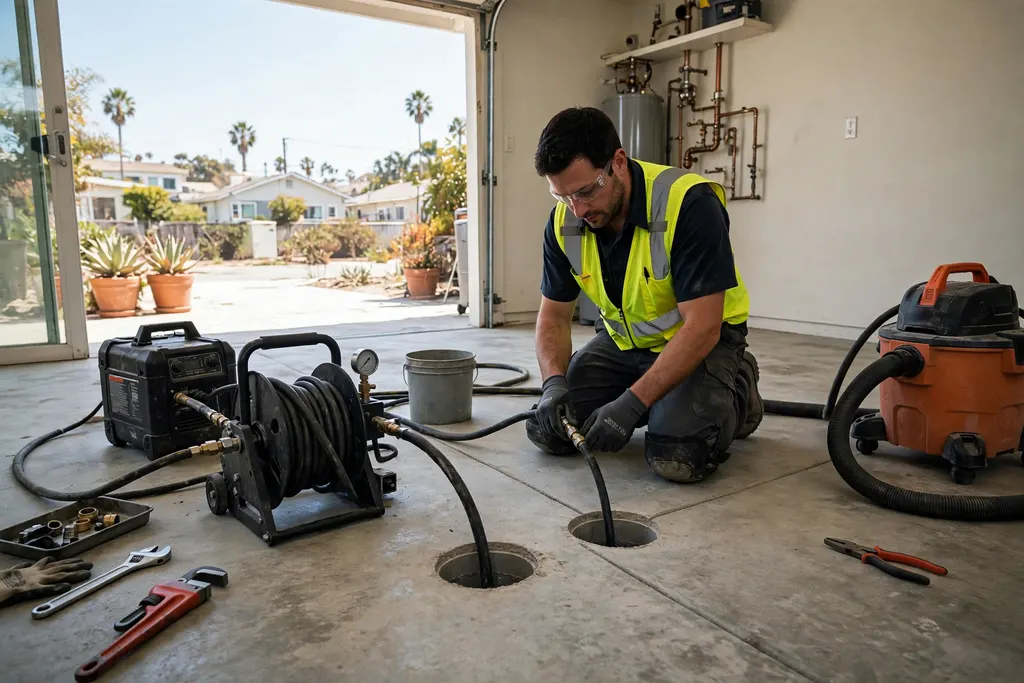
Trenchless slab leak repair fixes or replaces a failing water line under your slab without opening the floor. Depending on what the camera shows, the specialist either pulls a resin-saturated liner through the old pipe and cures it in place, or bursts the old pipe apart while pulling a new line through the same path. Both approaches work through small access points — often a cleanout or a single careful excavation outside the slab — so tile, hardwood, and driveways stay intact.
The appeal is direct: no jackhammer in the hallway, no floor replacement, no trench across the yard. In Redondo Beach 90277, where the simple flat lots keep every part of the job straightforward, the no-dig approach is not just convenient — it is often the most practical way to do the job well.
How it works here: we are the connector, not the crew. Your call to (833) 713-2101 reaches our referral line, and we match you with an independent slab-leak specialist who works in Redondo Beach 90277. The specialist diagnoses, you approve the plan, and only then does work start.
Prefer to talk it through? Ask a Pro and tell us what you are seeing in your Redondo Beach home.
Why Redondo Beach Changes How This Repair Works
North Redondo is the inland strip — 1950s to 1970s single-family homes and condos, more residential and less tourist than 90278. Pipe stock is 1950s–70s copper with cast-iron or ABS drains, under slab-on-grade in the great majority of homes. The ground is flat inland alluvium with good drainage and slightly less marine exposure than the beachside ZIP. This is high-volume, predictable work: 60-to-70-year-old copper pinholing on schedule, short runs, flat lots, easy access. Detection is clean, repairs are by the book, and there are few of the complications that mark the hillside or beachside ZIPs. Condos add the shared-line mapping step, but the pipe story is the same.
Textbook trenchless territory — short runs, flat lots, standard copper. Lining seals the pitting; bursting handles the runs that are past it. North Redondo is where the method looks simplest because the conditions are.
That is the Redondo Beach calculation with trenchless: the repair stays underground, but the demolition disappears. Whether it fits your home comes down to pipe condition, access, and what the ground is doing — exactly what the on-site diagnosis is for.
How Trenchless Repair Works — Without Tearing Up Your Home
Every trenchless job starts with electronic detection and a camera inspection — no one should line or burst a pipe they have not seen. The camera shows the pipe's material, diameter, and condition: pitting, cracks, offsets, bellies. If the pipe is a candidate for lining, it gets cleaned and descaled first; a liner saturated with epoxy resin is then inverted or pulled into place and cured until it hardens into a smooth new pipe inside the old one. If the pipe is too far gone for a liner but the path is sound, pipe bursting is the alternate route: a bursting head breaks the old pipe outward while a new line follows right behind it through the same underground path. Either way, the entry and exit points are small. Inside the house, floors stay down. Outside, landscaping takes a fraction of the disturbance that open trenching would cause. Cure times vary by method and pipe length, and the specialist will explain the timeline for your specific run before work begins.
Preparing for the visit takes ten minutes and saves more: clear access to the water meter, the water heater, and any cleanouts you know about. Locate your main shutoff valve — if you cannot find it, say so on the call, because shutting off the water quickly is the most useful thing a homeowner can do when a leak is suspected. Gather any history you have: prior slab leaks, previous repairs, remodels that moved plumbing. That background often aims the camera correctly before it ever enters the pipe, which shortens the diagnostic and gets the repair plan in your hands sooner.
What Happens When You Call (833) 713-2101
Step 1: The Call
Call (833) 713-2101. You will reach our referral line, where we connect you with an independent local specialist serving Redondo Beach. Expect a few direct questions: warm spots on the floor, the sound of running water with taps off, a water bill that jumped, low pressure. Those answers tell the specialist what to test first.
Step 2: The Diagnosis
On site, the specialist pressure-tests the lines, listens electronically, and runs a camera through the suspect pipe. For trenchless work this step is decisive — the camera footage determines whether your pipe can be lined, needs bursting, or is not a trenchless candidate at all.
Step 3: The Plan
You get a plain-language explanation of what was found and which repair paths fit — Trenchless Slab Leak Repair among them — before any work is authorized. No work starts on a guess.
When Trenchless Repair Isn't the Right Fix
Trenchless is not universal. A pipe that has fully collapsed cannot be lined — the liner needs a host pipe to take its shape. Severe offsets or separated joints can stop a liner or a bursting head alike. Lines with tight bends, heavy bellies holding standing water, or extensive buildup at joints may also rule it out. And when the camera shows a whole system at end of life — pitting everywhere, not one bad section — lining a single run is patching a failing system; rerouting or a fuller replacement is the honest recommendation. A straight camera inspection is what separates the candidates from the not-candidates, which is why the diagnosis step is never skipped.
Serving Redondo Beach 90277: Neighborhoods We Cover
Serving North Redondo 90277 — the inland neighborhoods along Artesia Boulevard, Aviation Boulevard, and Inglewood Avenue, near the Metro C Line western terminus. In a condo? Mention the building layout and HOA contact when you call so shared-line mapping is part of the plan.
North Redondo's condo stock deserves one extra note: many buildings share water service in ways that are not obvious from the unit layout, so the diagnostic maps the building's plumbing before recommending anything. Bring HOA documents or building plans to the visit if you have them — they shorten the mapping step considerably and get the repair authorized faster.
Suspect a Slab Leak? Talk to a Specialist Today
One call connects you with a local slab leak professional serving Rancho Palos Verdes, CA — day or night.
Call (833) 713-2101Frequently Asked Questions
Our 1960s home has its first slab leak. What is the usual path?
Confirm with pressure testing, camera the run, and let the footage decide: Trenchless Repair for repairable runs, replacement thinking for system-wide failure. In 90277 the first leak at 60-plus years usually means the run is broadly pitted — plan for the pattern, not just the pinhole. For trenchless work, this is decided by the camera inspection: the footage shows whether the pipe can be lined or needs bursting.
How disruptive will this be to our daily routine?
Less than you expect. Trenchless Slab Leak Repair works through small access points or interior routes — no slab demolition, no days of jackhammering. Most North Redondo tract jobs are compact because the runs are short and the lots are simple. Because trenchless follows the existing pipe path, none of this requires regrading or reworking the lot.
Our condo HOA wants documentation. What do we get?
The diagnostic produces test results and camera footage you can share — pressure readings, the leak location, and the recommended method. Ask the specialist for a written summary for the HOA when you call. That is precisely where trenchless methods pay off — the repair happens through small access points instead of open excavation.
Should we re-pipe instead of repairing?
It depends on scope: one bad run is a repair; a system failing everywhere is a replacement conversation. The camera and pressure tests draw that line honestly. Trenchless Slab Leak Repair sits in the middle — rehabilitate or abandon the failing runs without a whole-house re-pipe. For trenchless work, this is decided by the camera inspection: the footage shows whether the pipe can be lined or needs bursting.
Is North Redondo really simpler than the beachside?
For slab work, yes — flat lots, inland alluvium, less salt, no bluffs. The complications that mark 90278 (salt, sand migration) and the Peninsula (grade, movement) mostly do not apply. Simpler conditions, simpler repairs. Because trenchless follows the existing pipe path, none of this requires regrading or reworking the lot.
Does trenchless work on the copper supply lines under my slab?
Yes — under-slab copper is one of the most common trenchless applications in South Bay homes. Pinhole leaks from corrosion are exactly what lining seals, and bursting replaces runs that are too far gone to line. The camera inspection confirms which category your line falls into.
What happens to the old pipe?
With lining, the old pipe becomes the host — the new epoxy pipe forms inside it and the old wall simply stays in the ground. With bursting, the old pipe is fractured outward as the new line takes its path. Either way, nothing has to be dug up and hauled away.