Trenchless Slab Leak Repair in Rancho Palos Verdes, CA
Trenchless Slab Leak Repair in Rancho Palos Verdes, CA 90275 repairs or replaces failing under-slab water lines — with no floor demolition and no trench across your yard.
In Short
Trenchless Slab Leak Repair in Rancho Palos Verdes, CA 90275 repairs or replaces failing under-slab water lines — with no floor demolition and no trench across your yard. Rancho Palos Verdes's 1960s hillside homes with aging under-slab copper are prime candidates. Call (833) 713-2101: first a symptom review with a specialist, then testing to confirm the leak.
Trenchless Slab Leak Repair in Rancho Palos Verdes 90275: What Local Homes Need to Know
Rancho Palos Verdes 90275 is the one place in our service area where the ground itself moves. Beneath the 1960s ranch and split-level homes of Portuguese Bend and Lunada Bay, under-slab copper now sits in its sixth decade — right in the failure window — while the Greater Portuguese Bend Landslide Complex creeps beneath some neighborhoods on a bentonite clay slide plane. A slab leak here is never just a plumbing problem; it is a plumbing problem in moving ground.
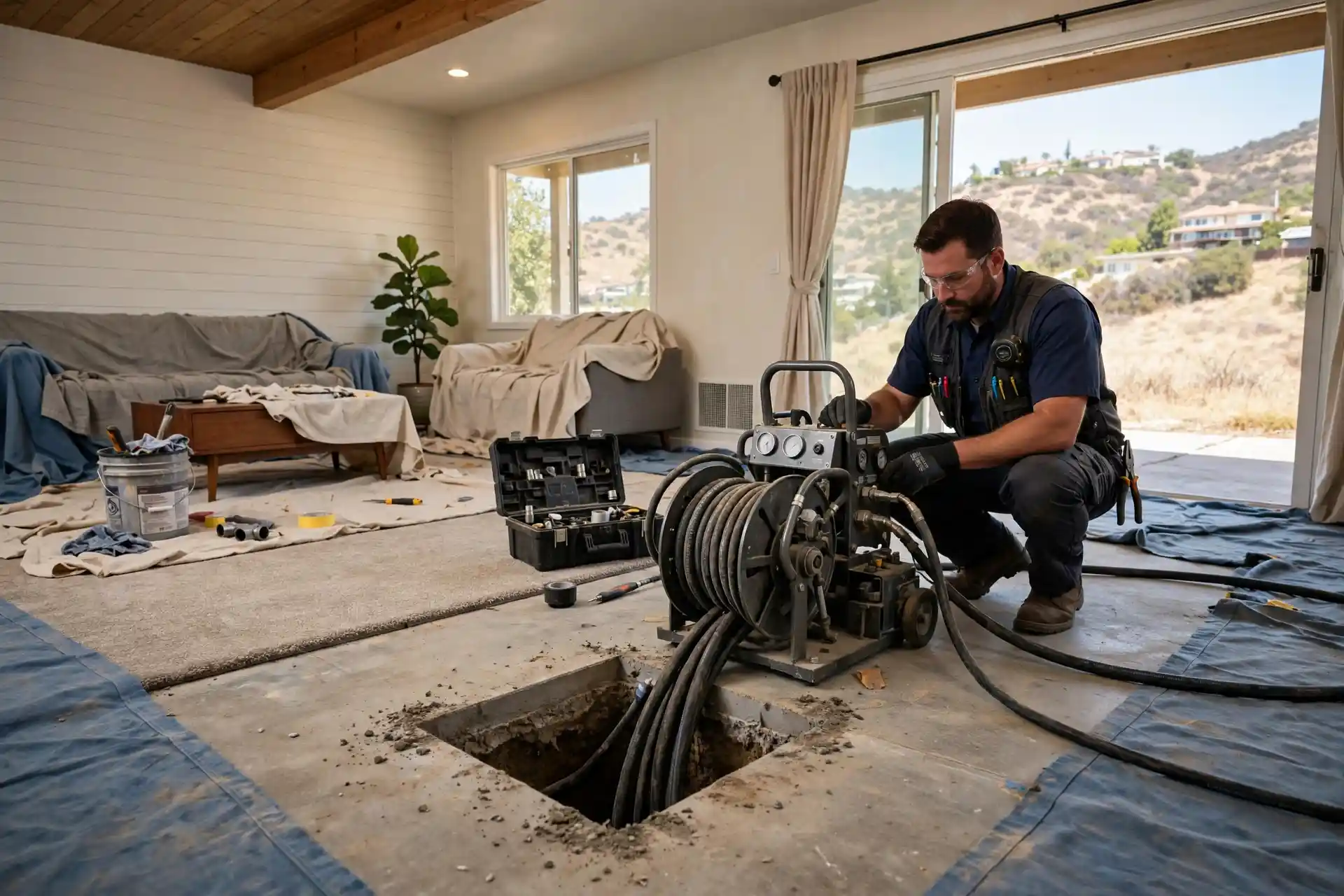
Trenchless slab leak repair fixes or replaces a failing water line under your slab without opening the floor. Depending on what the camera shows, the specialist either pulls a resin-saturated liner through the old pipe and cures it in place, or bursts the old pipe apart while pulling a new line through the same path. Both approaches work through small access points — often a cleanout or a single careful excavation outside the slab — so tile, hardwood, and driveways stay intact.
The appeal is direct: no jackhammer in the hallway, no floor replacement, no trench across the yard. In Rancho Palos Verdes 90275, where the terraced hillside lots and creeping ground make open excavation risky, the no-dig approach is not just convenient — it is often the most practical way to do the job well.
A note on how this works: Slab Leak Repair Experts is a referral service. When you call (833) 713-2101, we connect you with an independent local specialist serving Rancho Palos Verdes — the specialist performs the diagnosis and the repair, and you approve the plan before any work begins.
Call (833) 713-2101 — describe your symptoms and get connected with a Rancho Palos Verdes specialist.
Why Rancho Palos Verdes Changes How This Repair Works
The geology is Monterey Formation shale — Middle Miocene to Early Pliocene bedrock — with the Portuguese Tuff altered to bentonite clay. That clay layer is the slide plane of the roughly 700-acre Greater Portuguese Bend Landslide Complex, moving since 1956 and accelerated to inches per week during the 2023–24 storms. Dewatering wells are in operation, a building moratorium remains in effect, and Ordinance 692 (2025) permanently bans new residential construction inside the complex. For slab plumbing, creeping land shears under-slab copper and stresses slabs beyond what corrosion alone explains — and wet winters make it worse. Detection work here must rule out hillside groundwater seepage versus a true pipe leak, because the symptoms overlap. Any repair plan has to account for ongoing soil movement: a repair that is rigidly locked into creeping ground can be re-stressed by the next rainy season.
Trenchless methods are attractive on these hillside lots because they avoid open excavation on unstable slopes — lining or bursting through small access points disturbs far less ground. The caveat is movement itself: a liner locked into a pipe that the ground keeps shearing needs an assessment first, and the specialist should say plainly whether the slide zone makes trenchless unwise for your street.
That is the Rancho Palos Verdes calculation with trenchless: the repair stays underground, but the demolition disappears. Whether it fits your home comes down to pipe condition, access, and what the ground is doing — exactly what the on-site diagnosis is for.
How Trenchless Repair Works — Without Tearing Up Your Home
Every trenchless job starts with electronic detection and a camera inspection — no one should line or burst a pipe they have not seen. The camera shows the pipe's material, diameter, and condition: pitting, cracks, offsets, bellies. If the pipe is a candidate for lining, it gets cleaned and descaled first; a liner saturated with epoxy resin is then inverted or pulled into place and cured until it hardens into a smooth new pipe inside the old one. If the pipe is too far gone for a liner but the path is sound, pipe bursting is the alternate route: a bursting head breaks the old pipe outward while a new line follows right behind it through the same underground path. Either way, the entry and exit points are small. Inside the house, floors stay down. Outside, landscaping takes a fraction of the disturbance that open trenching would cause. For under-slab copper supply lines, lining is the more common trenchless answer; bursting tends to serve longer lateral and service-line runs.
Preparing for the visit takes ten minutes and saves more: clear access to the water meter, the water heater, and any cleanouts you know about. Locate your main shutoff valve — if you cannot find it, say so on the call, because shutting off the water quickly is the most useful thing a homeowner can do when a leak is suspected. Gather any history you have: prior slab leaks, previous repairs, remodels that moved plumbing. That background often aims the camera correctly before it ever enters the pipe, which shortens the diagnostic and gets the repair plan in your hands sooner.
What Happens When You Call (833) 713-2101
Step 1: The Call
Call (833) 713-2101. You will reach our referral line, where we connect you with an independent local specialist serving Rancho Palos Verdes. Expect a few direct questions: warm spots on the floor, the sound of running water with taps off, a water bill that jumped, low pressure. Those answers tell the specialist what to test first.
Step 2: The Diagnosis
On site, the specialist pressure-tests the lines, listens electronically, and runs a camera through the suspect pipe. For trenchless work this step is decisive — the camera footage determines whether your pipe can be lined, needs bursting, or is not a trenchless candidate at all.
Step 3: The Plan
You get a plain-language explanation of what was found and which repair paths fit — Trenchless Slab Leak Repair among them — before any work is authorized. No work starts on a guess.
When Trenchless Repair Isn't the Right Fix
Trenchless is not universal. A pipe that has fully collapsed cannot be lined — the liner needs a host pipe to take its shape. Severe offsets or separated joints can stop a liner or a bursting head alike. Lines with tight bends, heavy bellies holding standing water, or extensive buildup at joints may also rule it out. And when the camera shows a whole system at end of life — pitting everywhere, not one bad section — lining a single run is patching a failing system; rerouting or a fuller replacement is the honest recommendation. A straight camera inspection is what separates the candidates from the not-candidates, which is why the diagnosis step is never skipped.
Serving Rancho Palos Verdes 90275: Neighborhoods We Cover
We connect homeowners across Rancho Palos Verdes 90275 — from the bluff-top streets above Lunada Bay to the terraced neighborhoods along Palos Verdes Drive South, and the hillside tracts off Hawthorne Boulevard and Crenshaw Boulevard. Familiar landmarks on service routes include Point Vicente Lighthouse, the Portuguese Bend Reserve, Wayfarers Chapel, and Trump National Golf Club. If your home sits inside or near the landslide complex, mention it on the call — the specialist factors ground movement into the diagnosis before recommending any method.
Suspect a Slab Leak? Talk to a Specialist Today
One call connects you with a local slab leak professional serving Rancho Palos Verdes, CA — day or night.
Call (833) 713-2101Frequently Asked Questions
Our home is near Portuguese Bend. Can ground movement break a repaired pipe?
It can stress one, which is why the repair method matters as much as the repair itself. The landslide complex moves on a bentonite clay slide plane and accelerated during the 2023–24 storms. A repair locked rigidly into creeping ground can be re-stressed by the next wet winter. Mention your proximity to the slide area when you call so the specialist plans for it. That is precisely where trenchless methods pay off — the repair happens through small access points instead of open excavation.
How do you tell a real slab leak from hillside groundwater seepage?
The symptoms overlap — damp floors, musty smells, moisture at the slab edge — but the tests do not. Pressure testing and meter isolation show whether a pressurized line is actually losing water; groundwater seepage will not move a meter. In RPV 90275, ruling out seepage first prevents paying for a pipe repair that was never the problem. For trenchless work, this is decided by the camera inspection: the footage shows whether the pipe can be lined or needs bursting.
Our house was built in the 1960s. Is the copper under the slab done?
1960s copper is in its sixth decade — squarely in the failure window, and the bentonite-influenced soils and hillside moisture here do it no favors. Pinhole leaks from pitting are the classic 90275 call. Whether the answer is Trenchless Repair depends on how widespread the corrosion is: one bad section is a repair candidate, system-wide pitting points toward bigger solutions. Because trenchless follows the existing pipe path, none of this requires regrading or reworking the lot.
Can equipment even reach our terraced hillside lot?
Terraced lots and steep driveways off Palos Verdes Drive South complicate heavy excavation — which is exactly why low-dig methods exist. Trenchless Slab Leak Repair works through small access points rather than open trenches, so terraces, retaining walls, and landscaping stay intact. The specialist confirms access on the diagnostic visit. That is precisely where trenchless methods pay off — the repair happens through small access points instead of open excavation.
Does the building moratorium in the landslide area affect pipe repairs?
Ordinance 692 (2025) bans new residential construction inside the landslide complex, and a moratorium remains in effect — but repairing existing plumbing is maintenance, not new construction. Still, permits and access rules in the complex get extra scrutiny, so tell the specialist your street when you call and they will plan accordingly. For trenchless work, this is decided by the camera inspection: the footage shows whether the pipe can be lined or needs bursting.
Will trenchless repair really save my floors?
That is the central reason homeowners choose it. Lining and bursting both work through small access points — usually a cleanout or a compact excavation outside the slab — so tile, hardwood, and concrete inside the home stay in place. There are small openings where the new line ties in, and the specialist will show you exactly where before work begins.
How do I know if my pipe can be lined instead of burst?
The camera decides. A pipe with pitting, pinholes, and cracks but intact shape is a lining candidate. A pipe that is crushed, fully collapsed, or separated at joints usually is not — bursting or another method takes over. No reputable specialist recommends one method without showing you the footage first.