Trenchless Slab Leak Repair in Lomita, CA
Trenchless Slab Leak Repair in Lomita, CA 90717 repairs or replaces failing under-slab water lines — with no floor demolition and no trench across your yard.
In Short
Trenchless Slab Leak Repair in Lomita, CA 90717 repairs or replaces failing under-slab water lines — with no floor demolition and no trench across your yard. Lomita's 1950s ranch homes with 70-year-old copper on short runs are prime candidates. Call (833) 713-2101: first a symptom review with a specialist, then testing to confirm the leak.
Trenchless Slab Leak Repair in Lomita 90717: What Local Homes Need to Know
Lomita 90717 — 'The Friendly City' — is classic 1950s slab-ranch territory: small lots, short pipe runs, and copper now at 70-year corrosion age. Jobs here are typically fast: easy detection on flat ground, short runs to rehabilitate, minimal restoration. The housing is modest, the lots are compact, and Trenchless Repair fits like it was designed for exactly this.
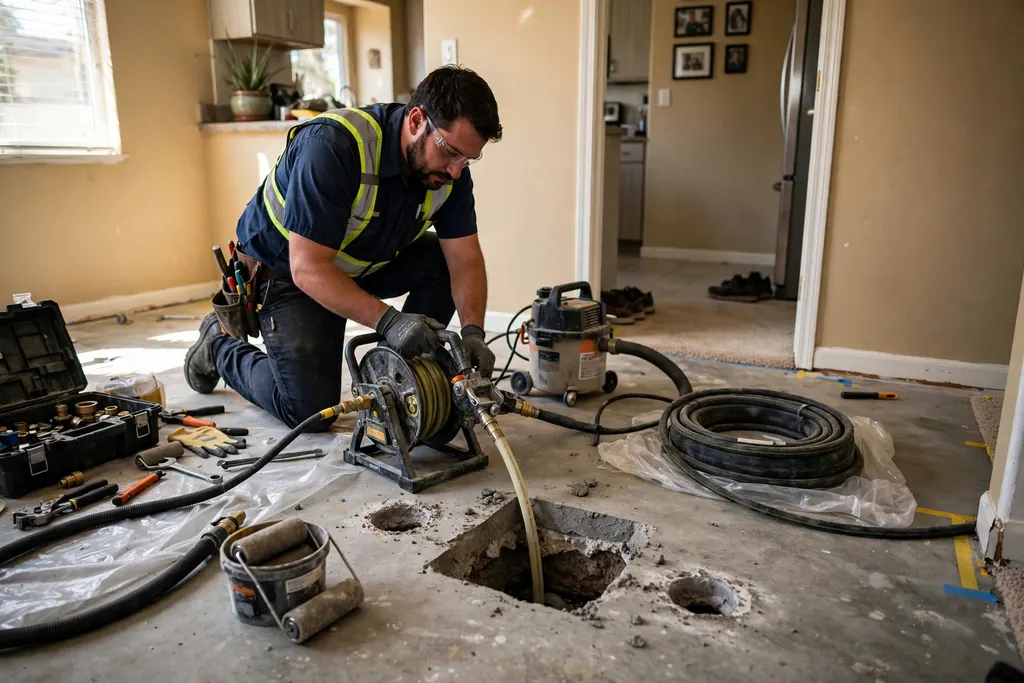
Trenchless slab leak repair fixes or replaces a failing water line under your slab without opening the floor. Depending on what the camera shows, the specialist either pulls a resin-saturated liner through the old pipe and cures it in place, or bursts the old pipe apart while pulling a new line through the same path. Both approaches work through small access points — often a cleanout or a single careful excavation outside the slab — so tile, hardwood, and driveways stay intact.
The appeal is direct: no jackhammer in the hallway, no floor replacement, no trench across the yard. In Lomita 90717, where small lots leave barely any room for excavation equipment, the no-dig approach is not just convenient — it is often the most practical way to do the job well.
A note on how this works: Slab Leak Repair Experts is a referral service. When you call (833) 713-2101, we connect you with an independent local specialist serving Lomita — the specialist performs the diagnosis and the repair, and you approve the plan before any work begins.
Contact Us Now — describe your symptoms and get connected with a Lomita specialist.
Why Lomita Changes How This Repair Works
Most Lomita homes went up in the 1950s — small-lot ranch houses on flat coastal plain at about 95 feet elevation, with alluvial soils and good drainage. Pipe stock is a 1950s copper-and-galvanized mix with cast-iron drains, under slab-on-grade in the great majority of homes. Short pipe runs are the defining feature: meter to house is short, under-slab runs are short, and that compresses every part of the job — detection is quick, rehabilitation covers less footage, and restoration is minimal. The 70-year copper is at textbook pinhole age. The watch-out is deferred maintenance on rental stock: small rentals where leaks run longer before anyone calls, so 90717 jobs occasionally uncover more flooring damage than the leak alone would suggest.
Short runs are trenchless at its simplest — a liner can cover the whole run through two small access points, often in a single compact operation. On Lomita's small lots there is barely room for excavation equipment anyway, which makes no-dig the natural default.
That is the Lomita calculation with trenchless: the repair stays underground, but the demolition disappears. Whether it fits your home comes down to pipe condition, access, and what the ground is doing — exactly what the on-site diagnosis is for.
How Trenchless Repair Works — Without Tearing Up Your Home
Every trenchless job starts with electronic detection and a camera inspection — no one should line or burst a pipe they have not seen. The camera shows the pipe's material, diameter, and condition: pitting, cracks, offsets, bellies. If the pipe is a candidate for lining, it gets cleaned and descaled first; a liner saturated with epoxy resin is then inverted or pulled into place and cured until it hardens into a smooth new pipe inside the old one. If the pipe is too far gone for a liner but the path is sound, pipe bursting is the alternate route: a bursting head breaks the old pipe outward while a new line follows right behind it through the same underground path. Either way, the entry and exit points are small. Inside the house, floors stay down. Outside, landscaping takes a fraction of the disturbance that open trenching would cause. For under-slab copper supply lines, lining is the more common trenchless answer; bursting tends to serve longer lateral and service-line runs.
Preparing for the visit takes ten minutes and saves more: clear access to the water meter, the water heater, and any cleanouts you know about. Locate your main shutoff valve — if you cannot find it, say so on the call, because shutting off the water quickly is the most useful thing a homeowner can do when a leak is suspected. Gather any history you have: prior slab leaks, previous repairs, remodels that moved plumbing. That background often aims the camera correctly before it ever enters the pipe, which shortens the diagnostic and gets the repair plan in your hands sooner.
What Happens When You Call (833) 713-2101
Step 1: The Call
Call (833) 713-2101. You will reach our referral line, where we connect you with an independent local specialist serving Lomita. Expect a few direct questions: warm spots on the floor, the sound of running water with taps off, a water bill that jumped, low pressure. Those answers tell the specialist what to test first.
Step 2: The Diagnosis
On site, the specialist pressure-tests the lines, listens electronically, and runs a camera through the suspect pipe. For trenchless work this step is decisive — the camera footage determines whether your pipe can be lined, needs bursting, or is not a trenchless candidate at all.
Step 3: The Plan
You get a plain-language explanation of what was found and which repair paths fit — Trenchless Slab Leak Repair among them — before any work is authorized. No work starts on a guess.
When Trenchless Repair Isn't the Right Fix
Trenchless is not universal. A pipe that has fully collapsed cannot be lined — the liner needs a host pipe to take its shape. Severe offsets or separated joints can stop a liner or a bursting head alike. Lines with tight bends, heavy bellies holding standing water, or extensive buildup at joints may also rule it out. And when the camera shows a whole system at end of life — pitting everywhere, not one bad section — lining a single run is patching a failing system; rerouting or a fuller replacement is the honest recommendation. A straight camera inspection is what separates the candidates from the not-candidates, which is why the diagnosis step is never skipped.
Serving Lomita 90717: Neighborhoods We Cover
Serving Lomita 90717 — the ranch neighborhoods along Narbonne Avenue, Pacific Coast Highway, and Lomita Boulevard, around the Lomita Railroad Museum and Lomita Park. Small lot, short runs, fast diagnosis: when you call, describe the symptoms and the specialist will tell you what to expect on the visit.
Lomita's compact lots mean the diagnostic visit itself is quick — but do not skip it. Even on a short run, the camera inspection determines whether the pipe is a lining candidate, a bursting candidate, or a reroute case. Guessing the method from symptoms alone is how simple jobs become complicated ones; the footage keeps it simple.
Suspect a Slab Leak? Talk to a Specialist Today
One call connects you with a local slab leak professional serving Rancho Palos Verdes, CA — day or night.
Call (833) 713-2101Frequently Asked Questions
Our 1950s ranch has a hot spot on the kitchen floor. How bad is it?
It is the standard Lomita call — a hot-water line pinholing under 70-year-old copper. The good news about small lots: detection is fast, the run is short, and Trenchless Repair resolves it without opening the floor. Call before it spreads to the cabinets. That is precisely where trenchless methods pay off — the repair happens through small access points instead of open excavation.
We rent out our Lomita property and just found the leak. Is the damage worse?
Often, yes — rental-stock leaks in 90717 tend to run longer before discovery, so flooring and baseboards may need attention beyond the pipe repair. The pipe fix itself (Trenchless Repair) is the same; the difference is scoping restoration. Document everything for your records. For trenchless work, this is decided by the camera inspection: the footage shows whether the pipe can be lined or needs bursting.
Are short pipe runs simpler to fix?
Shorter runs mean less footage to rehabilitate, fewer access points, and less restoration — the job is simply smaller in every dimension, which is why Lomita jobs tend to be straightforward. The specialist scopes your specific run on the diagnostic visit. Because trenchless follows the existing pipe path, none of this requires regrading or reworking the lot.
Can you work around our tenants' schedule?
Minimal-dig methods are tenant-friendly by design — small access points, no slab demolition, no days of jackhammering. Trenchless Slab Leak Repair keeps disruption low, which matters in occupied rentals. Coordinate timing when you call. That is precisely where trenchless methods pay off — the repair happens through small access points instead of open excavation.
Our home has some galvanized mixed with copper. Does that matter?
The 1950s mix is common in Lomita — partial re-pipes over the decades leave hybrid systems. The camera inspection maps what is actually down there, and the repair plan follows the footage: each material gets judged on its own condition. For trenchless work, this is decided by the camera inspection: the footage shows whether the pipe can be lined or needs bursting.
Will trenchless repair really save my floors?
That is the central reason homeowners choose it. Lining and bursting both work through small access points — usually a cleanout or a compact excavation outside the slab — so tile, hardwood, and concrete inside the home stay in place. There are small openings where the new line ties in, and the specialist will show you exactly where before work begins.
How do I know if my pipe can be lined instead of burst?
The camera decides. A pipe with pitting, pinholes, and cracks but intact shape is a lining candidate. A pipe that is crushed, fully collapsed, or separated at joints usually is not — bursting or another method takes over. No reputable specialist recommends one method without showing you the footage first.