Slab Leak Pipe Rerouting in Rancho Palos Verdes, CA
Slab Leak Pipe Rerouting in Rancho Palos Verdes, CA 90275 abandons and replaces failing under-slab water lines — with a new overhead line that never touches the soil again.
In Short
Slab Leak Pipe Rerouting in Rancho Palos Verdes, CA 90275 abandons and replaces failing under-slab water lines — with a new overhead line that never touches the soil again. Rancho Palos Verdes's 1960s hillside homes with aging under-slab copper are prime candidates. Call (833) 713-2101: first a symptom review with a specialist, then testing to confirm the leak.
Slab Leak Pipe Rerouting in Rancho Palos Verdes 90275: What Local Homes Need to Know
Rancho Palos Verdes 90275 is the one place in our service area where the ground itself moves. Beneath the 1960s ranch and split-level homes of Portuguese Bend and Lunada Bay, under-slab copper now sits in its sixth decade — right in the failure window — while the Greater Portuguese Bend Landslide Complex creeps beneath some neighborhoods on a bentonite clay slide plane. A slab leak here is never just a plumbing problem; it is a plumbing problem in moving ground.
Pipe rerouting abandons the leaking under-slab line and installs a brand-new water line through the walls, ceiling, or attic. The old pipe stays buried under the slab, capped and dead. Your water takes a new, accessible path that never touches the soil again — which means the corrosion, ground movement, or whatever killed the old line cannot reach the new one.
The appeal is direct: no concrete cutting, no trench, and a new pipe that never touches the soil again. In Rancho Palos Verdes 90275, where the terraced hillside lots and creeping ground make open excavation risky, getting the water lines out of the ground is often the most durable answer.
A note on how this works: Slab Leak Repair Experts is a referral service. When you call (833) 713-2101, we connect you with an independent local specialist serving Rancho Palos Verdes — the specialist performs the diagnosis and the repair, and you approve the plan before any work begins.
Book Service — describe your symptoms and get connected with a Rancho Palos Verdes specialist.
Why Rancho Palos Verdes Changes How This Repair Works
The geology is Monterey Formation shale — Middle Miocene to Early Pliocene bedrock — with the Portuguese Tuff altered to bentonite clay. That clay layer is the slide plane of the roughly 700-acre Greater Portuguese Bend Landslide Complex, moving since 1956 and accelerated to inches per week during the 2023–24 storms. Dewatering wells are in operation, a building moratorium remains in effect, and Ordinance 692 (2025) permanently bans new residential construction inside the complex. For slab plumbing, creeping land shears under-slab copper and stresses slabs beyond what corrosion alone explains — and wet winters make it worse. Detection work here must rule out hillside groundwater seepage versus a true pipe leak, because the symptoms overlap. Any repair plan has to account for ongoing soil movement: a repair that is rigidly locked into creeping ground can be re-stressed by the next rainy season.
Rerouting is often the smartest answer in the slide zone: abandon the under-slab line entirely and run the new supply through the house, where the moving ground cannot touch it. It is the one repair method immune to soil creep, which is why it comes up constantly for Portuguese Bend and Lunada Bay homes.
For many Rancho Palos Verdes homes, rerouting is the cleanest exit from under-slab plumbing trouble: the failed line is retired, the new line is reachable for any future work, and the soil under the slab stops being your problem. The on-site visit confirms whether your home's layout makes it the right call.
How Pipe Rerouting Works — Without Tearing Up Your Home
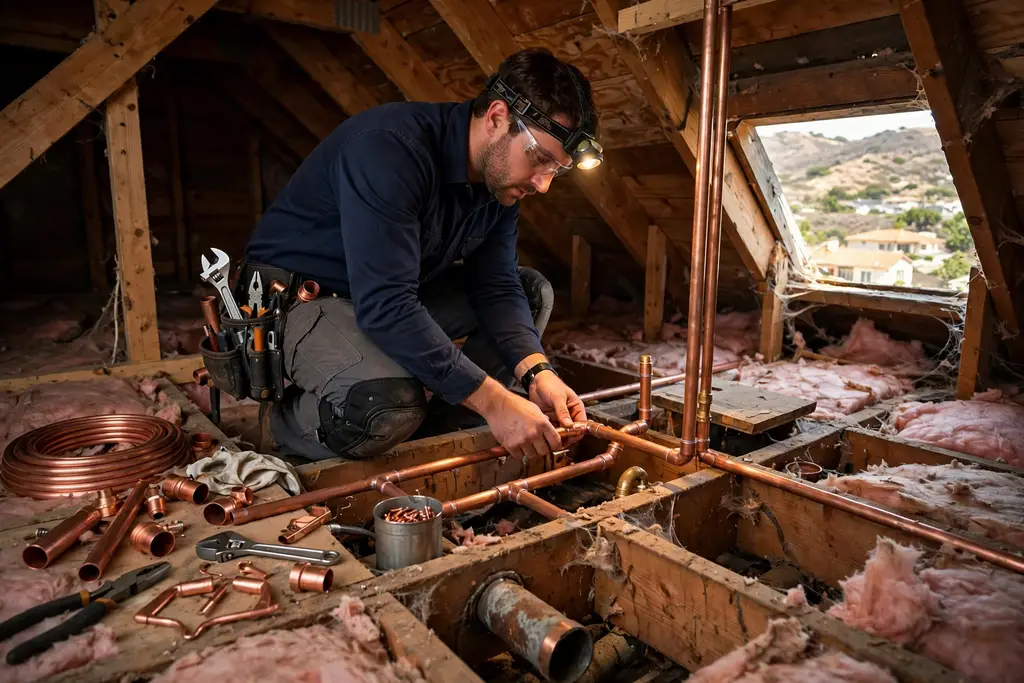
Rerouting starts the same way every repair should: with confirmed detection. Once the leaking run is identified, the specialist maps a new route — commonly through the attic and down inside walls, or along ceiling joists boxed into a soffit. The new line is installed along that path, connected at both ends to the existing system, and pressure-tested before the old under-slab line is permanently capped and abandoned. Inside, the work means opening sections of drywall to run and secure the pipe, then patching. There is no concrete cutting, no trench through the slab, and no excavation in the yard. Because the new pipe runs inside the building envelope rather than in the ground, it is protected from the soil conditions that damaged the original line. Attic runs get insulated to protect against temperature swings, and the specialist will walk you through the planned path before any drywall is opened.
Before the visit, think about attic access — clear the scuttle or pull-down stairs if you can, since the specialist will want to see the proposed route. Note which walls back onto plumbing (kitchens, baths, laundry); those are the likely tie-in points. If rooms were recently remodeled, say so: fresh finishes deserve extra care in the patching plan. And locate the main shutoff valve. None of this is mandatory — the specialist works with what is there — but it makes the route planning faster and the drywall patching cleaner.
What Happens When You Call (833) 713-2101
Step 1: The Call
Call (833) 713-2101. You will reach our referral line, where we connect you with an independent local specialist serving Rancho Palos Verdes. Expect a few direct questions: warm spots on the floor, the sound of running water with taps off, a water bill that jumped, low pressure. Those answers tell the specialist what to test first.
Step 2: The Diagnosis
On site, the specialist confirms the leak with pressure testing and electronic location, then maps your home's layout for a new pipe route — attic access, wall chases, and where the new line will tie in.
Step 3: The Plan
You get a plain-language explanation of what was found and which repair paths fit — Slab Leak Pipe Rerouting among them — before any work is authorized. No work starts on a guess.
When Pipe Rerouting Isn't the Right Fix
Rerouting is not always the answer either. A single pinhole leak in an otherwise healthy, accessible line can be a straightforward spot repair — abandoning a good system to reroute around one defect is overkill. Rerouting is a supply-line solution; drain and sewer problems follow different repair paths. And foundation type matters: if the leak turns out to be in an accessible crawlspace or exterior line rather than under the slab, the repair gets simpler, not harder — the diagnostic visit sorts that out before any plan is made
Serving Rancho Palos Verdes 90275: Neighborhoods We Cover
We connect homeowners across Rancho Palos Verdes 90275 — from the bluff-top streets above Lunada Bay to the terraced neighborhoods along Palos Verdes Drive South, and the hillside tracts off Hawthorne Boulevard and Crenshaw Boulevard. Familiar landmarks on service routes include Point Vicente Lighthouse, the Portuguese Bend Reserve, Wayfarers Chapel, and Trump National Golf Club. If your home sits inside or near the landslide complex, mention it on the call — the specialist factors ground movement into the diagnosis before recommending any method.
Suspect a Slab Leak? Talk to a Specialist Today
One call connects you with a local slab leak professional serving Rancho Palos Verdes, CA — day or night.
Call (833) 713-2101Frequently Asked Questions
Our home is near Portuguese Bend. Can ground movement break a repaired pipe?
It can stress one, which is why the repair method matters as much as the repair itself. The landslide complex moves on a bentonite clay slide plane and accelerated during the 2023–24 storms. A repair locked rigidly into creeping ground can be re-stressed by the next wet winter. Mention your proximity to the slide area when you call so the specialist plans for it. Rerouting removes this variable completely — the new line runs inside the house, not through that soil.
How do you tell a real slab leak from hillside groundwater seepage?
The symptoms overlap — damp floors, musty smells, moisture at the slab edge — but the tests do not. Pressure testing and meter isolation show whether a pressurized line is actually losing water; groundwater seepage will not move a meter. In RPV 90275, ruling out seepage first prevents paying for a pipe repair that was never the problem. This is why rerouting is often the recommended path here: abandon the buried line and stop fighting the ground.
Our house was built in the 1960s. Is the copper under the slab done?
1960s copper is in its sixth decade — squarely in the failure window, and the bentonite-influenced soils and hillside moisture here do it no favors. Pinhole leaks from pitting are the classic 90275 call. Whether the answer is Pipe Rerouting depends on how widespread the corrosion is: one bad section is a repair candidate, system-wide pitting points toward bigger solutions. With a reroute, the new pipe's environment is the building interior — none of these underground conditions apply.
Can equipment even reach our terraced hillside lot?
Terraced lots and steep driveways off Palos Verdes Drive South complicate heavy excavation — which is exactly why low-dig methods exist. Slab Leak Pipe Rerouting works through small access points rather than open trenches, so terraces, retaining walls, and landscaping stay intact. The specialist confirms access on the diagnostic visit. Rerouting removes this variable completely — the new line runs inside the house, not through that soil.
Does the building moratorium in the landslide area affect pipe repairs?
Ordinance 692 (2025) bans new residential construction inside the landslide complex, and a moratorium remains in effect — but repairing existing plumbing is maintenance, not new construction. Still, permits and access rules in the complex get extra scrutiny, so tell the specialist your street when you call and they will plan accordingly. This is why rerouting is often the recommended path here: abandon the buried line and stop fighting the ground.
Will the new pipe run through my attic? Is that okay?
Attic routing is the most common reroute path in South Bay ranch homes, and it is standard practice. The new line is secured, insulated, and pressure-tested. Because it runs inside the building envelope instead of in the soil, it is protected from the ground conditions that destroyed the original line.
What happens to the old leaking pipe under the slab?
It stays where it is — capped at both ends and permanently abandoned. There is no reason to excavate a dead line. Once isolated from water pressure, it cannot leak again.