Slab Leak Pipe Rerouting in Hawthorne, CA
Slab Leak Pipe Rerouting in Hawthorne, CA 90250 abandons and replaces failing under-slab water lines — with a new overhead line that never touches the soil again.
In Short
Slab Leak Pipe Rerouting in Hawthorne, CA 90250 abandons and replaces failing under-slab water lines — with a new overhead line that never touches the soil again. Hawthorne's 1950s homes with 70-year-old copper are prime candidates. Call (833) 713-2101: first a symptom review with a specialist, then testing to confirm the leak.
Slab Leak Pipe Rerouting in Hawthorne 90250: What Local Homes Need to Know
Hawthorne 90250 is 1950s slab-tract territory at peak failure age — most homes went up in the 50s, the copper is 70 years old, and dense multifamily means one leak can affect several units. One caution before anything else: pockets of pre-1950 raised-foundation stock still exist, so foundation type gets confirmed before any slab-specific method is quoted. Slab Leak Pipe Rerouting follows the diagnosis, not the assumption.
Pipe rerouting abandons the leaking under-slab line and installs a brand-new water line through the walls, ceiling, or attic. The old pipe stays buried under the slab, capped and dead. Your water takes a new, accessible path that never touches the soil again — which means the corrosion, ground movement, or whatever killed the old line cannot reach the new one.
The appeal is direct: no concrete cutting, no trench, and a new pipe that never touches the soil again. In Hawthorne 90250, where tract homes and multi-unit buildings both reward minimal disruption, getting the water lines out of the ground is often the most durable answer.
One thing to know upfront: Slab Leak Repair Experts connects homeowners with independent local specialists. Call (833) 713-2101 and we will put you in touch with a pro serving Hawthorne — every finding gets explained and every repair gets your approval before it happens.
Ready for a straight answer? Ask a Pro — we will connect you with an independent specialist serving Hawthorne 90250.
Why Hawthorne Changes How This Repair Works
Hawthorne's housing is predominantly 1950s single-family — Hollyglen and Del Aire pockets among the tracts — with significant multifamily mixed in. Pipe stock is the 1950s copper-and-galvanized mix with cast-iron drains, under slab-on-grade in the great majority of homes. The ground is flat coastal plain; alluvium; no complications. The 1950s copper is at textbook pinhole age, and multifamily density means shared lines and multi-unit impact are routine diagnostic considerations. The pre-1950 pockets matter: raised-foundation homes with under-floor access get simpler repairs, and quoting slab methods for a non-slab house is the error the diagnostic exists to prevent. Confirm foundation, confirm material, then choose the method.
When multifamily shared lines keep failing, rerouting separates and renews them overhead — dedicated runs, accessible for the future. For single-family tracts with multi-run failure, a reroute ends the cycle in one project.
For many Hawthorne homes, rerouting is the cleanest exit from under-slab plumbing trouble: the failed line is retired, the new line is reachable for any future work, and the soil under the slab stops being your problem. The on-site visit confirms whether your home's layout makes it the right call.
How Pipe Rerouting Works — Without Tearing Up Your Home
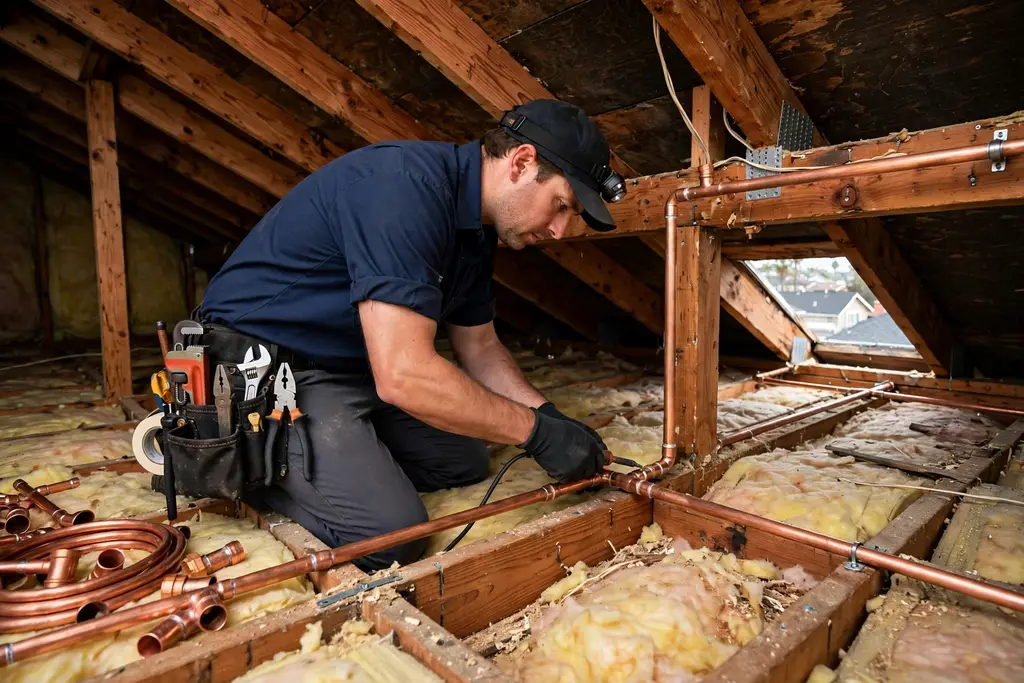
Rerouting starts the same way every repair should: with confirmed detection. Once the leaking run is identified, the specialist maps a new route — commonly through the attic and down inside walls, or along ceiling joists boxed into a soffit. The new line is installed along that path, connected at both ends to the existing system, and pressure-tested before the old under-slab line is permanently capped and abandoned. Inside, the work means opening sections of drywall to run and secure the pipe, then patching. There is no concrete cutting, no trench through the slab, and no excavation in the yard. Because the new pipe runs inside the building envelope rather than in the ground, it is protected from the soil conditions that damaged the original line. In single-story ranch homes — the dominant style across much of the South Bay — attic reroutes are especially straightforward.
Before the visit, think about attic access — clear the scuttle or pull-down stairs if you can, since the specialist will want to see the proposed route. Note which walls back onto plumbing (kitchens, baths, laundry); those are the likely tie-in points. If rooms were recently remodeled, say so: fresh finishes deserve extra care in the patching plan. And locate the main shutoff valve. None of this is mandatory — the specialist works with what is there — but it makes the route planning faster and the drywall patching cleaner.
What Happens When You Call (833) 713-2101
Step 1: The Call
Call (833) 713-2101. You will reach our referral line, where we connect you with an independent local specialist serving Hawthorne. Expect a few direct questions: warm spots on the floor, the sound of running water with taps off, a water bill that jumped, low pressure. Those answers tell the specialist what to test first.
Step 2: The Diagnosis
On site, the specialist confirms the leak with pressure testing and electronic location, then maps your home's layout for a new pipe route — attic access, wall chases, and where the new line will tie in.
Step 3: The Plan
You get a plain-language explanation of what was found and which repair paths fit — Slab Leak Pipe Rerouting among them — before any work is authorized. No work starts on a guess.
When Pipe Rerouting Isn't the Right Fix
Rerouting is not always the answer either. A single pinhole leak in an otherwise healthy, accessible line can be a straightforward spot repair — abandoning a good system to reroute around one defect is overkill. Rerouting is a supply-line solution; drain and sewer problems follow different repair paths. And foundation type matters: if the leak turns out to be in an accessible crawlspace or exterior line rather than under the slab, the repair gets simpler, not harder — the diagnostic visit sorts that out before any plan is made
Serving Hawthorne 90250: Neighborhoods We Cover
Serving Hawthorne 90250 — the tract neighborhoods along Hawthorne Boulevard, Crenshaw Boulevard, and Inglewood Avenue, the Hollyglen and Del Aire pockets, and the corridors near the I-105/I-405 interchange. Unsure of your foundation type? Just describe the home's age when you call — the specialist verifies it on site.
A final Hawthorne note: the Hollyglen and Del Aire pockets have slightly varied lot layouts compared with the main tracts, so the specialist confirms the pipe route on site rather than assuming the tract standard. With industrial corridors along Crenshaw, some mixed-use blocks need commercial-versus-residential line mapping done carefully — mention your block type when you call so the diagnostic arrives with the right plan.
Suspect a Slab Leak? Talk to a Specialist Today
One call connects you with a local slab leak professional serving Rancho Palos Verdes, CA — day or night.
Call (833) 713-2101Frequently Asked Questions
Our home might be pre-1950. Does that change the repair?
It can change everything — pre-1950 homes in 90250 are often raised-foundation, where the equivalent leak is under-floor and simpler to fix than a true slab leak. The specialist confirms foundation type on the diagnostic visit before any slab-specific method like Pipe Rerouting is discussed. Do not skip that step. With a reroute, the new pipe's environment is the building interior — none of these underground conditions apply.
Our apartment building has low pressure in three units. Related?
Very possibly one shared supply line failing — the classic multifamily presentation. Pressure isolation by branch maps which line serves which units and finds the break. Get building ownership involved early so the repair authorization is ready when the diagnosis lands. Rerouting removes this variable completely — the new line runs inside the house, not through that soil.
Is 1950s copper in Hawthorne really done?
At 70 years, yes — pinhole failures from interior pitting are the norm across 90250's tracts. The diagnostic shows whether your home has one bad section or a system-wide pattern; that distinction chooses between Pipe Rerouting and replacement thinking. This is why rerouting is often the recommended path here: abandon the buried line and stop fighting the ground.
Will the work shut off water to the whole building?
Planning avoids it — Slab Leak Pipe Rerouting can usually be staged so only the affected lines are down, and only during the work windows. The specialist coordinates shutdown timing with building management when you call. With a reroute, the new pipe's environment is the building interior — none of these underground conditions apply.
Our Hollyglen home has had two leaks. Pattern or coincidence?
Pattern. Repeat leaks in 70-year-old copper mean the system is failing broadly, and spot repairs buy shrinking intervals. The honest pivot is rehabilitating or abandoning the runs — Pipe Rerouting territory — rather than a third patch. The camera will show the extent. Rerouting removes this variable completely — the new line runs inside the house, not through that soil.
Is a rerouted line as reliable as the original?
It is typically more reliable going forward: new pipe, accessible routing, and no contact with the soil that damaged the old line. Future maintenance, if ever needed, happens without breaking concrete.
Can rerouting handle a whole house with multiple leaks?
Yes — and that is one of its strengths. When pressure tests show the under-slab system failing in more than one place, rerouting the affected runs solves all of them at once instead of chasing leaks one slab opening at a time.