Slab Leak Insurance Claim Help in Long Beach, CA 90813
Need slab leak insurance claim help in Long Beach, CA? We serve 90813 - Willmore City, Cambodia Town and the historic core - throughslab-leak specialists.
In Short
Need slab leak insurance claim help in Long Beach, CA? We serve 90813 - Willmore City, Cambodia Town and the historic core - throughslab-leak specialists. On your first call we verify the ZIP, listen to what you're seeing, and the first step is a documentation checklist tailored to your home, your damage, and where you are in the claims.
How Slab Leak Insurance Claim Help Works Differently in Long Beach 90813
Start with what the file must establish. Historic core - Craftsman and bungalow homes from 1902-1934 in the Hellman Street Craftsman Historic District and Drake Park/Willmore City Historic District, with neighborhoods like Willmore City, Cambodia Town, East Village, Hellman, Rose Park and Craftsman Village. The pipe underneath is typically Century-old stock: galvanized steel and cast iron, often partially repiped; slab additions from the 1940s-60s carry copper. Slab-on-grade prevalence is Mixed - raised foundations dominate the pre-1940 stock; slab on postwar additions and infill. A 90813 claim file weaves those facts into the narrative honestly - the home's age, the pipe's generation, the local soil - so the adjuster sees a complete, credible picture instead of a bare damage list.
In Long Beach 90813, slab-leak insurance documentation often reframes the claim entirely. The pre-1940 Craftsman and bungalow stock on raised foundations means many calls are crawlspace leaks, not slab leaks - and the file should establish the foundation type up front so the claim is evaluated as what it is: an under-floor plumbing failure, typically with simpler access and different damage patterns than a slab claim. For the postwar slab additions with copper, the standard under-slab kit applies. In the historic districts, any exterior work faces city requirements, so permits and approvals become part of the documentation trail. Century-old galvanized also invites the wear-and-tear question; the sudden-onset timeline and evidence of prior function carry the answer. Right frame, right evidence, right district paperwork.
Slab leak insurance claim help is documentation and guidance support for homeowners filing a homeowner's insurance claim for slab-leak damage: what to photograph, which readings and reports to gather, how sudden water damage differs from long-term wear in an adjuster's eyes, and how to present a clear, organized file. It is practical help with the paperwork side of a stressful event - not claims adjusting and not legal advice. In Long Beach, the documentation is tailored to local claim pitfalls: The only area in the set where pre-slab raised foundations dominate - many slab-leak calls here are actually under-floor (crawlspace) leaks, which are cheaper to fix. The checklist adapts, but the principle doesn't - evidence gathered early, organized clearly, handed over complete.
The decision framework for Long Beach 90813 homeowners is temporal: the most valuable documentation is gathered in the first 48 hours, before cleanup, drying, or demolition changes the scene. Photograph everything, write the timeline while it's fresh, keep every receipt, and get the detection report in the file. Historic-district rules can restrict exterior trenching and tunneling, so the repair plan has to be checked against City of Long Beach requirements before anyone quotes exterior access.
90813 Warning Signs That Point Toward Slab Leak Insurance Claim Help
Homeowners usually seek this help right after discovery: the floor is warm, the meter is spinning, or a plumber has just confirmed a leak under the slab - and now there is a claim number to feed with evidence. The most valuable documentation is gathered in the first 48 hours: photos of damage, meter readings, the detection report, and a written timeline. The 90813 pattern adds a documentation note: Historic-district rules can restrict exterior trenching and tunneling, so the repair plan has to be checked against City of Long Beach requirements before anyone quotes exterior access. Capture it all early - photos, readings, the detection report, and a written timeline - while the evidence is fresh.
How Slab Leak Insurance Claim Help Works on a Long Beach Property
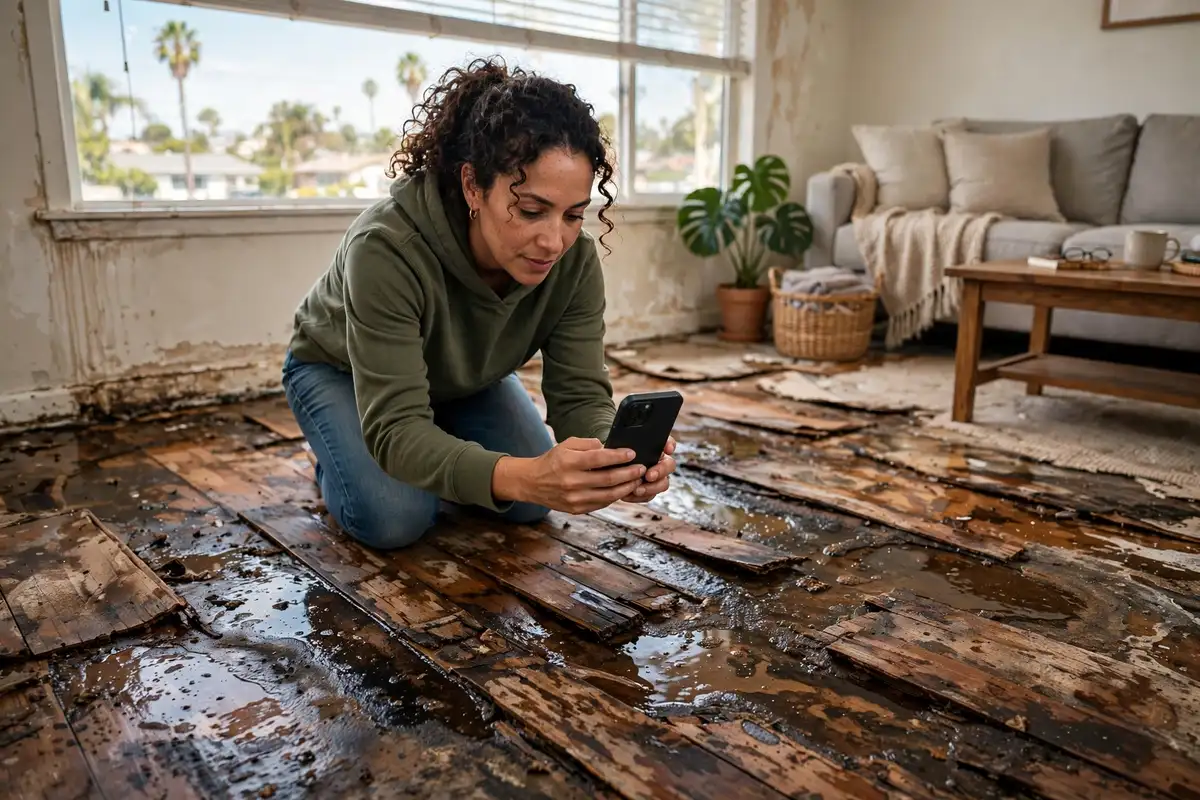
The process starts with a discovery call about what happened and what the policy situation looks like. Then comes a documentation checklist tailored to the home: photos and video of every affected area, moisture and thermal readings where available, the leak-detection report, repair estimates, and receipts for emergency mitigation like water shutoff or drying. Everything is organized into a claim file the homeowner can hand to their adjuster. What you receive is organization, not representation: a complete, dated, photographed file you hand to your adjuster yourself. A 1914 Craftsman on West 10th Street is typical of the district: raised foundation, century-old galvanized, and a leak that is reached from the crawlspace rather than through concrete. Local context like that goes into the file's background notes so the adjuster isn't guessing.
90813 Soil, Water and Pipe Facts Behind Local Slab Leak Insurance Claim Help Calls
Long Beach 90813 sits on Flat coastal plain with urban fill in the oldest blocks and a high water table near the LA River and ports. Marine climate with November-to-March rain. Homes here: Historic core - Craftsman and bungalow homes from 1902-1934 in the Hellman Street Craftsman Historic District and Drake Park/Willmore City Historic District, with neighborhoods like Willmore City, Cambodia Town, East Village, Hellman, Rose Park and Craftsman Village. Pipe underneath: Century-old stock: galvanized steel and cast iron, often partially repiped; slab additions from the 1940s-60s carry copper. Slab-on-grade prevalence is Mixed - raised foundations dominate the pre-1940 stock; slab on postwar additions and infill. The key local fact for slab leak insurance claim help: The only area in the set where pre-slab raised foundations dominate - many slab-leak calls here are actually under-floor (crawlspace) leaks, which are cheaper to fix. Verify foundation type first. Historic-district rules can restrict exterior trenching and tunneling work - check City of Long Beach requirements before quoting exterior access. On the ground that means: Historic-district rules can restrict exterior trenching and tunneling, so the repair plan has to be checked against City of Long Beach requirements before anyone quotes exterior access. And for reference: A 1914 Craftsman on West 10th Street is typical of the district: raised foundation, century-old galvanized, and a leak that is reached from the crawlspace rather than through concrete.
Your First-48-Hours Documentation Checklist in Long Beach 90813
Your 90813 documentation kit, assembled in the first two days: dated photos/video of all damage before anything is disturbed; a written timeline from first symptom through shutoff; the electronic detection report pinpointing the failure; meter readings and the spiked water bill; receipts for mitigation (drying, emergency repairs); and the failed pipe section itself, kept and photographed. Historic-district rules can restrict exterior trenching and tunneling, so the repair plan has to be checked against City of Long Beach requirements before anyone quotes exterior access. Then the file goes to your adjuster complete - because in Long Beach, as everywhere, the best-documented claim is the fastest-moving one.
Your First Call: What to Expect in Long Beach
Your call to (833) 713-2101 starts simply: we verify the 90813 ZIP, hear the symptoms in your words, and note anything already tried. Then Slab Leak Repair Experts - a referral service connecting Long Beach homeowners with local specialists - pairs you with a specialist who knows slab leak insurance claim help on Willmore City, Cambodia Town and the historic core-area homes like yours. The specialist takes it from there: questions, a visit if needed, and a plain-spoken plan. Talk to a specialist at (833) 713-2101 at (833) 713-2101.
Suspect a Slab Leak? Talk to a Specialist Today
One call connects you with a local slab leak professional serving Rancho Palos Verdes, CA — day or night.
Call (833) 713-2101Frequently Asked Questions
How do I prove my 90813 leak was sudden and not gradual wear?
With a timeline and corroboration: the date you first noticed symptoms, how quickly they progressed, when you shut the water off, the detection report pinpointing a specific failure point, and any records of prior normal function - steady water bills, prior plumbing work. In Long Beach, the only area in the set where pre-slab raised foundations dominate - many slab-leak calls here are actually under-floor (crawlspace) leaks, which are cheaper to fix. - which is exactly why the timeline must be written while fresh and backed by dated evidence, not reconstructed from memory weeks later.
The adjuster says my Long Beach damage is from groundwater, not the pipe. What helps?
The diagnostic evidence that proves a plumbing failure: meter-test results showing water loss with everything off, pressure-isolation results identifying the failed line, the detection report pinpointing it, and photos of the failed section. In 90813, the only area in the set where pre-slab raised foundations dominate - many slab-leak calls here are actually under-floor (crawlspace) leaks, which are cheaper to fix. - so the file must make the plumbing cause undeniable rather than letting dampness speak for itself. This is the single most common dispute in high-water-table areas, and it's won with instruments, not arguments.
My 90813 home has Century-old stock: galvanized steel and cast iron, often partially repiped; slab additions from the 1940s-60s carry copper. - will the insurer call it wear and tear?
They may ask the question, which is why the file answers it preemptively: a dated sudden-onset timeline, evidence of prior normal function, and the detection report showing a specific failure point rather than systemic decay. The only area in the set where pre-slab raised foundations dominate - many slab-leak calls here are actually under-floor (crawlspace) leaks, which are cheaper to fix. Age alone doesn't make a failure gradual - a 70-year-old pipe can fail suddenly - but the file has to prove this one did. Stick to facts, dates, and instruments.
How do I prove my 90813 leak was sudden and not gradual wear?
With a timeline and corroboration: the date you first noticed symptoms, how quickly they progressed, when you shut the water off, the detection report pinpointing a specific failure point, and any records of prior normal function - steady water bills, prior plumbing work. In Long Beach, the only area in the set where pre-slab raised foundations dominate - many slab-leak calls here are actually under-floor (crawlspace) leaks, which are cheaper to fix. - which is exactly why the timeline must be written while fresh and backed by dated evidence, not reconstructed from memory weeks later.