Slab Leak Insurance Claim Help in Hawthorne, CA 90250
Need slab leak insurance claim help in Hawthorne, CA? We serve 90250 - Hollyglen, Del Aire and central Hawthorne - throughslab-leak specialists.
In Short
Need slab leak insurance claim help in Hawthorne, CA? We serve 90250 - Hollyglen, Del Aire and central Hawthorne - throughslab-leak specialists. On your first call we verify the ZIP, listen to what you're seeing, and the first step is a documentation checklist tailored to your home, your damage, and where you are in the claims process. Reach us at.
How Slab Leak Insurance Claim Help Works Differently in Hawthorne 90250
Start with what the file must establish. Most homes built in the 1950s, with Hollyglen and Del Aire pockets and significant multifamily; a 1944-built home with a floor furnace shows the pre-1950 raised-foundation stock still present in pockets. The pipe underneath is typically 1950s copper and galvanized mix; cast-iron drains. Slab-on-grade prevalence is Very high, with pre-1950 raised-foundation pockets. A 90250 claim file weaves those facts into the narrative honestly - the home's age, the pipe's generation, the local soil - so the adjuster sees a complete, credible picture instead of a bare damage list.
In Hawthorne 90250, slab-leak insurance documentation starts with the foundation check - because the claim changes with it. A 1950s slab tract home gets the standard under-slab documentation kit. A pre-1950 raised-foundation home (like the 1944 example with the floor furnace) is a crawlspace claim with different damage patterns and different repair economics, and the file should establish the foundation type explicitly so the adjuster evaluates the right scenario. In multifamily buildings, the shared-versus-dedicated line documentation from Harbor City applies: whose line, whose damage, which policy. The flat alluvial lots keep the physical documentation simple; the complexity is in correctly framing which kind of claim this is before the first photo is filed.
Slab leak insurance claim help is documentation and guidance support for homeowners filing a homeowner's insurance claim for slab-leak damage: what to photograph, which readings and reports to gather, how sudden water damage differs from long-term wear in an adjuster's eyes, and how to present a clear, organized file. It is practical help with the paperwork side of a stressful event - not claims adjusting and not legal advice. That 1944 Hawthorne home with the original floor furnace is a reminder: not every 90250 house sits on a slab, and a five-minute foundation check prevents a misquoted job. That local detail belongs in the file's background section - adjusters decide faster when they don't have to guess at context.
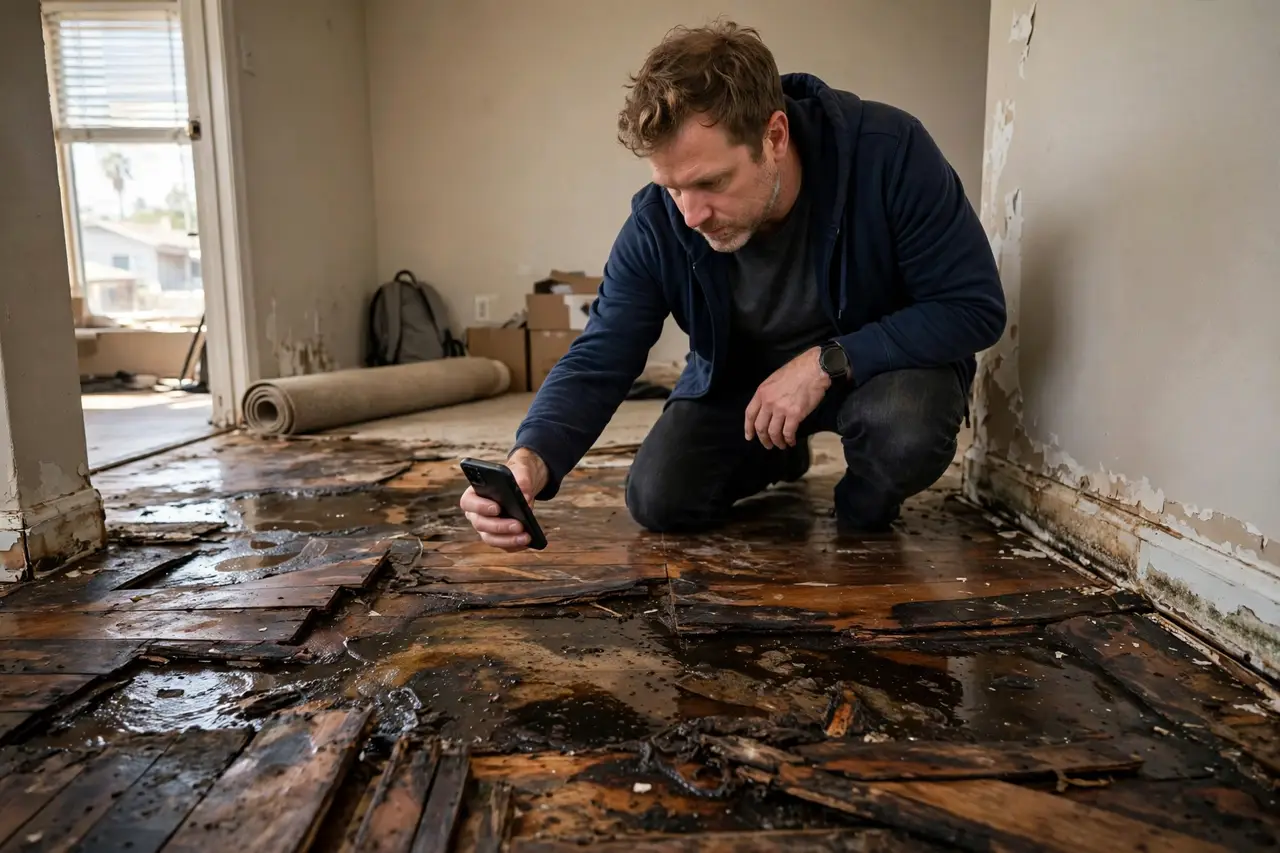
The decision framework for Hawthorne 90250 homeowners is temporal: the most valuable documentation is gathered in the first 48 hours, before cleanup, drying, or demolition changes the scene. Photograph everything, write the timeline while it's fresh, keep every receipt, and get the detection report in the file. Multifamily density means one leak can mean several affected households - and several decision-makers.
Signs Your Hawthorne Home May Need Slab Leak Insurance Claim Help
Homeowners usually seek this help right after discovery: the floor is warm, the meter is spinning, or a plumber has just confirmed a leak under the slab - and now there is a claim number to feed with evidence. The most valuable documentation is gathered in the first 48 hours: photos of damage, meter readings, the detection report, and a written timeline. In Hawthorne 90250, the documentation clock starts at discovery: photograph the damage before anything is cleaned or dried, note the date and time, and keep the water bill showing the spike. 1950s slab tracts at peak failure age, plus dense multifamily where one leak affects several units.
How Slab Leak Insurance Claim Help Works on a Hawthorne Property
The process starts with a discovery call about what happened and what the policy situation looks like. Then comes a documentation checklist tailored to the home: photos and video of every affected area, moisture and thermal readings where available, the leak-detection report, repair estimates, and receipts for emergency mitigation like water shutoff or drying. Everything is organized into a claim file the homeowner can hand to their adjuster. For a Hawthorne 90250 homeowner, the checklist is built around your specific situation - the home's era (most homes built in the 1950s, with hollyglen and del aire pockets and significant multifamily), the damage observed, and where you stand with your insurer. Multifamily density means one leak can mean several affected households - and several decision-makers.
Hawthorne 90250: The Local Facts That Drive Slab Leak Insurance Claim Help Decisions
Hawthorne 90250 sits on Flat coastal plain with alluvium; industrial corridors along Crenshaw from the aerospace era. Mediterranean climate with November-to-March rain. Homes here: Most homes built in the 1950s, with Hollyglen and Del Aire pockets and significant multifamily; a 1944-built home with a floor furnace shows the pre-1950 raised-foundation stock still present in pockets. Pipe underneath: 1950s copper and galvanized mix; cast-iron drains. Slab-on-grade prevalence is Very high, with pre-1950 raised-foundation pockets. The key local fact for slab leak insurance claim help: 1950s slab tracts at peak failure age, plus dense multifamily where one leak affects several units. Confirm foundation type before quoting - the pre-1950 raised-foundation pockets change the job entirely. On the ground that means: Multifamily density means one leak can mean several affected households - and several decision-makers. And for reference: That 1944 Hawthorne home with the original floor furnace is a reminder: not every 90250 house sits on a slab, and a five-minute foundation check prevents a misquoted job.
Your First-48-Hours Documentation Checklist in Hawthorne 90250
The first-48-hours checklist for Hawthorne 90250: (1) Photograph and video every affected area before cleanup - floors, walls, baseboards, the water's path - with dates. (2) Write the timeline: when you first noticed, what you saw, when you shut the water off. (3) Save the water bill showing the spike and note meter readings. (4) Get the leak-detection report in writing - 1950s slab tracts at peak failure age, plus dense multifamily where one leak affects several units. (5) Keep receipts for everything: emergency plumber, water shutoff, drying equipment, temporary repairs. (6) Don't discard the failed pipe section - photograph it and keep it. Organized early, this file answers the adjuster's questions before they're asked.
What Happens When You Call (833) 713-2101
Your call to (833) 713-2101 starts simply: we verify the 90250 ZIP, hear the symptoms in your words, and note anything already tried. Then Slab Leak Repair Experts - a referral service connecting Hawthorne homeowners with local specialists - pairs you with a specialist who knows slab leak insurance claim help on Hollyglen, Del Aire and central Hawthorne-area homes like yours. The specialist takes it from there: questions, a visit if needed, and a plain-spoken plan. Talk to a specialist at (833) 713-2101 at (833) 713-2101.
Suspect a Slab Leak? Talk to a Specialist Today
One call connects you with a local slab leak professional serving Rancho Palos Verdes, CA — day or night.
Call (833) 713-2101Frequently Asked Questions
The adjuster says my Hawthorne damage is from groundwater, not the pipe. What helps?
The diagnostic evidence that proves a plumbing failure: meter-test results showing water loss with everything off, pressure-isolation results identifying the failed line, the detection report pinpointing it, and photos of the failed section. In 90250, 1950s slab tracts at peak failure age, plus dense multifamily where one leak affects several units. - so the file must make the plumbing cause undeniable rather than letting dampness speak for itself. This is the single most common dispute in high-water-table areas, and it's won with instruments, not arguments.
My 90250 home has 1950s copper and galvanized mix; cast-iron drains. - will the insurer call it wear and tear?
They may ask the question, which is why the file answers it preemptively: a dated sudden-onset timeline, evidence of prior normal function, and the detection report showing a specific failure point rather than systemic decay. 1950s slab tracts at peak failure age, plus dense multifamily where one leak affects several units. Age alone doesn't make a failure gradual - a 70-year-old pipe can fail suddenly - but the file has to prove this one did. Stick to facts, dates, and instruments.
How do I prove my 90250 leak was sudden and not gradual wear?
With a timeline and corroboration: the date you first noticed symptoms, how quickly they progressed, when you shut the water off, the detection report pinpointing a specific failure point, and any records of prior normal function - steady water bills, prior plumbing work. In Hawthorne, 1950s slab tracts at peak failure age, plus dense multifamily where one leak affects several units. - which is exactly why the timeline must be written while fresh and backed by dated evidence, not reconstructed from memory weeks later.
The adjuster says my Hawthorne damage is from groundwater, not the pipe. What helps?
The diagnostic evidence that proves a plumbing failure: meter-test results showing water loss with everything off, pressure-isolation results identifying the failed line, the detection report pinpointing it, and photos of the failed section. In 90250, 1950s slab tracts at peak failure age, plus dense multifamily where one leak affects several units. - so the file must make the plumbing cause undeniable rather than letting dampness speak for itself. This is the single most common dispute in high-water-table areas, and it's won with instruments, not arguments.