Slab Leak Detection in Wilmington 90744, CA
Slab Leak Detection in Wilmington 90744, CA — non-destructive testing that confirms whether a hidden leak exists under your concrete slab — and which line it's on — before anyone talks about breaking concrete.
In Short
Slab Leak Detection in Wilmington 90744, CA — non-destructive testing that confirms whether a hidden leak exists under your concrete slab — and which line it's on — before anyone talks about breaking concrete. Serving the 90744 ZIP: meter test, pressure isolation, acoustic listening, thermal imaging. First step when you call (833) 713-2101: a guided five-minute meter check.
What the Detection Visit Looks Like in Wilmington (90744)
A detection visit in Wilmington is methodical, not dramatic. Nobody brings a jackhammer on day one — the whole point is to avoid one. Here's the sequence, and how 90744's conditions shape each step.
What to Expect When We Come Out to Wilmington
Plan on someone being home for the visit — we need access to the rooms above the suspected area, the water heater, and the main shutoff. Move what you can away from the walls where the listening happens; the equipment is sensitive and the visit goes faster in a quiet house. if your home is 1940s–50s and still on original pipe, say so up front — you're at the boundary where detection becomes planning, not just diagnosis
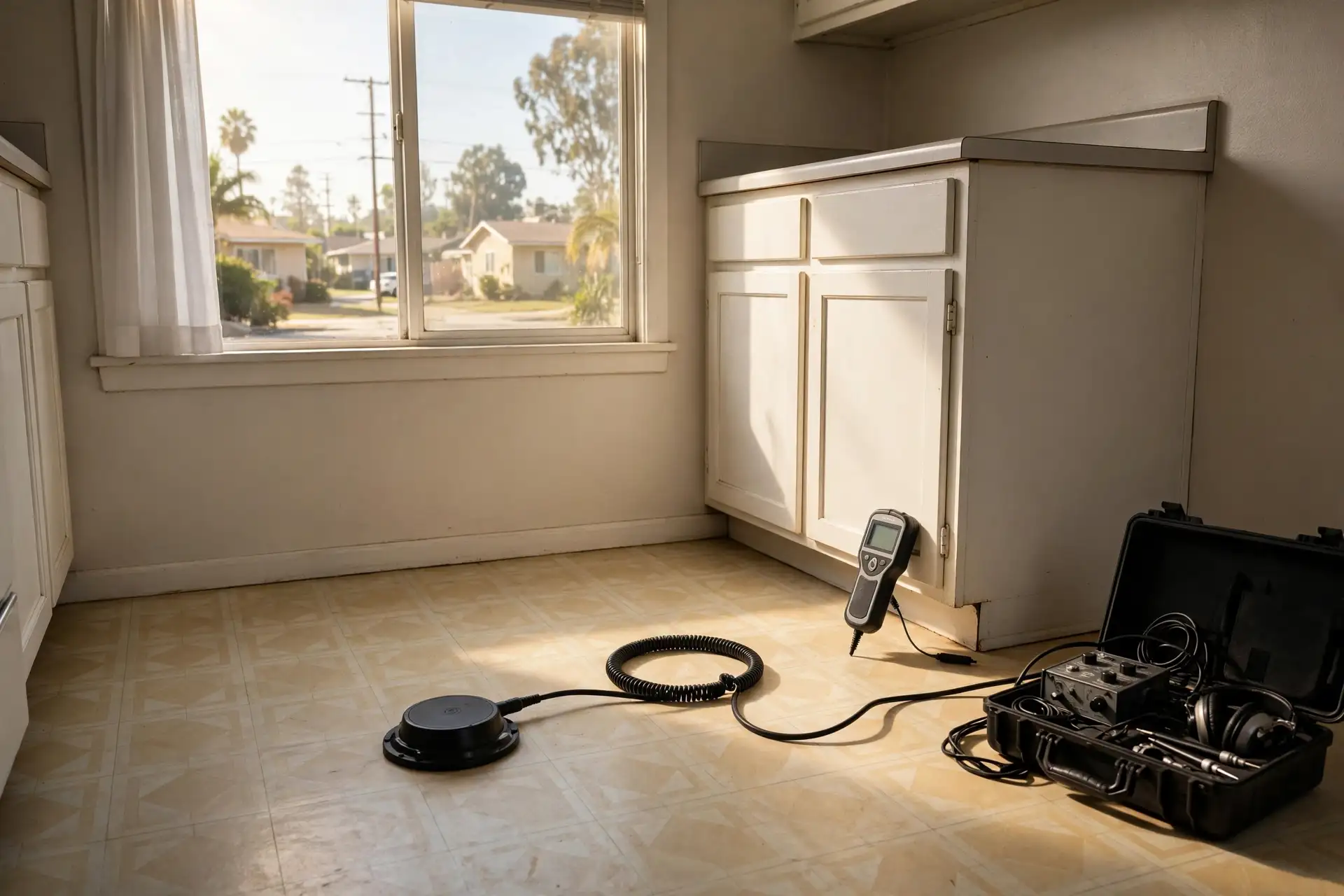
What you won't get is a jackhammer on day one. Detection is a no-dig discipline: meter, pressure gauges, microphones, and a camera. If a previous company told you they need to open the floor "just to look," that's exactly the exploratory digging electronic methods were invented to replace. Still unsure whether it's a slab leak? That's exactly what the call is for: (833) 713-2101.
Local Notes for Wilmington 90744
The 90744 ZIP covers Wilmington's working-class postwar neighborhoods along Pacific Coast Highway, Avalon Boulevard, and Anaheim Street — flat harbor plain, with the refinery and industrial corridor as the local landmark backdrop (the Banning Museum and the Drum Barracks Civil War Museum are the historic anchors). Housing is 1940s–1960s single-family with some multifamily, on flat alluvial soil with a high water table. Slab foundations are the norm, with galvanized-to-copper supply lines and cast-iron drains — the classic high-volume slab-leak profile.
Wilmington homeowners should treat the water meter as an early-warning instrument: check it quarterly with fixtures off, because the ground here will hide what the meter reveals. If your home is 1940s–50s on original galvanized or early copper, you're at the pipe-life boundary — a detection visit now is planning, not panic. And after heavy rain, remember that saturated soil mimics leak symptoms; the meter test is what separates groundwater wicking from a genuine failure. Call (833) 713-2101 — lead with the build era and we'll know exactly what we're walking into.
How this works: you call our line, we match you with a slab-leak specialist who serves 90744 — no fee for the call itself. Questions about slab leak detection in the 90744 ZIP? Call (833) 713-2101.
Where Leaks Hide Easiest: Detection in Wilmington 90744
Wilmington pairs a high water table with some of the oldest pipe stock in the service area — 1940s–60s galvanized transitioning to copper — and that combination gives 90744 the highest slab-leak call density profile we serve. Saturated harbor-plain alluvium does the hiding: groundwater mutes the acoustic signature of small leaks and keeps the soil around the slab permanently damp, so nothing ever looks dry enough to alarm anyone. The leaks here are found by the meter and the pressure gauges, not by listening.
Many Wilmington homes sit at the 70-to-80-year pipe-life boundary, where galvanized fails from the inside out — interior corrosion throttling flow and weeping into soil that was already wet. The classic 90744 call is a bill that climbs for months with no warm floor, no sound, no visible water. Detection runs meter first, full-system pressure isolation second, and treats every pressure loss as a find: at this age, one confirmed leak is a reason to map the whole system before the homeowner chooses a repair path.
The refinery and industrial corridor nearby is cosmetic context, not a plumbing factor — the story is water table plus pipe age, full stop. Because groundwater masks small leaks so thoroughly, we also test the long service lines from meter to house separately; in Wilmington's flat tract layouts, the service line is a disproportionate share of "slab leak" calls. If your bill has been creeping up in a 1940s–60s Wilmington home, the pattern fits — and the detection visit is the fastest way to a yes or no.
Suspect a Slab Leak? Talk to a Specialist Today
One call connects you with a local slab leak professional serving Rancho Palos Verdes, CA — day or night.
Call (833) 713-2101Frequently Asked Questions
Can groundwater really hide a leak from your equipment?
It can hide it from casual observation and smear it for acoustic sensors — saturated soil conducts the leak's sound in all directions, so the signal arrives diffuse. It cannot hide a leak from a meter test or a pressure gauge: water leaving a pressurized pipe is physics, not acoustics. That's why Slab Leak Detection in 90744 leads with the gauges and uses the sensors as confirmation, not the other way around.
My home still has original 1940s pipe. Is replacement the only answer?
Not necessarily the only answer, but it's the conversation to have. At 70–80 years, original galvanized or early copper is past its design life — Slab Leak Detection can tell you whether it's failing today and where, but the honest long-term advice for boundary-age pipe is usually a repipe or reroute plan rather than another decade of spot repairs. We'll give you the diagnosis first and the planning conversation second, in that order.
Does the refinery corridor affect plumbing?
Not the pipes themselves — that's cosmetic context, not a corrosion factor. What matters in Wilmington is the water table and the pipe age, full stop. Don't let the industrial backdrop distract from the actual diagnostics: meter, pressure, sound, heat. Slab Leak Detection reads the same in 90744 as anywhere — the ground is just noisier about it.
How often should I check my meter in Wilmington?
Quarterly, minimum — it takes two minutes. All fixtures off, watch the dial: any movement means water is going somewhere. In 90744 the meter is genuinely your best early-warning system because the saturated ground hides what the meter reveals. If you see movement, call (833) 713-2101 before you see damage — the detection visit is cheapest when the leak is youngest.
How long does a typical detection visit take in Wilmington?
Most visits run one to two hours on site, plus the phone triage beforehand. 1940s–60s working-class postwar homes, many at the 70–80-year pipe-life boundary — the meter test and pressure isolation are quick; the acoustic and thermal survey takes the time it takes. What stretches a visit in the 90744 ZIP is usually access: rooms that need clearing, or a water heater tucked somewhere awkward. We'll tell you what to have ready when we schedule.
My water meter spins but I can't find any water. Is that a slab leak?
It's the single most common way a slab leak announces itself in Wilmington: the meter moves with every fixture off, but nothing is visibly wet — because the water is escaping under the slab, into the soil. groundwater masks small leaks and smears acoustic signals, so the meter test and pressure isolation matter more here than anywhere else nearby — the sensors confirm, but the gauges decide Either way, a spinning meter with dry fixtures is worth a detection visit. It's the cheapest way to get a yes or no.
What if the tests show it isn't a slab leak after all?
Then the visit still did its job — it kept you from paying for concrete work you didn't need. In Wilmington, the usual alternatives are groundwater wicking — the high water table keeps soil saturated enough to dampen slabs with no pipe failure involved. We'll tell you what the evidence points to and who actually handles that kind of problem, rather than inventing a slab leak to sell a repair.