Slab Leak Detection in Torrance 90505, CA
Slab Leak Detection in Torrance 90505, CA — non-destructive testing that confirms whether a hidden leak exists under your concrete slab — and which line it's on — before anyone talks about breaking concrete.
In Short
Slab Leak Detection in Torrance 90505, CA — non-destructive testing that confirms whether a hidden leak exists under your concrete slab — and which line it's on — before anyone talks about breaking concrete. Serving the 90505 ZIP: meter test, pressure isolation, acoustic listening, thermal imaging. First step when you call (833) 713-2101: a guided five-minute meter check.
What the Detection Visit Looks Like in Torrance (90505)
A detection visit in Torrance is methodical, not dramatic. Nobody brings a jackhammer on day one — the whole point is to avoid one. Here's the sequence, and how 90505's conditions shape each step.
What to Expect When We Come Out to Torrance
Plan on someone being home for the visit — we need access to the rooms above the suspected area, the water heater, and the main shutoff. Move what you can away from the walls where the listening happens; the equipment is sensitive and the visit goes faster in a quiet house. if your lot is terraced or your slab steps with the grade, mention it when you call — it changes the access planning
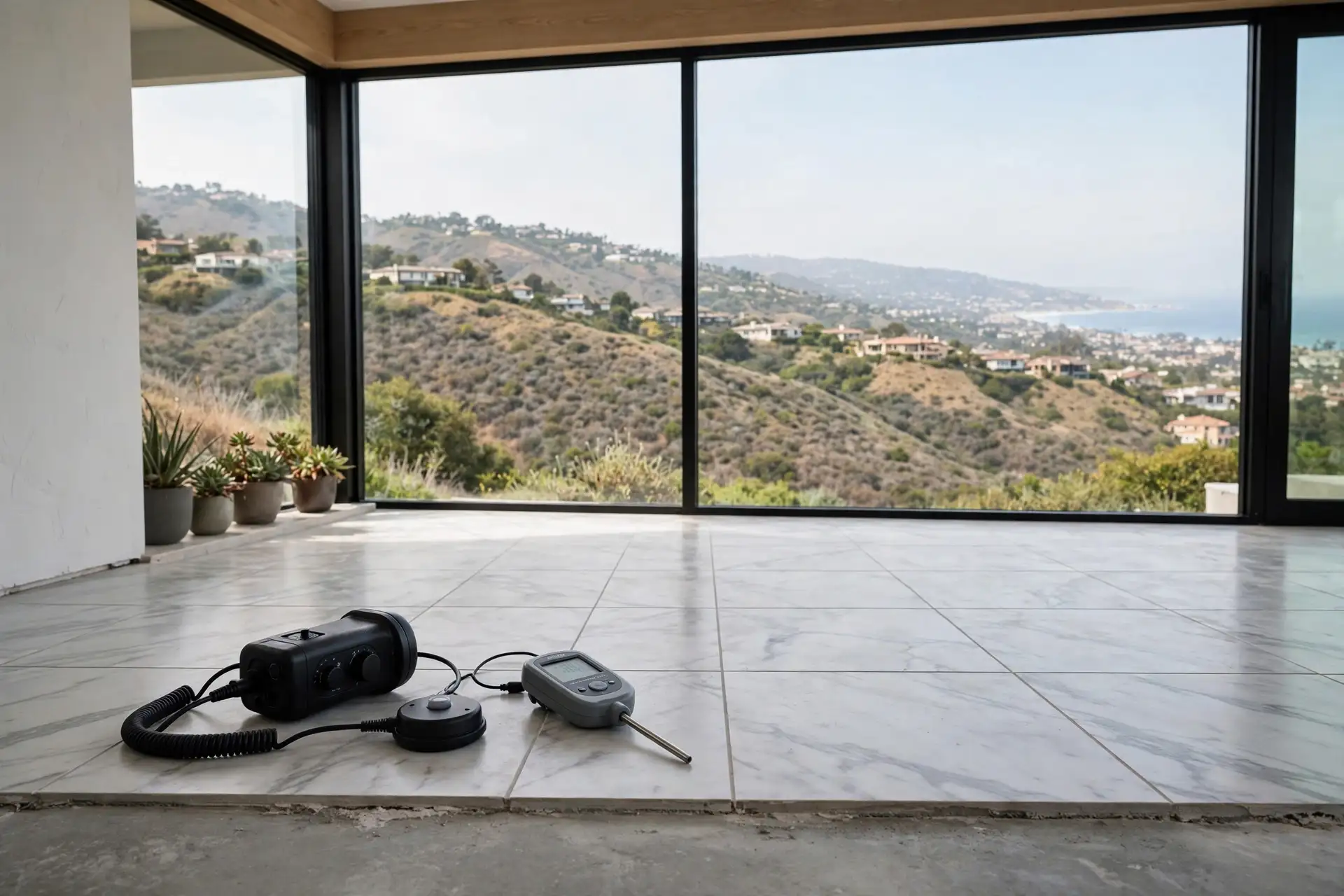
What you won't get is a jackhammer on day one. Detection is a no-dig discipline: meter, pressure gauges, microphones, and a camera. If a previous company told you they need to open the floor "just to look," that's exactly the exploratory digging electronic methods were invented to replace. Questions before you book? Call (833) 713-2101 — we'd rather answer them now than discover them mid-visit.
Local Notes for Torrance 90505
The 90505 ZIP covers South Torrance: the Hillside area with its view lots, Southwood Riviera, and the 1950s–60s ranch and split-level tracts along Anza Avenue, Calle Mayor, and Pacific Coast Highway. The grade rises toward the Palos Verdes Peninsula, and the lots terrace with it — retaining walls, stepped slabs, and concentrated runoff are the local vernacular. Slab-on-grade is the norm but stepped, not flat; copper supply lines from the 1950s–60s run underneath with cast-iron drains.
On a terraced 90505 lot, two things matter more than on flat ground. First, learn where your water goes downhill — a leak's damage shows up in the rooms below the break, sometimes a full terrace down, so don't assume the wet room is the leak room. Second, winter runoff at retaining walls is normal and not a leak; the meter test is what separates hillside water from pipe water. If your slab steps with the grade, say so when you call (833) 713-2101 — access planning starts there.
We're a referral line: you talk to us, and we connect you with a slab-leak specialist serving the 90505 area. Questions about slab leak detection in the 90505 ZIP? Call (833) 713-2101.
Stepped Slabs and Slope Water: Detection in South Torrance 90505
South Torrance's Hillside and Southwood Riviera neighborhoods climb toward the Peninsula on terraced lots, and the slabs here step with the grade — multiple elevations under one roof. Stepped slabs complicate everything downstream: tunneling and rerouting need access and elevation planning that flat lots never require. Detection precision matters more here because the repair is harder; the acoustic and thermal survey must map not just the leak's line but which step of the slab it sits under, since the repair approach changes with elevation.
Hillside water movement is the diagnostic complication: terraced lots shed winter rain fast, runoff concentrates at retaining walls, and slope water can hide a leak's symptoms or mimic them. A thermal camera can be fooled by drainage patterns on a hillside lot — a broad cool anomaly that looks like a cold-line leak may be nothing but slope water. Pressure testing decides: plumbing leaks consume water and fail pressure holds; drainage does neither. In 90505, the gauges outrank the camera.
The pipe era is the same as West Torrance — 1950s–60s copper at failure age — so the failure probability is high and the diagnosis must be careful. If your South Torrance symptoms arrived with the winter rains and sit near a retaining wall or a downhill room, say so on the call; timing and position are diagnostic. The detection visit separates slope water from slab leak before anyone prices the harder hillside repair, which is exactly the order a stepped slab demands.
Suspect a Slab Leak? Talk to a Specialist Today
One call connects you with a local slab leak professional serving Rancho Palos Verdes, CA — day or night.
Call (833) 713-2101Frequently Asked Questions
What is a stepped slab, and why does it matter?
On terraced hillside lots, the slab isn't one flat plane — it steps down with the grade, with each section at a different elevation. That matters because pipe runs step too, repair access has to account for the elevation changes, and tunneling or rerouting gets geometrically more complex. Slab Leak Detection in 90505 always maps the steps: the electronic trace follows the grade, not just the floor plan. Mention the terracing when you call (833) 713-2101.
Can hillside runoff really look like a slab leak?
Convincingly. Terraced lots shed winter rain fast, and concentrated runoff at retaining walls can push moisture under slab edges — damp floors, musty smells, the whole performance. The difference is the pressure gauge: runoff can't make an isolated hot or cold side lose pressure. Slab Leak Detection in 90505 runs the pressure test precisely to draw that line. If it's the hill, not the pipe, we'll say so.
Why is tunneling harder on terraced lots?
Tunneling goes in from outside and under the slab — on a flat lot that's a straight shot, but on a terraced lot the tunnel has to navigate grade changes, retaining-wall footings, and stepped slab edges. It's still done, but the access planning is real work. That's part of why Slab Leak Detection precision matters more here: a good mark can mean the difference between a feasible tunnel and a reroute decision.
Is 90505 harder to work in than flat Torrance ZIPs?
More complex, not harder — the diagnostics are the same, but the interpretation accounts for grade, terracing, and stepped slabs. Detection visits take a little longer because the tracing maps elevation too. The payoff is accuracy: on a terraced lot, a wrong guess about location is expensive, so the extra care at the Slab Leak Detection stage pays for itself at the repair stage.
Will you have to break my concrete to find the leak?
No. Detection is deliberately non-destructive — that's its whole job. We find the leak's line and its general location with meters, pressure, sound, and heat. Concrete only gets discussed after detection, when the repair plan is being chosen, and even then the goal is the smallest possible opening. If someone wants to cut first and diagnose second, that's backwards.
My water meter spins but I can't find any water. Is that a slab leak?
It's the single most common way a slab leak announces itself in Torrance: the meter moves with every fixture off, but nothing is visibly wet — because the water is escaping under the slab, into the soil. hillside water movement on terraced lots can hide a real leak or mimic a fake one — pressure testing is what decides, because slope moisture can't fail a pressure test Either way, a spinning meter with dry fixtures is worth a detection visit. It's the cheapest way to get a yes or no.
What if the tests show it isn't a slab leak after all?
Then the visit still did its job — it kept you from paying for concrete work you didn't need. In Torrance, the usual alternatives are hillside water movement — terraced lots shed winter rain fast, and that concentrated runoff at retaining walls can mimic a supply leak's dampness. We'll tell you what the evidence points to and who actually handles that kind of problem, rather than inventing a slab leak to sell a repair.