Slab Leak Detection in Torrance 90501, CA
Slab Leak Detection in Torrance 90501, CA — non-destructive testing that confirms whether a hidden leak exists under your concrete slab — and which line it's on — before anyone talks about breaking concrete.
In Short
Slab Leak Detection in Torrance 90501, CA — non-destructive testing that confirms whether a hidden leak exists under your concrete slab — and which line it's on — before anyone talks about breaking concrete. Serving the 90501 ZIP: meter test, pressure isolation, acoustic listening, thermal imaging. First step when you call (833) 713-2101: a guided five-minute meter check.
What the Detection Visit Looks Like in Torrance (90501)
A detection visit in Torrance is methodical, not dramatic. Nobody brings a jackhammer on day one — the whole point is to avoid one. Here's the sequence, and how 90501's conditions shape each step.
What to Expect When We Come Out to Torrance
Plan on someone being home for the visit — we need access to the rooms above the suspected area, the water heater, and the main shutoff. Move what you can away from the walls where the listening happens; the equipment is sensitive and the visit goes faster in a quiet house. if you know your home's decade, lead with it — 1930s versus 1950s is the single most useful fact on a 90501 call
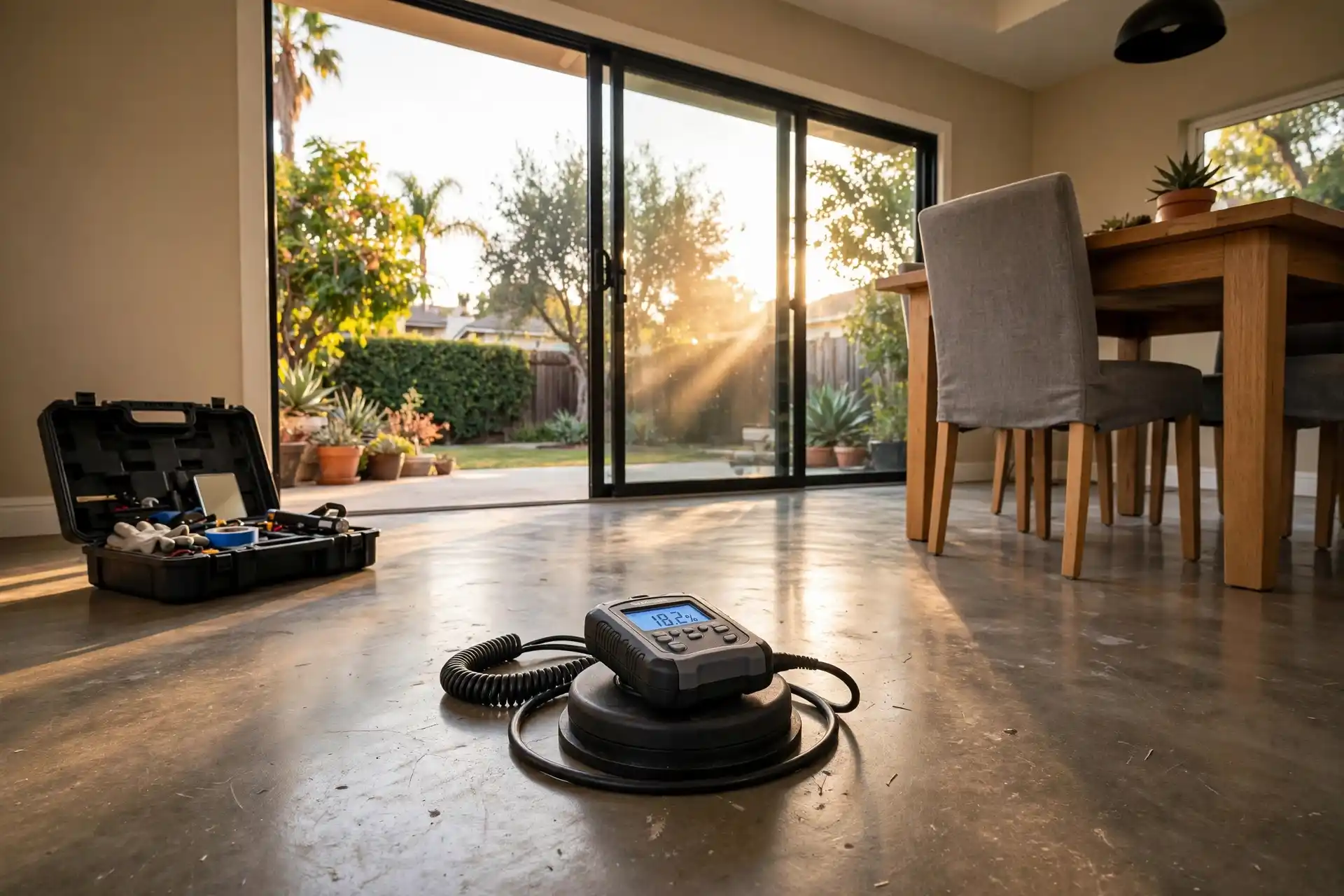
What you won't get is a jackhammer on day one. Detection is a no-dig discipline: meter, pressure gauges, microphones, and a camera. If a previous company told you they need to open the floor "just to look," that's exactly the exploratory digging electronic methods were invented to replace. Questions before you book? Call (833) 713-2101 — we'd rather answer them now than discover them mid-visit.
Local Notes for Torrance 90501
Central and east Torrance make up 90501: Downtown and Old Torrance with its 1920s–40s bungalow streets near Torrance High School, Wilson Park as the green anchor, and the 1950s tracts spreading east of Hawthorne Boulevard. Torrance Boulevard, Carson Street, and Western Avenue are the main east-west routes. Slab-on-grade dominates the postwar tracts; raised foundations persist in the oldest stock near the core. Pipes follow the era: galvanized and cast iron in the 1920s–40s homes, copper under slab from the 1950s on.
The one thing that speeds up every 90501 visit: know your home's decade and foundation type. A 1935 bungalow on a raised foundation and a 1954 tract home on a slab are different jobs wearing the same ZIP code. If you're in the older stock and still on galvanized, treat pressure drops as urgent — that pipe is at the end of its life. If you're in the 1950s tracts, watch for the classic copper signs: warm floors, creeping bills. Call (833) 713-2101 with the build year handy and we'll start in the right era.
We're a referral line: you talk to us, and we connect you with a slab-leak specialist serving the 90501 area. Questions about slab leak detection in the 90501 ZIP? Call (833) 713-2101.
1930s Galvanized or 1950s Copper? Detection in Old Torrance 90501
The 90501 ZIP is an era sandwich, and the era decides everything. Near Torrance High and Old Torrance downtown, 1920s–40s bungalows carry galvanized steel and cast iron — often on raised foundations, which changes the investigation entirely. East of Hawthorne Boulevard, 1950s tracts sit on slab with copper now 70 years old. Detection's first job in 90501 is establishing pipe material and foundation type, because the repair paths diverge completely: a 1930s galvanized system is a repipe candidate, while 1950s copper is a spot-repair or reroute conversation.
On the raised-foundation stock, the visit may never need electronics — a crawlspace inspection finds what a microphone would hunt for, faster and cheaper. On the 1950s slab tracts, the full sequence applies: meter test, hot-versus-cold pressure isolation, acoustic listening, thermal cross-check. Flat coastal-plain alluvium gives clean acoustic conditions, and the era is right at the failure mark. We never quote 90501 work before the foundation question is answered; it's the highest-leverage question in the ZIP.
If your 90501 home is a pre-war bungalow and someone quoted electronic slab-leak detection before looking under the house, get a second opinion — the crawlspace may hold the whole answer, visibly. If it's a 1950s tract home east of Hawthorne with a warm floor, that's the textbook slab-leak pattern at textbook age, and the detection visit is the right next step. Either way: era first, equipment second, and no concrete talk until both are known.
Suspect a Slab Leak? Talk to a Specialist Today
One call connects you with a local slab leak professional serving Rancho Palos Verdes, CA — day or night.
Call (833) 713-2101Frequently Asked Questions
How do I know if my Torrance home is even on a slab?
Check the perimeter: if you can see a crawlspace access or the house sits visibly above grade on a stem wall, it's likely raised — common in 90501's 1920s–40s stock near Old Torrance. If the exterior walls meet the ground with no visible crawlspace, it's probably slab-on-grade, the norm for the 1950s tracts. Slab Leak Detection starts with this question because a raised-foundation leak is a different (usually simpler) job. When you call (833) 713-2101, we'll help you sort it before we roll a truck.
Why do you ask for the build year on every 90501 call?
Because in this ZIP the build year predicts the plumbing: 1920s–40s means galvanized, cast iron, and possibly a raised foundation; 1950s means copper under slab at failure age. Those are different diagnostics, different repairs, and different budgets. The build year lets Slab Leak Detection start on the right track instead of discovering the era on site. It's the highest-value fact you can give us.
Are the 1950s tracts east of Hawthorne Boulevard at slab-leak age?
Yes — 1950s copper under slab is 70-plus years old, squarely in the failure window. The Southwood-style tracts in 90501 are textbook territory: warm-floor hot-line leaks, pinhole failures, creeping water bills. If your tract home is mid-50s original and never re-piped, Slab Leak Detection at the first symptom is just prudent. Call (833) 713-2101 — this is the most straightforward diagnostic we do.
Does the flat ground in Torrance make detection easier?
It removes complications rather than adding ease: flat coastal-plain alluvium means no hillside seepage lookalikes, no terraced access problems, and clean acoustic conditions. What remains is the era question — and that's a records question, not a ground question. 90501 detection visits are among the most predictable in the service area, which is good news for accuracy and for your bill.
How long does a typical detection visit take in Torrance?
Most visits run one to two hours on site, plus the phone triage beforehand. 1920s–50s homes — bungalows near Torrance High and 1950s tracts east of Hawthorne Boulevard — the meter test and pressure isolation are quick; the acoustic and thermal survey takes the time it takes. What stretches a visit in the 90501 ZIP is usually access: rooms that need clearing, or a water heater tucked somewhere awkward. We'll tell you what to have ready when we schedule.
Will you have to break my concrete to find the leak?
No. Detection is deliberately non-destructive — that's its whole job. We find the leak's line and its general location with meters, pressure, sound, and heat. Concrete only gets discussed after detection, when the repair plan is being chosen, and even then the goal is the smallest possible opening. If someone wants to cut first and diagnose second, that's backwards.
What if the tests show it isn't a slab leak after all?
Then the visit still did its job — it kept you from paying for concrete work you didn't need. In Torrance, the usual alternatives are drainage and grading issues on the flat alluvial plain, plus the simple fact that a 1930s raised-foundation home doesn't have a slab to leak under. We'll tell you what the evidence points to and who actually handles that kind of problem, rather than inventing a slab leak to sell a repair.