Slab Leak Detection in Rolling Hills 90274, CA
Slab Leak Detection in Rolling Hills 90274, CA — non-destructive testing that confirms whether a hidden leak exists under your concrete slab — and which line it's on — before anyone talks about breaking concrete.
In Short
Slab Leak Detection in Rolling Hills 90274, CA — non-destructive testing that confirms whether a hidden leak exists under your concrete slab — and which line it's on — before anyone talks about breaking concrete. Serving the 90274 ZIP: meter test, pressure isolation, acoustic listening, thermal imaging. First step when you call (833) 713-2101: a guided five-minute meter check.
What the Detection Visit Looks Like in Rolling Hills (90274)
A detection visit in Rolling Hills is methodical, not dramatic. Nobody brings a jackhammer on day one — the whole point is to avoid one. Here's the sequence, and how 90274's conditions shape each step.
What to Expect When We Come Out to Rolling Hills
Plan on someone being home for the visit — we need access to the rooms above the suspected area, the water heater, and the main shutoff. Move what you can away from the walls where the listening happens; the equipment is sensitive and the visit goes faster in a quiet house. gated access means scheduling needs the gate procedure — have your entry instructions ready when you call so the visit doesn't stall at the gate
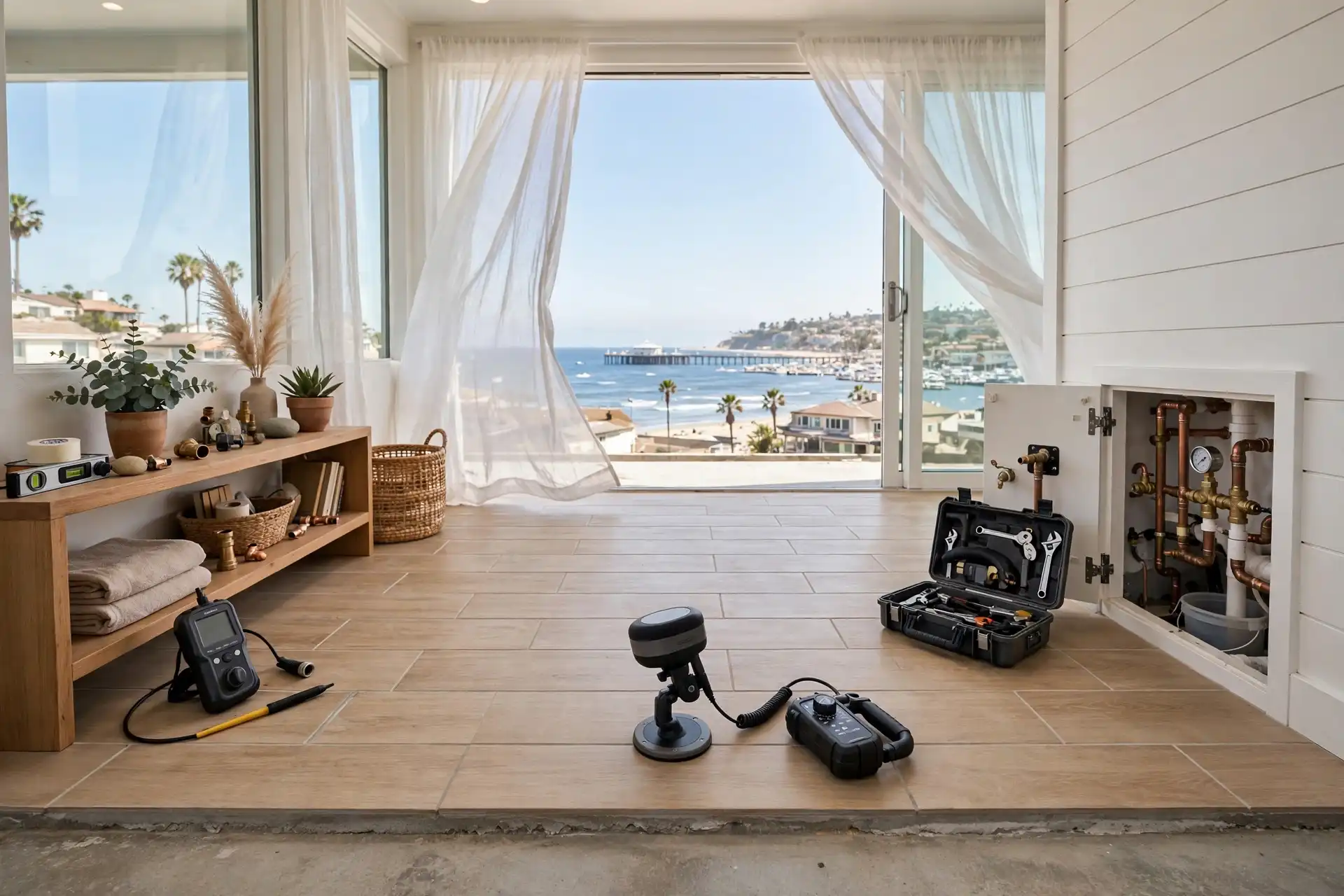
What you won't get is a jackhammer on day one. Detection is a no-dig discipline: meter, pressure gauges, microphones, and a camera. If a previous company told you they need to open the floor "just to look," that's exactly the exploratory digging electronic methods were invented to replace. Questions before you book? Call (833) 713-2101 — we'd rather answer them now than discover them mid-visit.
Local Notes for Rolling Hills 90274
Rolling Hills is entirely private gated roads behind the gates off Palos Verdes Drive North — Rolling Hills City Hall sits at the center, and the equestrian trail system threads the whole city. The 90274 ZIP is shared with Palos Verdes Estates and Rolling Hills Estates, but the housing couldn't be more different: ranch-style homes on one-acre-plus lots, most built from the 1950s through the 1970s, with barns, outbuildings, and extensive hardscape. Slab-on-grade foundations are the norm for the ranch stock, with 1950s–70s copper underneath and cast-iron or ABS drains.
Two things to know before you call from Rolling Hills. First, figure out whether your barns or outbuildings share the house's water service — a quick check is whether their water dies when you shut the house main. That one answer can save a full diagnostic visit aimed at the wrong building. Second, gated entry: have your gate procedure ready when scheduling, because the visit can't start at the gate. Call (833) 713-2101 and mention the outbuildings up front — we'll plan the isolation sequence around them.
We're a referral line: you talk to us, and we connect you with a slab-leak specialist serving the 90274 area. Questions about slab leak detection in the 90274 ZIP? Call (833) 713-2101.
Long Runs and Barn Lines: Detection Across Rolling Hills 90274
Rolling Hills' gated equestrian lots run an acre or more, and that changes the geometry of detection: under-slab pipe runs can stretch dozens of feet from the meter, so a single leak can sit far from where the symptoms appear. The acoustic sweep takes longer here — sensors work their way along the full run — but the method is the same: meter test, pressure isolation, then listening. The meter is especially decisive on long runs, because water moving with everything off has to be going somewhere specific.
Before any under-slab investigation begins, we rule out the Rolling Hills special: horse-property outbuildings and barns that share the water service. A "slab leak" call here regularly turns out to be a failed line to a barn or outbuilding — above ground, accessible, and far cheaper than under-slab work. We isolate outbuilding branches first and pressure-test them separately; more than one Rolling Hills visit has ended at a barn spigot instead of a jackhammer.
When the leak is genuinely under the slab, the repair economics favor rerouting over chasing it through dozens of feet of concrete — and detection precision decides the reroute's path. Hilltop terrain on Monterey shale with graded pads and extensive hardscape adds runoff to the picture, but the meter test separates plumbing from drainage cleanly. If your Rolling Hills bill jumped, the investigation starts at the meter and the outbuildings, not under the floor.
Suspect a Slab Leak? Talk to a Specialist Today
One call connects you with a local slab leak professional serving Rancho Palos Verdes, CA — day or night.
Call (833) 713-2101Frequently Asked Questions
Could my 'slab leak' actually be a line to the barn?
It happens more often than you'd think in Rolling Hills. Outbuildings and barns on horse property sometimes share the house's water service, and a failed line out there spins the meter exactly like an under-slab leak. Slab Leak Detection starts by isolating: shut the outbuilding feeds and watch the meter. If the meter stops, the house slab is innocent. Mention the outbuildings when you call (833) 713-2101 — it changes the whole sequence.
Why is rerouting so often recommended on acre lots?
Simple geometry: under-slab runs on one-acre-plus lots are very long, and opening dozens of feet of slab to chase one break is the most expensive repair in the book. Abandoning the failed under-slab run and routing a new line overhead — through attic and walls — usually costs less, disrupts nothing, and gets you a brand-new line for the trouble. Slab Leak Detection gives us the facts; the math usually points at reroute.
My meter is far from the house. Does that change detection?
It changes the first step. With the meter potentially a hundred-plus feet from the house, a spinning meter might mean a failed service line in the yard, not a slab leak at all. So Slab Leak Detection here always includes proving the leak's location category — yard service line, outbuilding feed, or under the slab — before any under-slab diagnosis begins. The meter test is the same; the interpretation is lot-specific.
Are 1950s copper lines on these lots at failure age?
Squarely. 1950s–70s copper under slab is 50–70 years old, which is the prime failure window for pinhole and corrosion failures — and long runs mean more pipe, more joints, and more chances. If your Rolling Hills ranch still has its original under-slab copper, Slab Leak Detection isn't a question of if you'll need it, it's when. A baseline detection visit now beats an emergency later.
How long does a typical detection visit take in Rolling Hills?
Most visits run one to two hours on site, plus the phone triage beforehand. 1950s–70s ranch homes on one-acre-plus horse properties — the meter test and pressure isolation are quick; the acoustic and thermal survey takes the time it takes. What stretches a visit in the 90274 ZIP is usually access: rooms that need clearing, or a water heater tucked somewhere awkward. We'll tell you what to have ready when we schedule.
Will you have to break my concrete to find the leak?
No. Detection is deliberately non-destructive — that's its whole job. We find the leak's line and its general location with meters, pressure, sound, and heat. Concrete only gets discussed after detection, when the repair plan is being chosen, and even then the goal is the smallest possible opening. If someone wants to cut first and diagnose second, that's backwards.
What if the tests show it isn't a slab leak after all?
Then the visit still did its job — it kept you from paying for concrete work you didn't need. In Rolling Hills, the usual alternatives are a failed water line to a barn or outbuilding — on horse property the outbuildings sometimes share the house's water service, and a leak out there spins the same meter. We'll tell you what the evidence points to and who actually handles that kind of problem, rather than inventing a slab leak to sell a repair.