Slab Leak Detection in Redondo Beach 90278, CA
Slab Leak Detection in Redondo Beach 90278, CA — non-destructive testing that confirms whether a hidden leak exists under your concrete slab — and which line it's on — before anyone talks about breaking concrete.
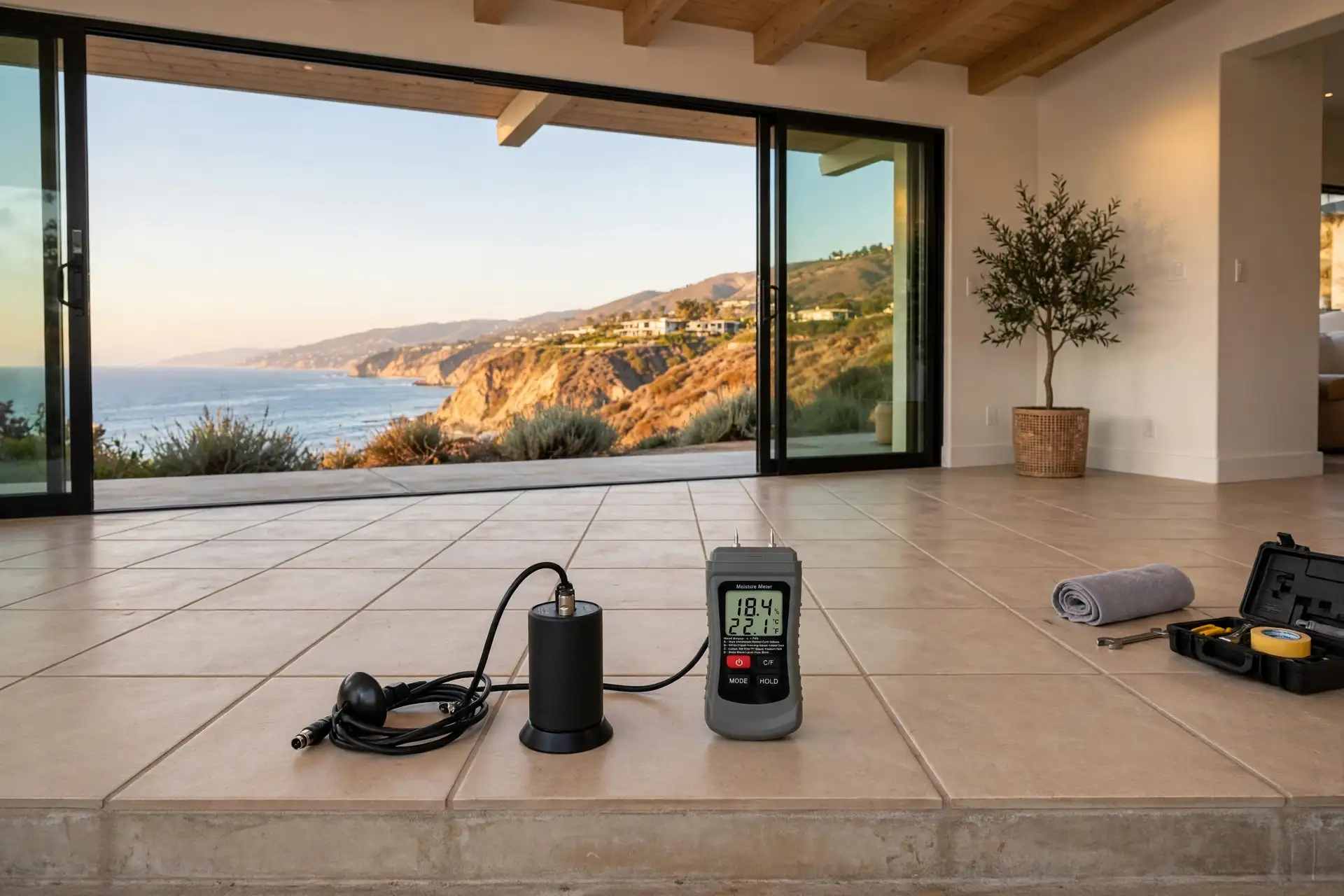
In Short
Slab Leak Detection in Redondo Beach 90278, CA — non-destructive testing that confirms whether a hidden leak exists under your concrete slab — and which line it's on — before anyone talks about breaking concrete. Serving the 90278 ZIP: meter test, pressure isolation, acoustic listening, thermal imaging. First step when you call (833) 713-2101: a guided five-minute meter check.
What the Detection Visit Looks Like in Redondo Beach (90278)
A detection visit in Redondo Beach is methodical, not dramatic. Nobody brings a jackhammer on day one — the whole point is to avoid one. Here's the sequence, and how 90278's conditions shape each step.
What to Expect When We Come Out to Redondo Beach
Plan on someone being home for the visit — we need access to the rooms above the suspected area, the water heater, and the main shutoff. Move what you can away from the walls where the listening happens; the equipment is sensitive and the visit goes faster in a quiet house. if your cottage still has original galvanized or a raised foundation, say so — South Redondo's oldest stock splits into two very different jobs
What you won't get is a jackhammer on day one. Detection is a no-dig discipline: meter, pressure gauges, microphones, and a camera. If a previous company told you they need to open the floor "just to look," that's exactly the exploratory digging electronic methods were invented to replace. Questions before you book? Call (833) 713-2101 — we'd rather answer them now than discover them mid-visit.
Local Notes for Redondo Beach 90278
South Redondo fills the 90278 ZIP: the beach cottage streets near the water, the denser multifamily blocks by the Redondo Beach Pier and King Harbor, and the mid-century infill spreading inland. Pacific Coast Highway, Catalina Avenue, and The Esplanade are the main routes; Veterans Park overlooks the water. Foundations are mixed — raised in the oldest cottages, slab in the postwar infill — and pipes follow the era: 1920s–40s galvanized and cast iron where original, copper from the 1950s on, much of it replumbed during rebuilds.
South Redondo's salt air is the quiet accelerator — if you're within a few blocks of the water on original or older copper, treat your pipes as a decade older than the permit says. And never trust the location of a damp spot in sandy soil: water travels, and the break is often well away from where it surfaces. That's not a reason to panic, it's a reason to call (833) 713-2101 for electronic methods instead of guessing. Cottage owners: check whether you're on a raised foundation first — it changes the job completely.
We're a referral line: you talk to us, and we connect you with a slab-leak specialist serving the 90278 area. Questions about slab leak detection in the 90278 ZIP? Call (833) 713-2101.
When Leaks Travel: Salt-Air Detection in South Redondo 90278
South Redondo's beach sand sits over alluvium and drains fast — which means a slab leak here travels far before it surfaces, and the warm spot or damp patch on your floor can sit well away from the actual breach. Visual hunting fails in 90278; this is where electronic detection most clearly earns its fee. Acoustic listening and thermal imaging close the gap between symptom and source that fast-draining sand creates. Where the symptom is, is not where the leak is — we say it on every South Redondo visit.
Salt air is the other accelerator: it attacks exposed and shallow copper from the outside in, and beachside South Redondo homes show slab leaks roughly a decade earlier than the same pipe would inland. The stock is mixed — 1920s–40s beach cottages near the water, many on raised foundations, plus mid-century infill and modern rebuilds — so detection starts by verifying foundation type and pipe material. Many homes were replumbed during rebuilds; finding a PEX attic reroute changes the entire investigation.
For the mid-century slab homes that remain, 1950s–60s copper in salt air is the highest-risk combination in the beach cities, and the detection protocol treats it that way: meter, pressure isolation, full-system mapping rather than stopping at the first anomaly, because salt-pitted copper can weep from several points. If your South Redondo bill has crept up with no visible water, sand and salt are the likely accomplices — and the detection visit is the fastest way to name them.
Suspect a Slab Leak? Talk to a Specialist Today
One call connects you with a local slab leak professional serving Rancho Palos Verdes, CA — day or night.
Call (833) 713-2101Frequently Asked Questions
How does salt air actually damage buried pipes?
It's the shallow and exposed copper that suffers most — salt-laden air and soil moisture accelerate outside-in corrosion on pipe near the surface, at the slab edge, and in crawlspaces. Deeply buried runs are somewhat shielded, but beachside homes have enough shallow exposure that the effect is real: South Redondo copper fails roughly a decade earlier than the same vintage inland. Slab Leak Detection here always factors the distance from the water into the diagnosis.
Why can't you just follow the wet spot to the leak?
Because in beach sand, water travels. Sandy soil drains fast laterally, so a leak's water can surface many feet from the break — following the dampness leads you to the symptom, not the source. That's the core argument for electronic methods in 90278: acoustic sensors hear the break itself, and line tracing maps the pipe, while your eyes just see where the water gave up. Slab Leak Detection ignores the wet spot's location and finds the break's.
Are the multifamily buildings near the pier harder to diagnose?
More coordinated, not harder. Denser buildings mean shared lines, stacked plumbing, and several households affected by one failure — so the visit includes mapping whose line is whose before any conclusions. The sandy-soil travel problem applies here too: water from a break can surface units away from the source. Slab Leak Detection in the pier-area buildings is methodical by necessity, and the written findings help the building's decision-maker act fast.
Does the sand help or hurt leak detection?
Both. Sand transmits the acoustic signature of a leak well — good for listening — but it lets water travel far from the break — bad for visual location. Net: electronic methods thrive here and eyeballing fails here. That's why Slab Leak Detection in South Redondo leans on sensors over sight, and why a damp spot's location is treated as a hint about the water's journey, not the break's address.
Will you have to break my concrete to find the leak?
No. Detection is deliberately non-destructive — that's its whole job. We find the leak's line and its general location with meters, pressure, sound, and heat. Concrete only gets discussed after detection, when the repair plan is being chosen, and even then the goal is the smallest possible opening. If someone wants to cut first and diagnose second, that's backwards.
My water meter spins but I can't find any water. Is that a slab leak?
It's the single most common way a slab leak announces itself in Redondo Beach: the meter moves with every fixture off, but nothing is visibly wet — because the water is escaping under the slab, into the soil. salt air attacks exposed and shallow copper faster than inland, so beachside homes show slab leaks roughly a decade earlier than the same pipe would inland — and sandy soil drains so fast that leaks travel far before surfacing, which defeats visual hunting Either way, a spinning meter with dry fixtures is worth a detection visit. It's the cheapest way to get a yes or no.
What if the tests show it isn't a slab leak after all?
Then the visit still did its job — it kept you from paying for concrete work you didn't need. In Redondo Beach, the usual alternatives are beach-cottage drainage quirks — sandy soil drains so fast that irrigation and runoff travel far, mimicking the wandering dampness of a slab leak. We'll tell you what the evidence points to and who actually handles that kind of problem, rather than inventing a slab leak to sell a repair.