Slab Leak Detection in Palos Verdes Estates 90274, CA
Slab Leak Detection in Palos Verdes Estates 90274, CA — non-destructive testing that confirms whether a hidden leak exists under your concrete slab — and which line it's on — before anyone talks about breaking concrete.
In Short
Slab Leak Detection in Palos Verdes Estates 90274, CA — non-destructive testing that confirms whether a hidden leak exists under your concrete slab — and which line it's on — before anyone talks about breaking concrete. Serving the 90274 ZIP: meter test, pressure isolation, acoustic listening, thermal imaging. First step when you call (833) 713-2101: a guided five-minute meter check.
What the Detection Visit Looks Like in Palos Verdes Estates (90274)
A detection visit in Palos Verdes Estates is methodical, not dramatic. Nobody brings a jackhammer on day one — the whole point is to avoid one. Here's the sequence, and how 90274's conditions shape each step.
What to Expect When We Come Out to Palos Verdes Estates
Plan on someone being home for the visit — we need access to the rooms above the suspected area, the water heater, and the main shutoff. Move what you can away from the walls where the listening happens; the equipment is sensitive and the visit goes faster in a quiet house. know your home's era before we arrive if you can — 1920s original versus 1960s tract changes the entire diagnostic path
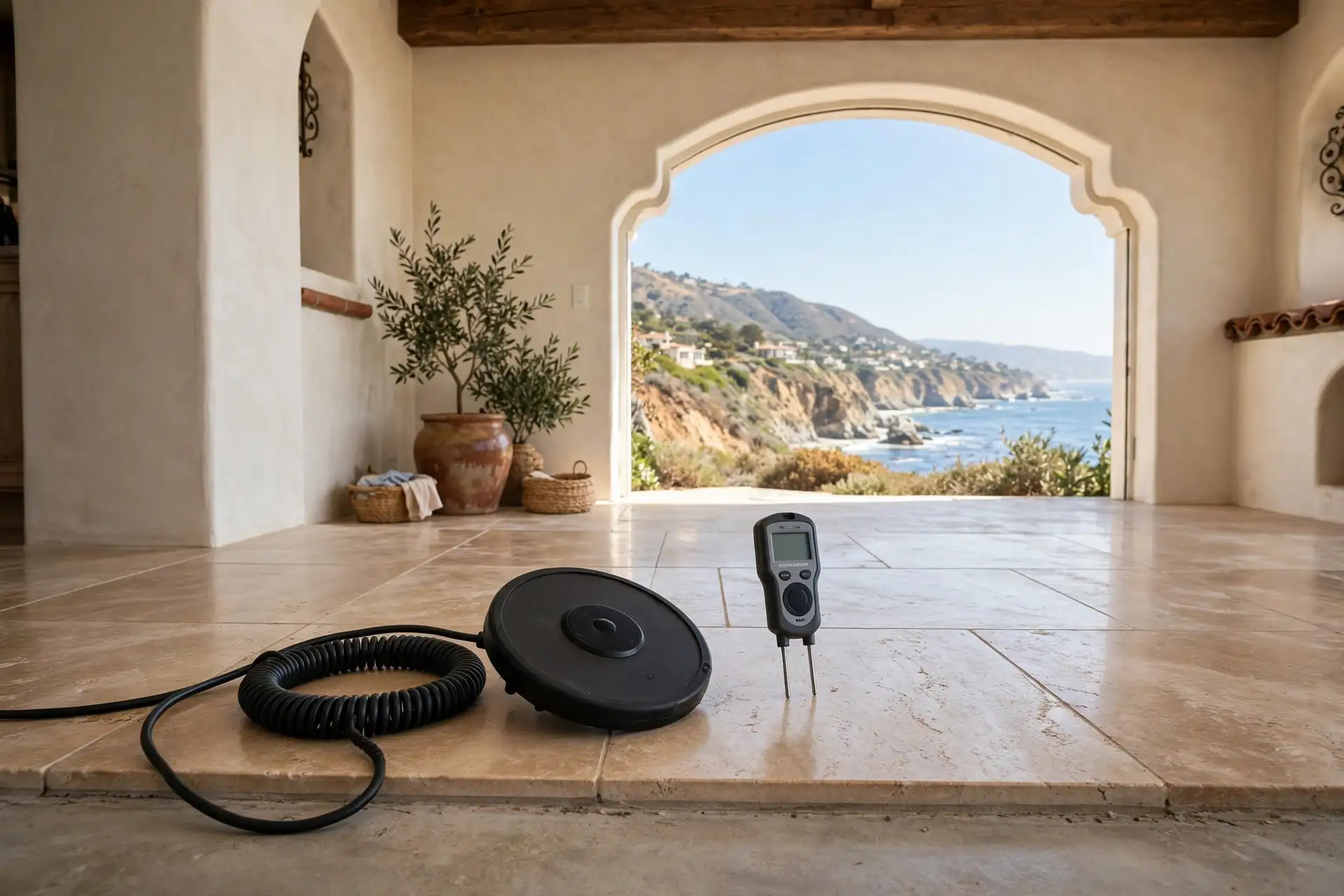
What you won't get is a jackhammer on day one. Detection is a no-dig discipline: meter, pressure gauges, microphones, and a camera. If a previous company told you they need to open the floor "just to look," that's exactly the exploratory digging electronic methods were invented to replace. Still unsure whether it's a slab leak? That's exactly what the call is for: (833) 713-2101.
Local Notes for Palos Verdes Estates 90274
The 90274 ZIP covers Palos Verdes Estates' master-planned neighborhoods — Malaga Cove with its 1920s–30s Spanish and Mediterranean Revival homes around Malaga Cove Plaza, plus the Lunada Bay, Montemalaga, and Valmonte tracts that filled in through the 1940s–60s. Palos Verdes Drive West and Palos Verdes Drive North are the main routes; Via Chico winds through the bluff neighborhoods. You'll know the Neptune Fountain, Malaga Cove Library, and the Palos Verdes Golf Club. Foundation types here are mixed: raised foundations in the pre-war stock, slab-on-grade in the postwar tracts — and that mix is the first thing we sort out on a call.
Before anything else, find out whether your home sits on a raised foundation or a slab — in Palos Verdes Estates the answer genuinely varies by block and era, and it changes the whole job. If your home still has original 1920s–40s galvanized, treat any pressure drop as urgent: that pipe doesn't have another decade in it. And on bluff-edge lots, don't assume dampness is a leak or assume a leak is dampness — that's exactly what the meter test is for. Call (833) 713-2101 and we'll start with the era and the meter.
How this works: you call our line, we match you with a slab-leak specialist who serves 90274 — no fee for the call itself. Questions about slab leak detection in the 90274 ZIP? Call (833) 713-2101.
Suspect a Slab Leak? Talk to a Specialist Today
One call connects you with a local slab leak professional serving Rancho Palos Verdes, CA — day or night.
Call (833) 713-2101Frequently Asked Questions
My Palos Verdes Estates home was built in the 1920s. Is it even a slab leak?
Maybe not — and that's the first thing Slab Leak Detection establishes here. Pre-war homes in Malaga Cove and the older tracts often sit on raised foundations, which means the leak may be under the floor in a crawlspace rather than under a slab — a different, usually simpler job. We'll ask about your home's era and foundation on the call, because the diagnostic path splits there. Call (833) 713-2101 with your best guess at the build year and we'll take it from there.
Why does excavation cost more on bluff-side lots?
Terraced lots mean equipment access is tight, shoring is real, and every foot of digging fights the grade. On a flat lot, opening an extra few feet of concrete is an annoyance; on a Malaga Cove terrace it's a significant cost. That's the economic argument for electronic pinpointing here: the location visit is cheap insurance against exploratory digging on a hillside.
My home was re-piped in the 1990s. Am I in the clear?
Clearer, not clear. A 1990s re-pipe moved you from century-old galvanized to copper with a fresh clock — but that copper is now 30-plus years into its own life, and under-slab or in-slab runs still age. Slab Leak Detection treats a re-piped home like any other: the meter test doesn't care when the pipe was installed, only whether it's holding pressure today.
Does the fog really affect plumbing, or is that just weather talk?
It affects diagnosis, which amounts to the same thing. Year-round marine-layer fog drip keeps bluff soils perpetually damp, and that dampness is what mimics slab leaks — cool, musty floors with no pipe failure behind them. It doesn't corrode buried copper faster in any meaningful way, but it means Slab Leak Detection in 90274 always starts by ruling moisture out. Skip that step and you'll chase ghosts.
How long does a typical detection visit take in Palos Verdes Estates?
Most visits run one to two hours on site, plus the phone triage beforehand. 1920s–1960s homes ranging from Spanish Revival originals to postwar tract houses — the meter test and pressure isolation are quick; the acoustic and thermal survey takes the time it takes. What stretches a visit in the 90274 ZIP is usually access: rooms that need clearing, or a water heater tucked somewhere awkward. We'll tell you what to have ready when we schedule.
My water meter spins but I can't find any water. Is that a slab leak?
It's the single most common way a slab leak announces itself in Palos Verdes Estates: the meter moves with every fixture off, but nothing is visibly wet — because the water is escaping under the slab, into the soil. vintage galvanized at 90–100 years fails from the inside out, while bluff-edge moisture mimics supply leaks from the outside in — detection has to establish pipe material and foundation type before it establishes anything else Either way, a spinning meter with dry fixtures is worth a detection visit. It's the cheapest way to get a yes or no.
What if the tests show it isn't a slab leak after all?
Then the visit still did its job — it kept you from paying for concrete work you didn't need. In Palos Verdes Estates, the usual alternatives are bluff-edge moisture — fog drip keeps these soils damp year-round, and that dampness wicks into slabs in ways that look exactly like a supply-line leak. We'll tell you what the evidence points to and who actually handles that kind of problem, rather than inventing a slab leak to sell a repair.