Slab Leak Detection in Hawthorne 90250, CA
Slab Leak Detection in Hawthorne 90250, CA — non-destructive testing that confirms whether a hidden leak exists under your concrete slab — and which line it's on — before anyone talks about breaking concrete.
In Short
Slab Leak Detection in Hawthorne 90250, CA — non-destructive testing that confirms whether a hidden leak exists under your concrete slab — and which line it's on — before anyone talks about breaking concrete. Serving the 90250 ZIP: meter test, pressure isolation, acoustic listening, thermal imaging. First step when you call (833) 713-2101: a guided five-minute meter check.
What the Detection Visit Looks Like in Hawthorne (90250)
A detection visit in Hawthorne is methodical, not dramatic. Nobody brings a jackhammer on day one — the whole point is to avoid one. Here's the sequence, and how 90250's conditions shape each step.
What to Expect When We Come Out to Hawthorne
Plan on someone being home for the visit — we need access to the rooms above the suspected area, the water heater, and the main shutoff. Move what you can away from the walls where the listening happens; the equipment is sensitive and the visit goes faster in a quiet house. multifamily visits need the manager and building access arranged ahead — the diagnostic can't start at a locked door
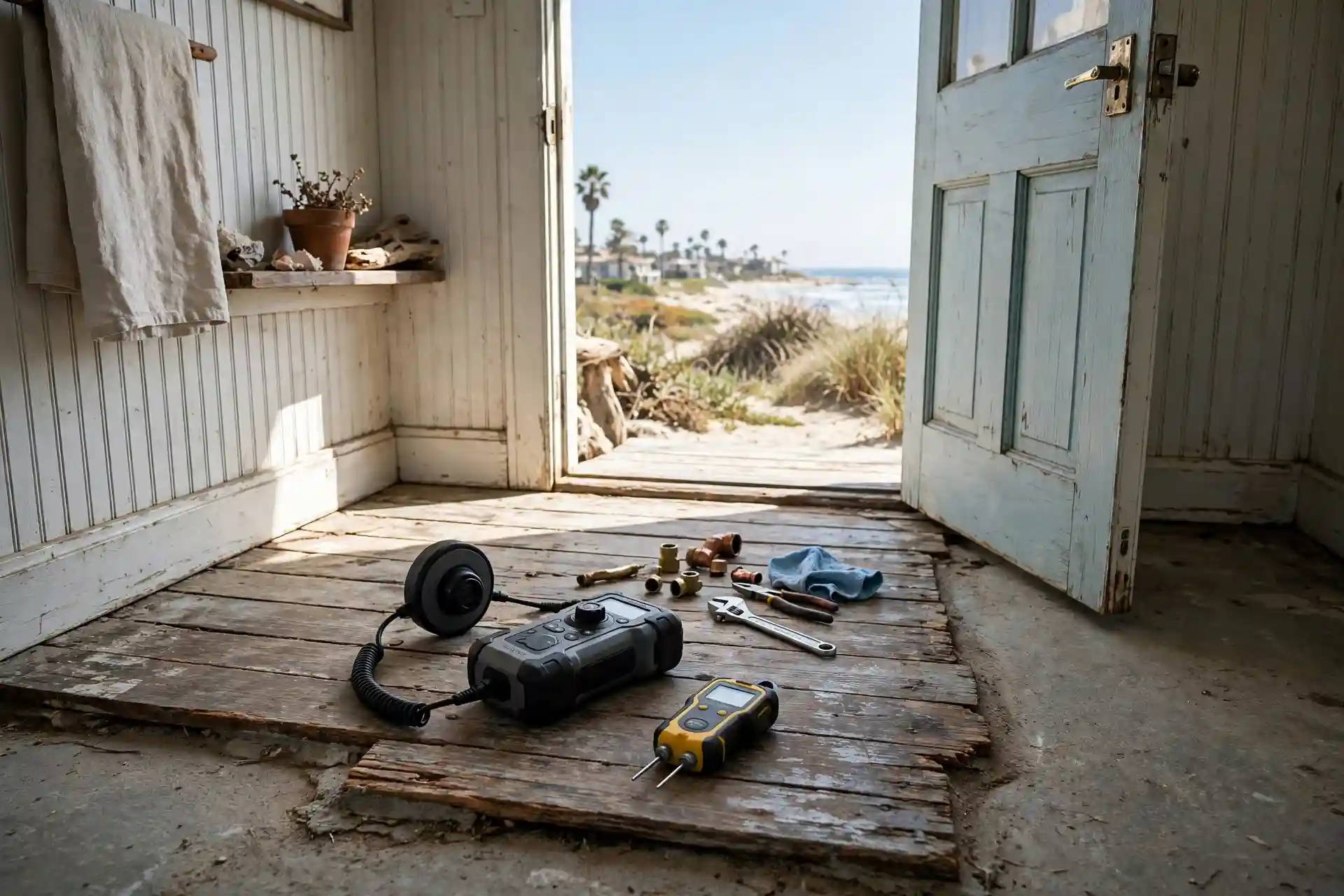
What you won't get is a jackhammer on day one. Detection is a no-dig discipline: meter, pressure gauges, microphones, and a camera. If a previous company told you they need to open the floor "just to look," that's exactly the exploratory digging electronic methods were invented to replace. Still unsure whether it's a slab leak? That's exactly what the call is for: (833) 713-2101.
Local Notes for Hawthorne 90250
The 90250 ZIP covers Hawthorne's 1950s tract grids along Hawthorne Boulevard, Crenshaw Boulevard, and Inglewood Avenue, between the I-105 and I-405 corridors. The SpaceX headquarters and Hawthorne Municipal Airport (Jack Northrop Field) mark the industrial edge; Hollyglen and Del Aire are the named residential pockets. Housing is predominantly 1950s single-family slab tracts with dense multifamily infill — copper-and-galvanized pipe mix, cast-iron drains — on flat coastal-plain alluvium. The pre-1950 raised-foundation pockets hide among the tracts.
Hawthorne's one non-negotiable: verify the foundation type before anything else. If your home is 1940s or earlier, check for a crawlspace — a 1944 home with a floor furnace is almost certainly raised, not slab, and the 'slab leak' is really an under-floor leak with easier access and a smaller bill. Tract homeowners: 1950s copper at peak age means the standard vigilance — meter checks, warm floors, quick calls to (833) 713-2101. Multifamily managers: keep the shutoff map and our number together; coordination is the job here.
How this works: you call our line, we match you with a slab-leak specialist who serves 90250 — no fee for the call itself. Questions about slab leak detection in the 90250 ZIP? Call (833) 713-2101.
Slab or Raised Foundation? Getting Detection Right in Hawthorne 90250
Hawthorne's 1950s slab tracts are at peak failure age, but the 90250 ZIP still holds pockets of pre-1950 raised-foundation stock — the 1944 example on West 123rd Street is the pattern — and the first job of any detection visit here is confirming which foundation you're standing on. A raised foundation changes everything: the "slab leak" may be a visible crawlspace leak that no electronic equipment is needed to find, and fixing it costs a fraction of under-slab work. We verify foundation type before quoting anything.
Where the foundation is slab, the 1950s copper-and-galvanized mix is now 70 years old, and the signature call is the warm floor from a hot-line failure. One Hawthorne-specific lookalike to rule out first: old floor furnaces, common in the 1940s–50s stock, throw real heat through the floor and can fool a thermal camera. We confirm the furnace is off and the anomaly persists before the meter test even starts — chasing furnace heat with acoustic equipment is the classic wasted visit.
Dense multifamily along the Hawthorne Boulevard corridor adds the shared-line question: we isolate and pressure-test per unit before anyone talks about concrete, because a leak in a shared line bills one unit and damages another. For 1950s originals on slab, the honest advice is speed — a warm spot at 70-year copper age deserves same-week attention, because under-slab copper this old doesn't stabilize. Call and describe the symptoms; we'll tell you whether it fits the Hawthorne pattern.
Suspect a Slab Leak? Talk to a Specialist Today
One call connects you with a local slab leak professional serving Rancho Palos Verdes, CA — day or night.
Call (833) 713-2101Frequently Asked Questions
How do I know if my Hawthorne home is on a raised foundation?
Look for the signs: a visible crawlspace access, the house sitting above grade on a stem wall, or a floor furnace — the 1940s Hawthorne homes with floor furnaces are the classic raised-foundation profile. If the walls meet the ground with no crawlspace, it's slab. Slab Leak Detection starts here because the jobs diverge completely: under-floor leaks are accessed from the crawlspace, slab leaks from above. Call (833) 713-2101 with your best guess and we'll confirm before dispatching the right approach.
Why does the foundation type change the cost so much?
Access. A raised-foundation leak is reached through a crawlspace — no concrete cutting, no flooring restoration, often a straightforward pipe fix with simpler access. A slab leak needs detection, pinpointing, concrete work, and patching. Same symptom (water where it shouldn't be), very different jobs. That's why Slab Leak Detection in 90250 always establishes the foundation first: quoting a slab repair for a crawlspace leak — or vice versa — is the most expensive mistake in this ZIP.
Are the 1950s tracts in Hawthorne at the same risk as Torrance's?
Essentially identical — same decade, same copper-and-galvanized mix, same flat coastal plain, same 70-year corrosion math. Hawthorne's 1950s tracts are at peak failure age right now, full stop. The differentiators are the multifamily density (more shared-line complexity) and the pre-1950 pockets (the foundation trap). For a standard 1950s tract home, Slab Leak Detection here is the same straightforward, high-value visit it is in Torrance.
What are Hollyglen and Del Aire like for slab leaks?
Variations on the theme: established residential pockets with their own micro-character, but the same 1950s-era plumbing fundamentals as the rest of 90250. Slab Leak Detection doesn't change by pocket — the meter test is the meter test. Mention your pocket when you call (833) 713-2101 mainly so we route efficiently; diagnostically, Hollyglen copper fails like Hawthorne copper.
How long does a typical detection visit take in Hawthorne?
Most visits run one to two hours on site, plus the phone triage beforehand. 1950s slab tracts at peak failure age, plus dense multifamily — with pre-1950 raised-foundation pockets still present — the meter test and pressure isolation are quick; the acoustic and thermal survey takes the time it takes. What stretches a visit in the 90250 ZIP is usually access: rooms that need clearing, or a water heater tucked somewhere awkward. We'll tell you what to have ready when we schedule.
My water meter spins but I can't find any water. Is that a slab leak?
It's the single most common way a slab leak announces itself in Hawthorne: the meter moves with every fixture off, but nothing is visibly wet — because the water is escaping under the slab, into the soil. the 1950s tracts are at peak failure age and the multifamily stock means one leak can affect several units — but the pre-1950 pockets (1940s homes with floor furnaces, raised foundations) are a standing trap: confirm the foundation type before quoting anything Either way, a spinning meter with dry fixtures is worth a detection visit. It's the cheapest way to get a yes or no.
What if the tests show it isn't a slab leak after all?
Then the visit still did its job — it kept you from paying for concrete work you didn't need. In Hawthorne, the usual alternatives are the raised-foundation pocket — a 1940s home with a floor furnace and a crawlspace doesn't have a slab leak at all, and treating it like one wastes everyone's time. We'll tell you what the evidence points to and who actually handles that kind of problem, rather than inventing a slab leak to sell a repair.