Slab Leak Detection in Gardena 90247, CA
Slab Leak Detection in Gardena 90247, CA — non-destructive testing that confirms whether a hidden leak exists under your concrete slab — and which line it's on — before anyone talks about breaking concrete.
In Short
Slab Leak Detection in Gardena 90247, CA — non-destructive testing that confirms whether a hidden leak exists under your concrete slab — and which line it's on — before anyone talks about breaking concrete. Serving the 90247 ZIP: meter test, pressure isolation, acoustic listening, thermal imaging. First step when you call (833) 713-2101: a guided five-minute meter check.
What the Detection Visit Looks Like in Gardena (90247)
A detection visit in Gardena is methodical, not dramatic. Nobody brings a jackhammer on day one — the whole point is to avoid one. Here's the sequence, and how 90247's conditions shape each step.
What to Expect When We Come Out to Gardena
Plan on someone being home for the visit — we need access to the rooms above the suspected area, the water heater, and the main shutoff. Move what you can away from the walls where the listening happens; the equipment is sensitive and the visit goes faster in a quiet house. property managers: have the owner's authorization path ready — the visit stalls when nobody can approve the next step
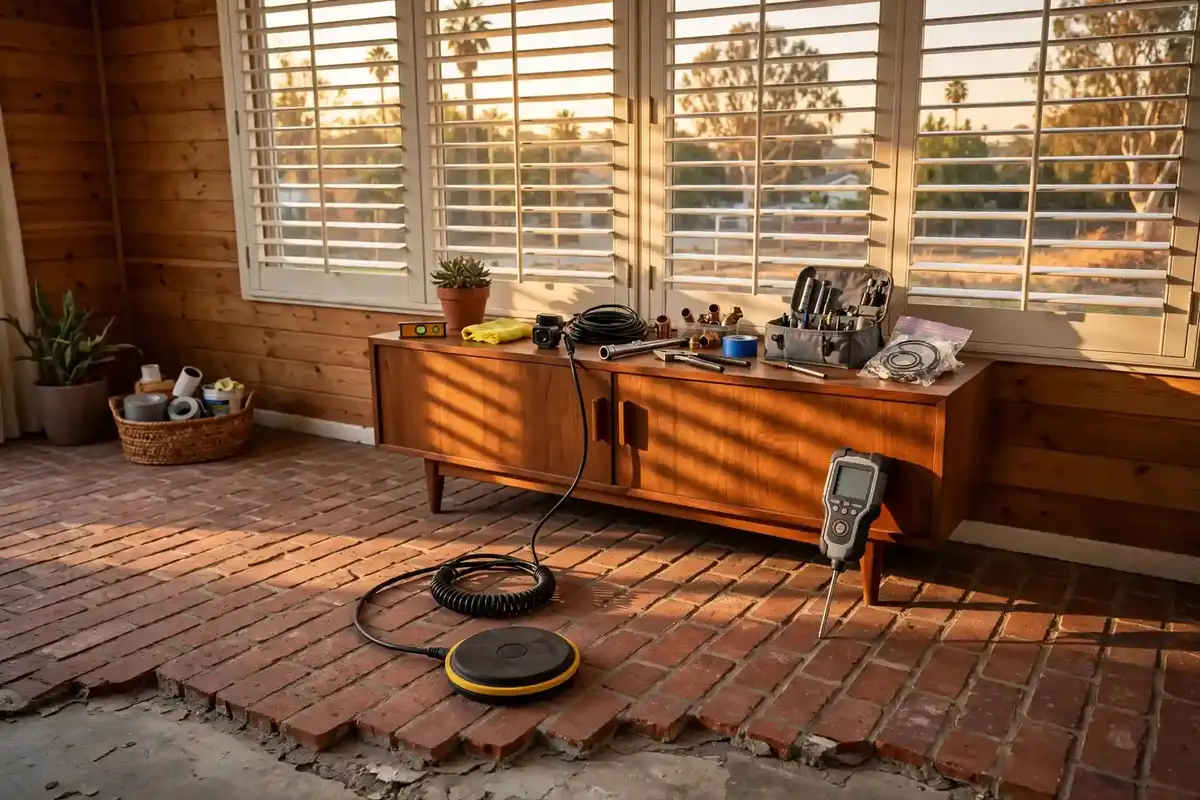
What you won't get is a jackhammer on day one. Detection is a no-dig discipline: meter, pressure gauges, microphones, and a camera. If a previous company told you they need to open the floor "just to look," that's exactly the exploratory digging electronic methods were invented to replace. Questions before you book? Call (833) 713-2101 — we'd rather answer them now than discover them mid-visit.
Local Notes for Gardena 90247
Central Gardena fills the 90247 ZIP: Vermont Avenue, Western Avenue, Redondo Beach Boulevard, and Artesia Boulevard frame the grid, with the I-110, SR-91, and I-405 corridors at the edges. The Gardena Bowl, the Gardena Valley Japanese Cultural Institute, and the post offices on Redondo Beach Boulevard and Gardena Boulevard are local anchors. Housing is 1940s–1960s postwar single-family and multifamily on flat alluvial soil at about 49 feet of elevation — slab foundations throughout, the galvanized-to-copper pipe mix, cast-iron drains.
Gardena property owners and managers: the economics here punish delay more than anywhere else in the service area, because late discovery converts pipe repairs into restoration projects. Put together a property file for each rental — shutoff location, build era, our number (833) 713-2101 — and tell tenants the three symptoms (warm floor, running-water sound, bill spike) in plain language. Tenants: reporting early protects your deposit and your living conditions alike. A two-minute meter check quarterly is the cheapest building maintenance there is.
We're a referral line: you talk to us, and we connect you with a slab-leak specialist serving the 90247 area. Questions about slab leak detection in the 90247 ZIP? Call (833) 713-2101.
Reading Late-Discovered Leaks in Gardena 90247
Gardena's 90247 housing stock is flat, dense, postwar single-family and small multifamily — the classic high-volume slab-leak profile. The twist is ownership: many small rental properties with absentee owners mean leaks run for weeks before anyone reports them, so detection here usually arrives after the damage has spread. The job splits in two: confirm an active leak is still running, and separate the fresh leak zone from old, dried damage. The meter test answers the first; thermal imaging answers the second, because old damage has gone cold.
Pressure isolation matters more than pinpoint acoustics in Gardena, because by the time we're called, the question is usually "how big" rather than "whether." A hot-side failure discovered late in a rental means warm water has been feeding the slab for a month — flooring and drywall damage follow, and slab-leak work in 90247 often pairs with mold remediation scope. We document the moisture spread with the thermal camera so the owner sees the full picture before authorizing anything, not after.
For landlords: a detection visit is cheap compared to what late discovery costs in 90247. Put the shutoff location and our number in every property file, and tell tenants the three symptoms — warm floor, running-water sound, jumping bill. Tenants who report early turn a pipe fix into a one-day job; tenants who wait turn it into a flooring job. If you're staring at damage now, call and we'll confirm whether the leak is active before you spend on restoration.
Suspect a Slab Leak? Talk to a Specialist Today
One call connects you with a local slab leak professional serving Rancho Palos Verdes, CA — day or night.
Call (833) 713-2101Frequently Asked Questions
Why is mold such a frequent part of Gardena slab-leak calls?
Time. Absentee ownership means leaks run for weeks or months before discovery, and persistent under-slab moisture plus Southern California warmth is the mold recipe. By the time a 90247 leak gets reported, the moisture has often been feeding growth behind baseboards and under flooring for a while. Slab Leak Detection finds the pipe failure; the mold scope is a separate remediation question we'll flag honestly. Early reporting is the only prevention — there's no product that substitutes for it.
Does late discovery change the repair itself?
It changes the scope around the repair, not the pipe fix. The break gets fixed the same way; but weeks of saturation mean the flooring, baseboards, drywall, and sometimes framing need assessment too. Slab Leak Detection pinpoints the actual break — which, after a long run, is often not at the center of the visible damage. That's precisely why pinpointing matters more here: it keeps the pipe repair targeted while the restoration scope gets its own honest estimate.
Are Gardena's pipes worse than neighboring cities'?
Not worse — just older on average and observed less. The 1940s–60s postwar stock is the same era as much of the South Bay; what differs is the ownership pattern, not the metallurgy. A 1955 copper line in Gardena fails like a 1955 copper line in Torrance. The difference is that Torrance's owner-occupant calls at the warm floor, while Gardena's absentee-owner property calls at the mold. Same pipe, different timeline.
What can tenants do if the landlord is slow to act?
Document everything: dates, photos of the symptoms, your written reports to the landlord or manager, and meter readings if you can get them. Keep reporting in writing. Slab Leak Detection can diagnose the problem — call (833) 713-2101 — but authorization for the repair follows the property's chain. Written documentation protects you and creates the record that gets slow situations moving. Don't stop reporting because the first report went nowhere.
Will you have to break my concrete to find the leak?
No. Detection is deliberately non-destructive — that's its whole job. We find the leak's line and its general location with meters, pressure, sound, and heat. Concrete only gets discussed after detection, when the repair plan is being chosen, and even then the goal is the smallest possible opening. If someone wants to cut first and diagnose second, that's backwards.
My water meter spins but I can't find any water. Is that a slab leak?
It's the single most common way a slab leak announces itself in Gardena: the meter moves with every fixture off, but nothing is visibly wet — because the water is escaping under the slab, into the soil. many small rental properties with absentee owners mean leaks run longer before detection — so 90247 calls skew toward bigger damage (mold, flooring loss) than owner-occupied cities, and the diagnostic question is often 'how long has this been running' as much as 'where is it' Either way, a spinning meter with dry fixtures is worth a detection visit. It's the cheapest way to get a yes or no.
What if the tests show it isn't a slab leak after all?
Then the visit still did its job — it kept you from paying for concrete work you didn't need. In Gardena, the usual alternatives are long-ignored maintenance issues — in absentee-owner rentals, years of small plumbing neglect can mask the moment a slab leak actually begins. We'll tell you what the evidence points to and who actually handles that kind of problem, rather than inventing a slab leak to sell a repair.