Slab Leak Detection in El Segundo 90245, CA
Slab Leak Detection in El Segundo 90245, CA — non-destructive testing that confirms whether a hidden leak exists under your concrete slab — and which line it's on — before anyone talks about breaking concrete.
In Short
Slab Leak Detection in El Segundo 90245, CA — non-destructive testing that confirms whether a hidden leak exists under your concrete slab — and which line it's on — before anyone talks about breaking concrete. Serving the 90245 ZIP: meter test, pressure isolation, acoustic listening, thermal imaging. First step when you call (833) 713-2101: a guided five-minute meter check.
What the Detection Visit Looks Like in El Segundo (90245)
A detection visit in El Segundo is methodical, not dramatic. Nobody brings a jackhammer on day one — the whole point is to avoid one. Here's the sequence, and how 90245's conditions shape each step.
What to Expect When We Come Out to El Segundo
Plan on someone being home for the visit — we need access to the rooms above the suspected area, the water heater, and the main shutoff. Move what you can away from the walls where the listening happens; the equipment is sensitive and the visit goes faster in a quiet house. if you're east of Sepulveda in the older blocks, say so — that's the highest-risk stock in the ZIP and it calibrates our urgency
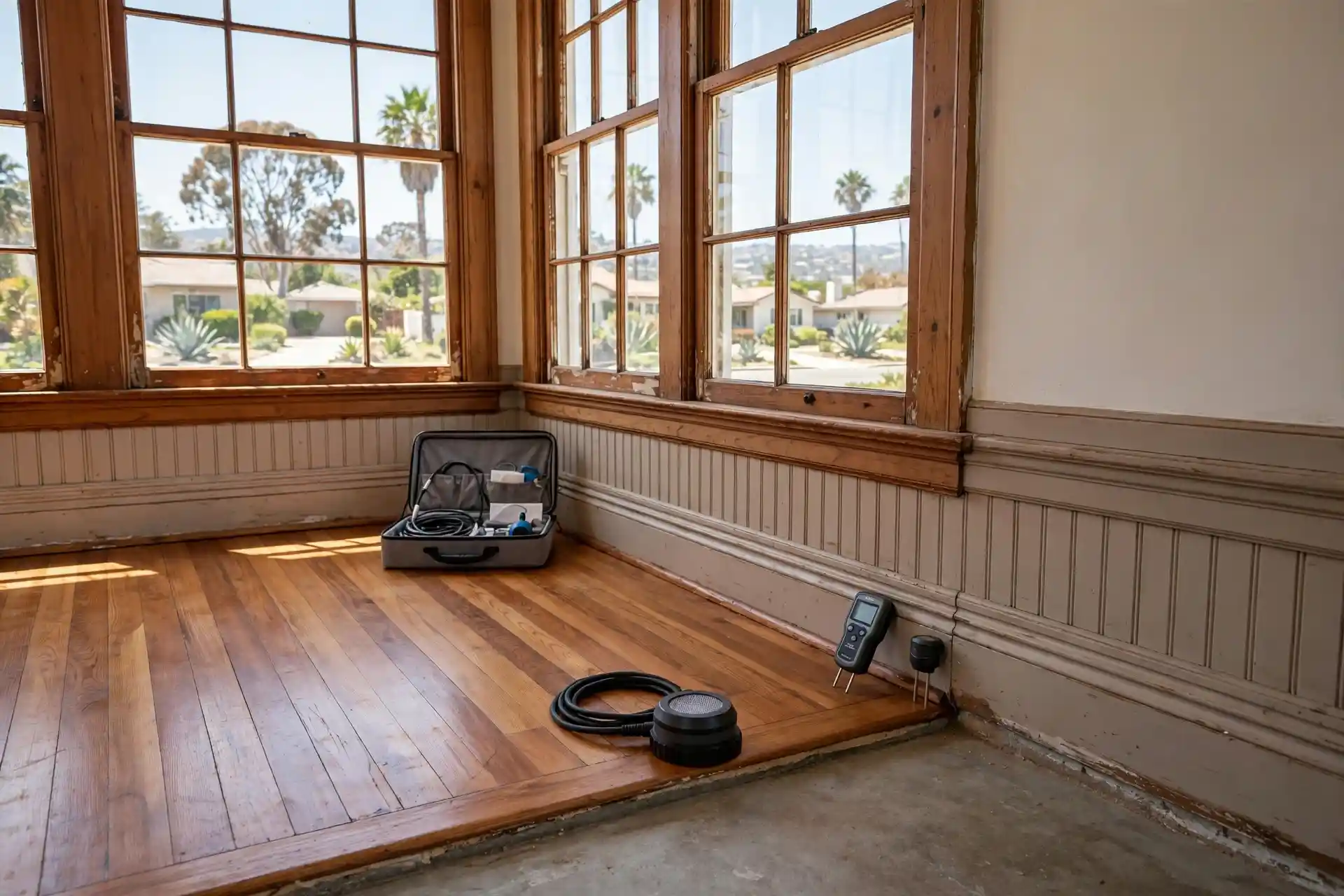
What you won't get is a jackhammer on day one. Detection is a no-dig discipline: meter, pressure gauges, microphones, and a camera. If a previous company told you they need to open the floor "just to look," that's exactly the exploratory digging electronic methods were invented to replace. Still unsure whether it's a slab leak? That's exactly what the call is for: (833) 713-2101.
Local Notes for El Segundo 90245
The 90245 ZIP covers El Segundo from the beach to the inland edge: Sepulveda Boulevard as the spine, El Segundo Boulevard, Rosecrans Avenue, and Imperial Highway framing the 1950s residential blocks. LAX sits at the northern edge; the Northrop Grumman and Raytheon campuses and the Chevron refinery mark the employment landscape; El Segundo Beach and The Point anchor the west side. Housing is 1950s single-family — the aerospace-company-town stock — on coastal dune sand, slab-on-grade, copper supply with cast-iron drains, plus newer multifamily near the beach.
El Segundo's east-of-Sepulveda blocks deserve inland-Torrance-plus urgency: same 1950s copper, harder soil and air, earlier failures. If your home is a 1950s original in those blocks, treat the symptoms the way Torrance treats 1960s homes — the salt air has been advancing your pipe's calendar for decades. And in dune sand, never trust a damp spot's location: water travels, and the break is found with sensors, not eyes. Call (833) 713-2101 at the first warm floor or meter movement — the timeline here doesn't reward waiting.
How this works: you call our line, we match you with a slab-leak specialist who serves 90245 — no fee for the call itself. Questions about slab leak detection in the 90245 ZIP? Call (833) 713-2101.
Salt Air, Sandy Soil, and Fast Copper Corrosion: Detection in El Segundo 90245
El Segundo’s coastal dunes make detection behave differently than on clay or rock. Loose sand absorbs acoustic energy, so the hiss of a pressurized leak doesn’t carry far underfoot, and pinpointing takes slower, tighter sensor work. What sand does well is thermal: a hot-line leak paints a crisp warm anomaly because dry sand around it holds no heat of its own. The local X factor is salt air — it pits 1950s copper from the outside in, and El Segundo copper fails younger than the same pipe inland.
The older residential blocks east of Sepulveda Boulevard, near the refinery, hold the highest-risk stock in 90245: 1950s copper under slab now 70-plus years into a service life that salt air has been shortening from day one. Detection here always starts with the pressure test rather than the thermal camera, because pitted copper can weep from several points at once, and a single warm spot can mislead. We isolate hot from cold, then map every pressure loss — one visit, full inventory.
If you live east of Sepulveda and your bill has crept up over months without drama — no warm floor, no sound — that slow creep fits pinhole copper weeping into thirsty sand that drains away before it surfaces. Beachside multifamily is newer and rarely calls; the action is in the older blocks. Describe what you're seeing and we'll tell you whether the pattern fits El Segundo's salt-air copper profile before anyone schedules a visit.
Suspect a Slab Leak? Talk to a Specialist Today
One call connects you with a local slab leak professional serving Rancho Palos Verdes, CA — day or night.
Call (833) 713-2101Frequently Asked Questions
Why does El Segundo copper fail faster than Torrance copper?
Environment. Same 1950s copper, but El Segundo's is buried in sandy soil breathing salt air — and that combination accelerates outside-in corrosion compared to Torrance's inland alluvium. The metallurgy is identical; the exposure isn't. Practically, it means the failure timeline here runs ahead: treat 1950s El Segundo copper the way you'd treat 1960s copper inland. Slab Leak Detection reads the same everywhere, but the urgency calibration is local.
Which part of El Segundo is highest-risk?
The older residential blocks east of Sepulveda, near the refinery — that's the 1950s company-town stock in the saltiest, sandiest conditions. The beachside multifamily is newer construction with modern materials and much lower risk. When you call (833) 713-2101, mention which side of Sepulveda you're on — it's the fastest risk calibration in the ZIP.
Does the sand make leaks harder to find?
It makes them harder to eyeball and fine for electronics. Dune sand lets water travel far from the break, so visual location fails — the damp spot misleads. But sand transmits acoustic signals well, and thermal imaging reads the temperature anomaly cleanly. Slab Leak Detection in 90245 leans on sensors over sight as a matter of policy: we find the break, not the puddle's last known address.
Is the refinery a factor in pipe corrosion?
Not directly — the corrosion driver is salt air and sandy soil, not the refinery's presence. The refinery matters as a landmark for locating the oldest, highest-risk residential blocks east of Sepulveda, not as a chemical factor in your pipes. Slab Leak Detection cares about your soil, your air, and your pipe's age — the industrial backdrop is geography, not chemistry.
How long does a typical detection visit take in El Segundo?
Most visits run one to two hours on site, plus the phone triage beforehand. 1950s aerospace-company-town homes — with the oldest residential blocks east of Sepulveda near the refinery — the meter test and pressure isolation are quick; the acoustic and thermal survey takes the time it takes. What stretches a visit in the 90245 ZIP is usually access: rooms that need clearing, or a water heater tucked somewhere awkward. We'll tell you what to have ready when we schedule.
Will you have to break my concrete to find the leak?
No. Detection is deliberately non-destructive — that's its whole job. We find the leak's line and its general location with meters, pressure, sound, and heat. Concrete only gets discussed after detection, when the repair plan is being chosen, and even then the goal is the smallest possible opening. If someone wants to cut first and diagnose second, that's backwards.
My water meter spins but I can't find any water. Is that a slab leak?
It's the single most common way a slab leak announces itself in El Segundo: the meter moves with every fixture off, but nothing is visibly wet — because the water is escaping under the slab, into the soil. 1950s copper in sandy, salt-air soil corrodes faster than the same vintage in inland Torrance — the oldest blocks east of Sepulveda, near the refinery, hold the highest-risk stock, while the beachside multifamily is newer and lower-risk Either way, a spinning meter with dry fixtures is worth a detection visit. It's the cheapest way to get a yes or no.