Slab Leak Detection in Carson 90745, CA
Slab Leak Detection in Carson 90745, CA — non-destructive testing that confirms whether a hidden leak exists under your concrete slab — and which line it's on — before anyone talks about breaking concrete.
In Short
Slab Leak Detection in Carson 90745, CA — non-destructive testing that confirms whether a hidden leak exists under your concrete slab — and which line it's on — before anyone talks about breaking concrete. Serving the 90745 ZIP: meter test, pressure isolation, acoustic listening, thermal imaging. First step when you call (833) 713-2101: a guided five-minute meter check.
What the Detection Visit Looks Like in Carson (90745)
A detection visit in Carson is methodical, not dramatic. Nobody brings a jackhammer on day one — the whole point is to avoid one. Here's the sequence, and how 90745's conditions shape each step.
What to Expect When We Come Out to Carson
Plan on someone being home for the visit — we need access to the rooms above the suspected area, the water heater, and the main shutoff. Move what you can away from the walls where the listening happens; the equipment is sensitive and the visit goes faster in a quiet house. know roughly where your service line runs from the meter to the house — even a guess helps us plan the isolation sequence
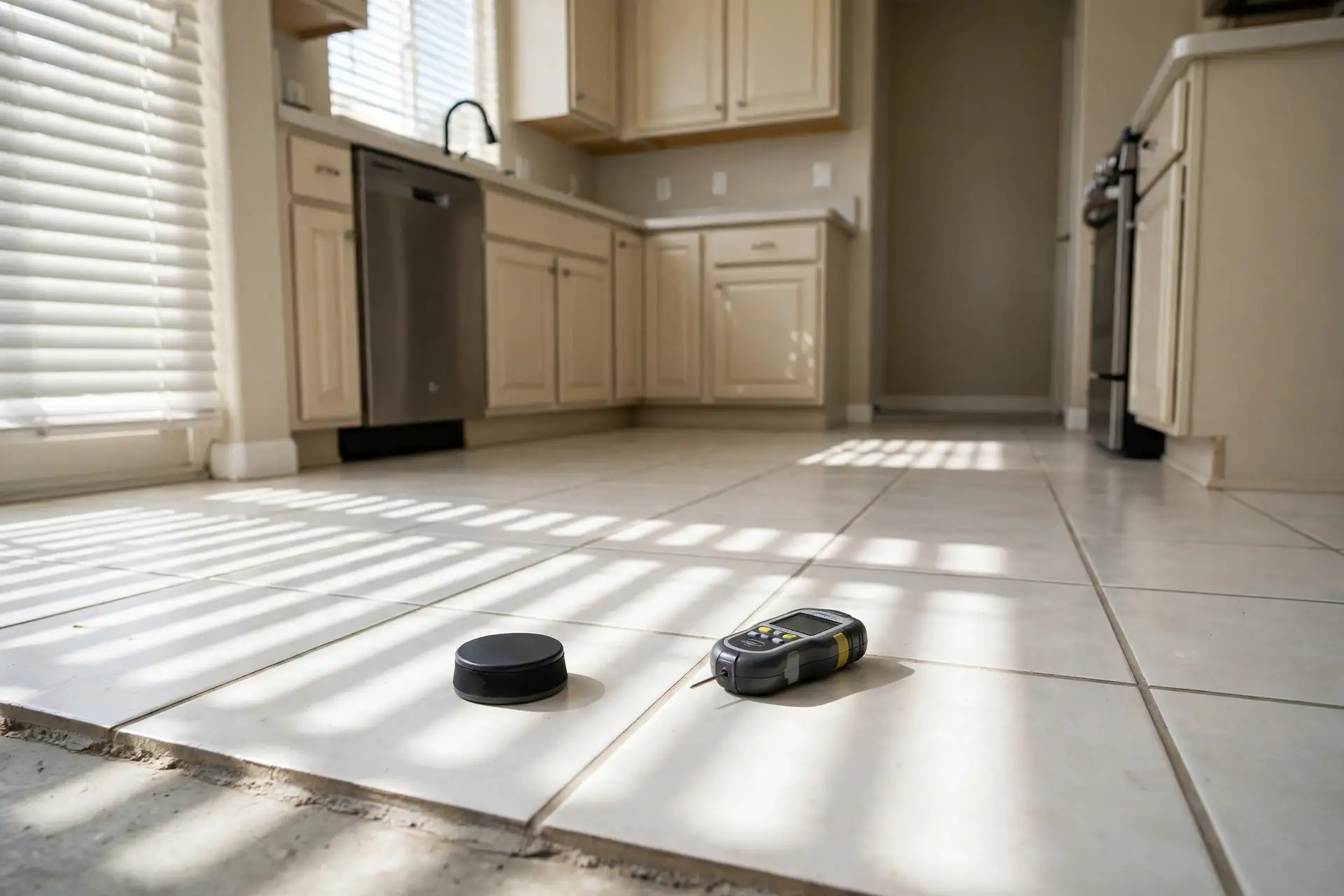
What you won't get is a jackhammer on day one. Detection is a no-dig discipline: meter, pressure gauges, microphones, and a camera. If a previous company told you they need to open the floor "just to look," that's exactly the exploratory digging electronic methods were invented to replace. Still unsure whether it's a slab leak? That's exactly what the call is for: (833) 713-2101.
Local Notes for Carson 90745
The 90745 ZIP covers Carson's postwar tract neighborhoods along Avalon Boulevard, Main Street, Carson Street, and the I-405/I-110 corridors. Landmarks: the Dignity Health Sports Park stadium complex, SouthBay Pavilion, and Cal State Dominguez Hills. Housing is 1950s–1970s single-family tracts on flat lots with shared fence lines — slab-on-grade throughout, copper in the later tracts and galvanized in the earliest, with cast-iron or ABS drains. The flat alluvial plain and high water table in low areas set the corrosion conditions.
Carson homeowners: the single most useful thing you can do is learn the path of your service line from the meter to the house. When a leak call comes in, the first fork in the diagnosis is yard versus slab — and knowing the service run's path speeds that fork enormously. After heavy rain, remember the low areas saturate and mimic symptoms; the meter test with the irrigation off is the arbiter. If your tract is 1950s–60s original, you're at peak age — treat the early symptoms with respect. Call (833) 713-2101 and mention the tract era.
How this works: you call our line, we match you with a slab-leak specialist who serves 90745 — no fee for the call itself. Questions about slab leak detection in the 90745 ZIP? Call (833) 713-2101.
When the Water Table Makes Listening Hard: Detection in Carson 90745
Carson sits on flat harbor-plain alluvium with a high water table, and saturated soil is the enemy of acoustic detection: groundwater conducts sound so well that a pinhole leak’s hiss dissolves into ambient noise. Meter testing and pressure isolation carry the real weight here — if the meter moves with every fixture off and the hot side won’t hold pressure, that means a leak whether the microphones hear it or not. Thermal imaging is the tiebreaker, because a warm floor anomaly reads cleanly even in noisy ground.
The housing stock splits into two risk bands: 1950s–60s tracts now at peak slab-leak age, and 1970s tracts just entering it. Either way, detection in Carson always tests the long meter-to-house service lines separately from the under-slab branches. Carson's shared-fence-line tract layouts stretch those service lines across long front yards, and the service line — not the slab — is a disproportionate share of "slab leak" calls here. Finding that out before concrete is considered saves a homeowner thousands.
The detection sequence here is meter first, pressure isolation second, thermal third, acoustic last — the reverse of the order used on dry ground. We also listen for the galvanized early stock's tell: interior corrosion that throttles flow, so a pressure drop with no visible water and no warm floor still points at the slab. If your Carson water bill climbed without a warm spot or the sound of running water, that pattern fits a galvanized pressure leak masked by high groundwater, and it's worth a detection visit.
Suspect a Slab Leak? Talk to a Specialist Today
One call connects you with a local slab leak professional serving Rancho Palos Verdes, CA — day or night.
Call (833) 713-2101Frequently Asked Questions
How do you tell a yard service-line leak from a slab leak?
Isolation. The meter test proves water is moving; then we isolate the house from the service line — if the meter stops when the house is valved off, the leak is in the yard run, not under the slab. In Carson's shared-fence-line tracts the service runs are long enough that this fork matters enormously: a yard leak is a trench in the landscaping, a slab leak is concrete work. Slab Leak Detection always runs this fork before any under-slab diagnosis. Guess wrong and you dig in the wrong place.
Are the 1970s Carson tracts at risk yet?
Entering it. 1970s copper is 50-plus years old — past the pinhole threshold in aggressive soil, not yet at the peak failure window of the 1950s–60s tracts. Think of the 1970s tracts as early-warning territory: the meter test is worth running at the first symptom, and a baseline detection visit is reasonable planning. The 1950s–60s tracts are the ones in the red zone right now.
Does the high water table affect the whole ZIP or just low areas?
Mostly the low areas — the water table follows the micro-topography, and Carson's flat plain has subtle lows where saturation persists. That's why Slab Leak Detection reads the lot: on higher tract ground the acoustic work is clean, in the lows it's smeared like Wilmington. Tell us if your street holds water after rain — it's a useful diagnostic clue, not just a drainage complaint.
What should I do before the visit if I suspect the service line?
Note where the ground is wettest along the meter-to-house path, check whether the wet area aligns with the service run, and make sure the meter box is accessible — we'll need it. Don't dig: a shovel through a pressurized service line turns a leak into a geyser. Slab Leak Detection will isolate yard versus slab in minutes with valves, not shovels. Call (833) 713-2101 and describe where the wetness sits relative to the meter.
How long does a typical detection visit take in Carson?
Most visits run one to two hours on site, plus the phone triage beforehand. 1950s–70s postwar tract homes on flat lots with shared fence lines — the meter test and pressure isolation are quick; the acoustic and thermal survey takes the time it takes. What stretches a visit in the 90745 ZIP is usually access: rooms that need clearing, or a water heater tucked somewhere awkward. We'll tell you what to have ready when we schedule.
Will you have to break my concrete to find the leak?
No. Detection is deliberately non-destructive — that's its whole job. We find the leak's line and its general location with meters, pressure, sound, and heat. Concrete only gets discussed after detection, when the repair plan is being chosen, and even then the goal is the smallest possible opening. If someone wants to cut first and diagnose second, that's backwards.
My water meter spins but I can't find any water. Is that a slab leak?
It's the single most common way a slab leak announces itself in Carson: the meter moves with every fixture off, but nothing is visibly wet — because the water is escaping under the slab, into the soil. the flat alluvial plain, high water table in low areas, and 1950s–60s tract stock give Carson the same corrosion-and-masking profile as Wilmington — plus long meter-to-house service lines that are themselves a common leak point and have to be ruled out first Either way, a spinning meter with dry fixtures is worth a detection visit. It's the cheapest way to get a yes or no.