Epoxy Pipe Lining in San Pedro, CA
Epoxy Pipe Lining in San Pedro, CA 90732 renews failing under-slab water lines — from the inside, sealing pinholes and corrosion with no excavation.
In Short
Epoxy Pipe Lining in San Pedro, CA 90732 renews failing under-slab water lines — from the inside, sealing pinholes and corrosion with no excavation. San Pedro's 1950s–70s hillside homes with copper at prime failure age are prime candidates. Call (833) 713-2101: first a symptom review with a specialist, then testing to confirm the leak.
Epoxy Pipe Lining in San Pedro 90732: What Local Homes Need to Know
San Pedro 90732 is the hillside counterpart to 90731's flats — Point Fermin, Cabrillo, White Point, and Vista del Oro, where 1950s–70s homes sit on coastal bluffs and terraced streets like Paseo del Mar. It is the second-most geotechnically sensitive area we serve, after Rancho Palos Verdes itself: slope drainage and bluff-edge moisture complicate every diagnosis, stepped slabs complicate repairs, and 1960s copper is at prime failure age with salt air shortening it further. Epoxy Pipe Lining here is planned around the hill, not in spite of it.
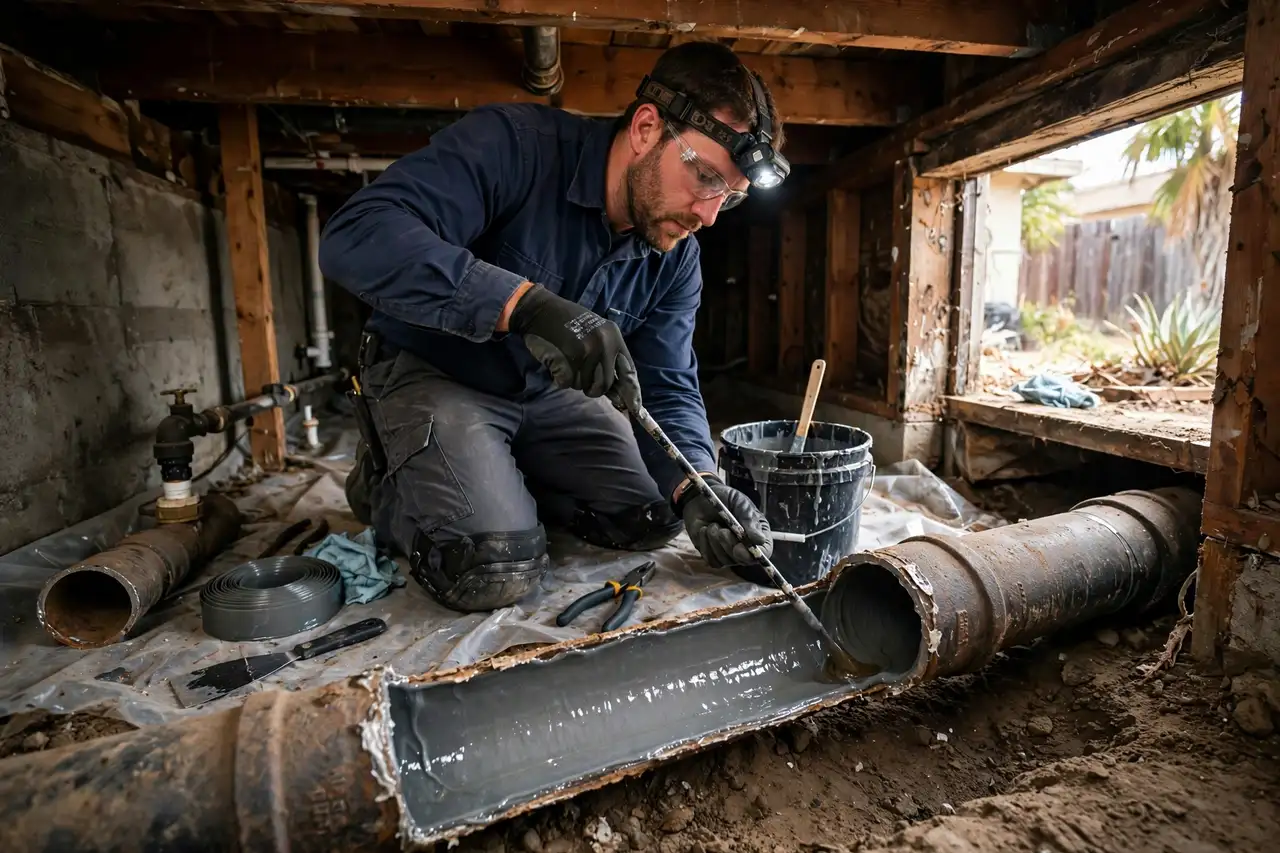
Epoxy pipe lining builds a new pipe inside the old one. After a camera inspection and a thorough cleaning, epoxy resin is applied to the interior wall of the existing line — either carried in on a liner that is inverted into the pipe, or applied directly onto the pipe wall — and cured until it hardens into a smooth, sealed barrier. Pinholes, pitting, and hairline cracks get covered from the inside, and the floor above never gets opened.
The appeal is direct: the pipe gets a new interior without a single trench or a lifted floor tile. In San Pedro 90732, where bluff-edge terraces make excavation awkward and risky, renewing the pipe from the inside is frequently the most sensible path available.
A note on how this works: Slab Leak Repair Experts is a referral service. When you call (833) 713-2101, we connect you with an independent local specialist serving San Pedro — the specialist performs the diagnosis and the repair, and you approve the plan before any work begins.
Request Service Today — describe your symptoms and get connected with a San Pedro specialist.
Why San Pedro Changes How This Repair Works
South and west San Pedro holds 1950s–1970s hillside single-family homes — 53.6% detached — on coastal bluffs with ocean exposure. Pipe stock is 1950s–70s copper with cast-iron or ABS drains, under slab-on-grade that is frequently stepped to follow the grade. The ground is bluff and hillside: slope-drainage pressure, terraced streets, bluff-edge erosion, salt air. Diagnosis has to separate three lookalikes — true pipe leaks, slope-drainage moisture, and bluff-edge seepage — and pressure testing is the arbiter. Repairs contend with stepped slabs and terraced access: excavation is awkward, tunneling follows grade badly, and every method gets planned around elevation changes. The copper itself is at prime failure age, and the marine exposure compresses the timeline.
Epoxy lining needs no excavation at all — the entire repair happens inside the pipe, which sidesteps both the terraced access problem and the bluff-edge disturbance question. For hillside copper with run-wide pitting, it is the lowest-impact answer available.
In San Pedro, epoxy lining earns its place wherever digging is difficult, destructive, or simply unnecessary — a sealed pipe with the slab untouched. The deciding factors never change: pipe integrity, access for the equipment, and an honest camera inspection before anyone commits.
How Epoxy Lining Works — Without Tearing Up Your Home
The lining process is methodical. First, electronic detection confirms the leak's location and a camera inspection maps the pipe's interior — material, diameter, and every defect. Next comes cleaning: descaling tools remove corrosion and buildup so the epoxy can bond to sound pipe wall. The line is then dried completely, because epoxy and moisture do not mix. Application follows — either a resin-saturated liner pulled or inverted into place, or epoxy applied directly onto the pipe wall — and then curing, which hardens the resin into a structural inner pipe. A final camera pass verifies coverage. The finished liner is slightly smaller in diameter than the original pipe, but the smooth epoxy surface typically restores flow. Access happens through existing cleanouts or small openings; there is no trench across your yard and no jackhammer in your hallway. Epoxy systems used on potable water lines are formulated for that purpose, and the specialist can explain the specific product and its ratings for your home.
A little preparation goes a long way: clear access to cleanouts, the water heater, and the water meter before the specialist arrives. The line must be taken out of service during cleaning and curing, so plan for a water-off window — the specialist will tell you how long your specific run needs. Note any prior lining or coating work on the pipes, and any chemical drain cleaners used recently; both affect how the pipe cleans and how the epoxy bonds. Honest history here prevents a failed bond later.
What Happens When You Call (833) 713-2101
Step 1: The Call
Call (833) 713-2101. You will reach our referral line, where we connect you with an independent local specialist serving San Pedro. Expect a few direct questions: warm spots on the floor, the sound of running water with taps off, a water bill that jumped, low pressure. Those answers tell the specialist what to test first.
Step 2: The Diagnosis
On site, the specialist pressure-tests, locates the leak electronically, and cameras the line. Lining lives or dies on this inspection: the pipe must be intact enough to host the epoxy, with no collapses or separations the resin cannot bridge.
Step 3: The Plan
You get a plain-language explanation of what was found and which repair paths fit — Epoxy Pipe Lining among them — before any work is authorized. No work starts on a guess.
When Epoxy Lining Isn't the Right Fix
Epoxy cannot save every pipe. Collapsed sections, major joint separations, and pipes deformed out of round are beyond what a liner can bridge. Heavy scale that cannot be fully cleaned will prevent bonding, and bellies that hold standing water need a different answer. If the camera shows failure across multiple runs rather than one bad section, lining each of them is rarely the sensible path — rerouting the supply system is usually the cleaner fix. Previous lining work can also complicate a second application. The camera inspection exists to catch all of this before resin is ever mixed.
Serving San Pedro 90732: Neighborhoods We Cover
Serving San Pedro 90732 — Point Fermin, Cabrillo, White Point, and Vista del Oro, along Gaffey Street, 25th Street, and Paseo del Mar, near the Point Fermin Lighthouse, Cabrillo Marine Aquarium, and the Korean Bell of Friendship. Hillside or bluff-edge lot? Lead with that when you call — the diagnostic builds drainage checks in from the start.
Suspect a Slab Leak? Talk to a Specialist Today
One call connects you with a local slab leak professional serving Rancho Palos Verdes, CA — day or night.
Call (833) 713-2101Frequently Asked Questions
Our bluff-edge home has damp floors. Pipe leak or bluff moisture?
In 90732 that is the defining diagnostic question — bluff-edge seepage and slope drainage mimic pipe leaks closely. Pressure testing and meter isolation give the definitive answer: pressurized-line loss means plumbing, holding pressure means groundwater. Insist on that test before any repair plan. Epoxy lining addresses exactly this kind of interior pipe damage without opening the floor above it.
What is a stepped slab and why does it matter?
Hillside 90732 homes often sit on slabs poured in levels following the grade. Stepped slabs complicate tunneling and excavation, but methods like Epoxy Lining — which work through the pipe path or interior routes — are largely unaffected. The diagnostic maps the slab before recommending anything. This is the core case for lining: the pipe's path stays, its interior gets renewed.
Our home was built in 1965. How urgent is this?
1960s copper is at prime failure age, and 90732's salt air compresses the timeline — pinhole leaks are expected, not surprising. Urgency depends on the leak's size and what the moisture is reaching, which the diagnostic establishes. Do not let it run: hillside moisture plus pipe water is a bad combination. A camera inspection confirms whether the pipe qualifies — lining needs an intact host pipe to bond to.
Can equipment reach our terraced street?
Terraced streets like Paseo del Mar complicate heavy excavation — another reason Epoxy Pipe Lining is the default here. Small access points or interior routes replace trenching. Describe your street's grade and parking when you call so the visit is planned correctly. Epoxy lining addresses exactly this kind of interior pipe damage without opening the floor above it.
Will the repair hold if the hill keeps moving?
Bluff-edge lots do shift, which is why the method matters: repairs locked into moving ground get re-stressed, while reroutes into the building envelope — or liners assessed against the lot's movement — are planned with the hill in mind. Raise the concern on the call; the specialist factors it into the recommendation. This is the core case for lining: the pipe's path stays, its interior gets renewed.
Is epoxy lining safe for drinking water?
Epoxy lining products used on potable water lines are formulated for that purpose, and the specialist can tell you the specific product and its ratings. The liner cures into an inert, sealed surface. If you want the product data sheet before authorizing work, ask — a straight answer is a good sign.
How much smaller does my pipe get after lining?
The liner takes up a small amount of the pipe's interior diameter. In practice, the smooth epoxy surface offsets the reduction — flow is typically restored because the rough, corroded interior it replaces was restricting flow anyway. The specialist can explain what to expect for your pipe's diameter.