Epoxy Pipe Lining in Palos Verdes Estates, CA
Epoxy Pipe Lining in Palos Verdes Estates, CA 90274 renews failing under-slab water lines — from the inside, sealing pinholes and corrosion with no excavation.
In Short
Epoxy Pipe Lining in Palos Verdes Estates, CA 90274 renews failing under-slab water lines — from the inside, sealing pinholes and corrosion with no excavation. Palos Verdes Estates's 1920s–60s homes with galvanized and aging copper are prime candidates. Call (833) 713-2101: first a symptom review with a specialist, then testing to confirm the leak.
Epoxy Pipe Lining in Palos Verdes Estates 90274: What Local Homes Need to Know
Palos Verdes Estates 90274 holds some of the oldest plumbing in the South Bay. The Spanish and Mediterranean Revival homes of Malaga Cove went up in the 1920s and 30s, and where the original galvanized steel and cast iron survive, it is now 90 to 100 years old — past end of life. Even homes that were re-piped onto or under slabs decades ago now carry aging copper. Add steep bluff-side lots where excavation is punishing, and Epoxy Pipe Lining becomes less a convenience than a necessity.
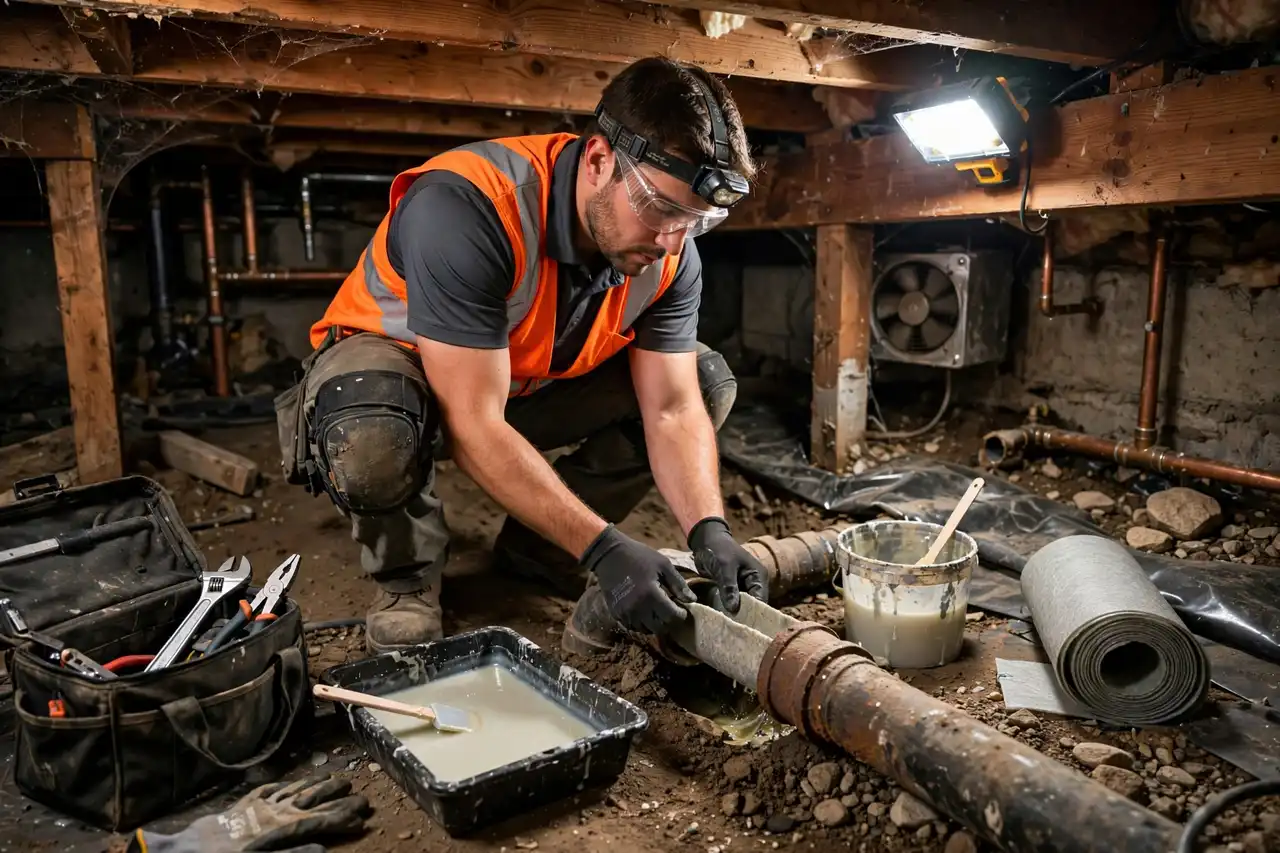
Epoxy pipe lining builds a new pipe inside the old one. After a camera inspection and a thorough cleaning, epoxy resin is applied to the interior wall of the existing line — either carried in on a liner that is inverted into the pipe, or applied directly onto the pipe wall — and cured until it hardens into a smooth, sealed barrier. Pinholes, pitting, and hairline cracks get covered from the inside, and the floor above never gets opened.
The appeal is direct: the pipe gets a new interior without a single trench or a lifted floor tile. In Palos Verdes Estates 90274, where steep bluff-side terraces make excavation punishing, renewing the pipe from the inside is frequently the most sensible path available.
How it works here: we are the connector, not the crew. Your call to (833) 713-2101 reaches our referral line, and we match you with an independent slab-leak specialist who works in Palos Verdes Estates 90274. The specialist diagnoses, you approve the plan, and only then does work start.
Prefer to talk it through? Book Service and tell us what you are seeing in your Palos Verdes Estates home.
Why Palos Verdes Estates Changes How This Repair Works
The city was master-planned in 1923, and its housing stock spans a century: 1920s–30s Malaga Cove, 1940s–60s tracts in Lunada Bay, Montemalaga, and Valmonte. Pipe materials follow the eras — galvanized supply and cast-iron drains in the pre-war stock, copper in the postwar tracts. Foundations are mixed too: raised in the oldest homes, slab-on-grade in the postwar tracts, so the first job on any call is confirming what is actually under the house. The ground is Monterey shale bedrock with coastal-bluff terrace soils, and the steep bluff lots in Malaga Cove and Lunada Bay make excavation access genuinely hard — digging on terraces is slow, which raises the premium on detection precision. Bluff-edge moisture and fog drip can also mimic slab-leak symptoms, so diagnosis has to separate groundwater from pipe water.
For the 1920s–40s galvanized and the aging re-pipe copper alike, epoxy lining seals interior corrosion without opening floors in homes where every surface — tile, hardwood, stone — is difficult to restore. In vintage homes, 'no demolition' stops being a luxury.
In Palos Verdes Estates, epoxy lining earns its place wherever digging is difficult, destructive, or simply unnecessary — a sealed pipe with the slab untouched. The deciding factors never change: pipe integrity, access for the equipment, and an honest camera inspection before anyone commits.
How Epoxy Lining Works — Without Tearing Up Your Home
The lining process is methodical. First, electronic detection confirms the leak's location and a camera inspection maps the pipe's interior — material, diameter, and every defect. Next comes cleaning: descaling tools remove corrosion and buildup so the epoxy can bond to sound pipe wall. The line is then dried completely, because epoxy and moisture do not mix. Application follows — either a resin-saturated liner pulled or inverted into place, or epoxy applied directly onto the pipe wall — and then curing, which hardens the resin into a structural inner pipe. A final camera pass verifies coverage. The finished liner is slightly smaller in diameter than the original pipe, but the smooth epoxy surface typically restores flow. Access happens through existing cleanouts or small openings; there is no trench across your yard and no jackhammer in your hallway. Hot-water lines can be lined too — heat accelerates the original corrosion, which is exactly why those lines are often the first candidates.
A little preparation goes a long way: clear access to cleanouts, the water heater, and the water meter before the specialist arrives. The line must be taken out of service during cleaning and curing, so plan for a water-off window — the specialist will tell you how long your specific run needs. Note any prior lining or coating work on the pipes, and any chemical drain cleaners used recently; both affect how the pipe cleans and how the epoxy bonds. Honest history here prevents a failed bond later.
What Happens When You Call (833) 713-2101
Step 1: The Call
Call (833) 713-2101. You will reach our referral line, where we connect you with an independent local specialist serving Palos Verdes Estates. Expect a few direct questions: warm spots on the floor, the sound of running water with taps off, a water bill that jumped, low pressure. Those answers tell the specialist what to test first.
Step 2: The Diagnosis
On site, the specialist pressure-tests, locates the leak electronically, and cameras the line. Lining lives or dies on this inspection: the pipe must be intact enough to host the epoxy, with no collapses or separations the resin cannot bridge.
Step 3: The Plan
You get a plain-language explanation of what was found and which repair paths fit — Epoxy Pipe Lining among them — before any work is authorized. No work starts on a guess.
When Epoxy Lining Isn't the Right Fix
Epoxy cannot save every pipe. Collapsed sections, major joint separations, and pipes deformed out of round are beyond what a liner can bridge. Heavy scale that cannot be fully cleaned will prevent bonding, and bellies that hold standing water need a different answer. If the camera shows failure across multiple runs rather than one bad section, lining each of them is rarely the sensible path — rerouting the supply system is usually the cleaner fix. Previous lining work can also complicate a second application. The camera inspection exists to catch all of this before resin is ever mixed.
Serving Palos Verdes Estates 90274: Neighborhoods We Cover
Coverage across Palos Verdes Estates 90274 includes Malaga Cove, Lunada Bay, Montemalaga, and Valmonte — along Palos Verdes Drive West and North, Via Chico, and the bluff-top streets. Malaga Cove Plaza, the Neptune Fountain, and the Palos Verdes Beach & Athletic Club are regular landmarks on service routes. Bluff-side or canyon-adjacent lot? Say so when you call — access planning starts before the specialist arrives.
Suspect a Slab Leak? Talk to a Specialist Today
One call connects you with a local slab leak professional serving Rancho Palos Verdes, CA — day or night.
Call (833) 713-2101Frequently Asked Questions
Our Malaga Cove home still has original 1920s plumbing. Is Epoxy Lining even possible?
It depends on what the camera finds. Ninety-year-old galvanized can be a lining candidate if it holds its shape, or a reroute candidate if it is failing everywhere — the inspection decides. What is certain is that original 1920s pipe is past end of life wherever it survives, so 'wait and see' is the riskiest option. This is the core case for lining: the pipe's path stays, its interior gets renewed.
Our lot is a steep bluff-side terrace. Can equipment reach it?
Steep bluff lots in Malaga Cove and Lunada Bay make open excavation extremely difficult — which is the whole argument for methods that work through small access points. Epoxy Pipe Lining avoids cutting a trench down your hillside. The specialist confirms access points on the diagnostic visit, so describe your lot when you call. A camera inspection confirms whether the pipe qualifies — lining needs an intact host pipe to bond to.
Could bluff-edge moisture be faking a slab leak?
Yes — fog drip and bluff-edge groundwater keep soils damp year-round here, and damp floors or musty smells near the bluff edge are not always pipe leaks. Pressure testing and meter checks separate groundwater from pressurized-line loss. In 90274, that differential diagnosis is step one, not an afterthought. Epoxy lining addresses exactly this kind of interior pipe damage without opening the floor above it.
Our home was re-piped under the slab in the 1980s. Is that copper failing already?
Re-pipe copper from the 70s or 80s is now 40–50 years old — old enough for pinhole failures, especially with coastal moisture in the soil. The re-pipe bought decades, not forever. A pressure test and electronic listening will show whether you are dealing with one bad section or system-wide pitting. This is the core case for lining: the pipe's path stays, its interior gets renewed.
Do we need to confirm our foundation type before calling?
It helps, but it is not required — the specialist confirms it on site. The mix of raised pre-war foundations and postwar slabs in Palos Verdes Estates means the repair path genuinely diverges: raised foundations often allow simpler under-floor work, while true slab leaks call for methods like Epoxy Lining. Just describe the house's age and the symptoms when you call. A camera inspection confirms whether the pipe qualifies — lining needs an intact host pipe to bond to.
Will epoxy lining stop the leak, or just slow it?
A properly installed liner seals pinholes, pitting, and hairline cracks — it is a repair, not a delay tactic. What it cannot do is bridge a collapsed section or a separated joint, which is why the camera inspection comes first. If the pipe qualifies, the seal is the fix.
Can you line a hot-water line?
Yes — and hot-water lines are often the best candidates, since heat-driven corrosion is what put the pinholes there in the first place. The epoxy systems used for this work are rated for hot-water service.