Emergency Slab Leak Repair in San Pedro 90731, CA
Emergency Slab Leak Repair in San Pedro 90731, CA — urgent response for an active under-slab leak — guided shutoff help, damage control, and fast stabilization of the failed line.
In Short
Emergency Slab Leak Repair in San Pedro 90731, CA — urgent response for an active under-slab leak — guided shutoff help, damage control, and fast stabilization of the failed line. Serving the 90731 ZIP: guided shutoff help, damage control, priority visits. First step on your call: we walk you to the main shutoff.
What the Emergency Visit Looks Like in San Pedro (90731)
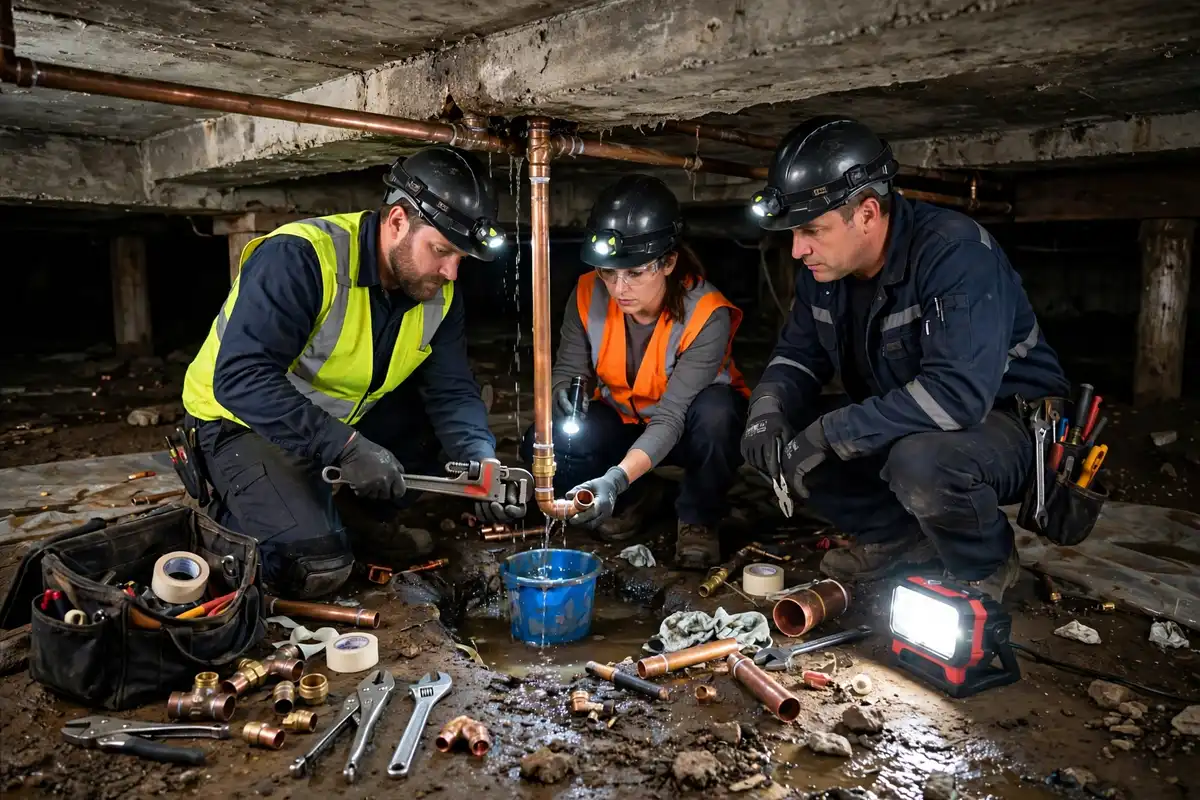
An emergency visit in San Pedro runs on a different clock than a scheduled detection — the first goal is always to stop the water, the second is to stop the damage, and the repair plan comes third. Here's the sequence.
What Happens After the Water Is Stopped
Before we arrive: get the main water off (we'll guide you), move valuables and rugs away from the wet area, and take phone photos of everything — the flooring, the walls, the meter. Those photos are gold later, whether for your own records or an insurance conversation. if you know whether your home still has galvanized or was converted to copper, tell us — in 90731 that single fact changes the diagnostic odds
Expect the water to stay off until the failed line is isolated or repaired — that's non-negotiable for safety and for stopping the damage. We'll restore service to the rest of the house as fast as the plumbing allows, and we'll tell you plainly what "fast" means for your specific layout. Questions before you book? Call (833) 713-2101 — we'd rather answer them now than discover them mid-visit.
Local Notes for San Pedro 90731
The 90731 ZIP covers central and east San Pedro: the downtown core, the Gaffey Street corridor, Pacific Avenue and Harbor Boulevard down toward the port. You'll know the Vincent Thomas Bridge, the Los Angeles Maritime Museum, the SS Lane Victory, and the Ports O' Call area. This is the denser, flatter half of San Pedro — 1940s through 1970s single-family homes mixed with multifamily buildings — on flat coastal-plain alluvium. Slab foundations dominate the postwar tracts; the older downtown stock is more mixed.
Two 90731 realities to plan around. First, the high water table: after heavy rain, saturated soil can mimic leak symptoms, so the meter test is your arbiter — learn where your meter is and how to read the dial. Second, the galvanized-to-copper transition: if your home is 1940s–50s and never re-piped, treat pressure drops as urgent, because that pipe fails from the inside with no visible warning. In multifamily buildings, sort out which shutoff controls your unit before you need it. Call (833) 713-2101 — mention the build era and we'll calibrate from there.
We're a referral line: you talk to us, and we connect you with a slab-leak specialist serving the 90731 area. Questions about emergency slab leak repair in the 90731 ZIP? Call (833) 713-2101.
Pressure Drops With No Puddle: Emergency Slab Leaks Near the Port
The classic 90731 emergency does not look like an emergency at first — the water bill spikes, the shower pressure sags, and there is no water anywhere. In the port-adjacent lowlands the high water table and damp alluvial soil drink a small leak before it ever surfaces, and older galvanized lines in the 1940s–50s stock fail from the inside out, corroding shut even as they leak. By the time water shows, the line may have been bleeding for weeks. Do not wait for a puddle to call it urgent.
Your first 30 minutes are diagnostic: find the meter — usually in a box at the curb on the Gaffey-side streets — and do the stop test. Make sure nobody is using water, then watch the low-flow indicator. Spinning means a live leak; that is your confirmation before we roll a truck. Then shut the main and open the lowest hose bib to relieve pressure; in these soils residual water keeps wicking for hours, so relieve it early.
Groundwater conducts sound, which makes electronic detection noisier here than inland — it is the one area where we spend extra time on pressure isolation, capping branches one at a time to prove which run is actually losing water before any slab work starts. That is slower on the front end and much faster overall, because it rules out the shared walls and multifamily branches common in central San Pedro before concrete is touched.
Suspect a Slab Leak? Talk to a Specialist Today
One call connects you with a local slab leak professional serving Rancho Palos Verdes, CA — day or night.
Call (833) 713-2101Frequently Asked Questions
Why is leak detection harder near the port?
Groundwater. The harbor lowlands hold a high water table in alluvial soil, and saturated ground conducts sound — which is exactly what acoustic leak sensors listen for. The result is a 'smeared' signal: the leak's sound arrives from everywhere at once. Emergency Slab Leak Repair in 90731 compensates by leaning harder on the meter test, pressure isolation, and thermal imaging, and by triangulating the acoustic pass from multiple positions. It takes longer; it's still definitive.
Does the high water table cause slab leaks, or just hide them?
Both, in different ways. Constantly damp alluvial soil accelerates copper corrosion from the outside — that's causation. And saturated ground smears acoustic signals and can wick moisture into slabs that looks like a leak — that's masking and mimicking. So 90731 gets more genuine corrosion failures and harder diagnoses. The meter test cuts through all of it: groundwater can't spin a meter.
I'm in a multifamily building. Does that change the visit?
It changes the first fifteen minutes. We have to establish which shutoff controls your unit and whether the leaking line is dedicated to you or shared — because opening a slab over a shared line without mapping it first is how you surprise the neighbors. Emergency Slab Leak Repair in multifamily buildings always includes that mapping step. Have your building's shutoff layout ready if you can; if you can't, we'll sort it on site.
What's the difference between 90731 and 90732 for slab leaks?
Ground and grade. 90731 is the flat, dense, port-adjacent half — high water table, alluvial soil, transition-era pipes. 90732 is the hillier south and west — bluff lots, stepped slabs, slope drainage, salt air. Detection in 90731 fights groundwater noise; detection in 90732 fights hillside seepage and access. Same city, different diagnostic puzzles. Tell us your ZIP when you call (833) 713-2101 and we'll bring the right playbook.
What should I do in the first ten minutes of a suspected emergency slab leak?
Shut the main water off — that's the whole list that matters. Then move rugs, electronics, and anything absorbent away from the wet area, and photograph everything before you touch it. In San Pedro, in the denser multifamily blocks, know which shutoff controls your unit — building mains and unit valves aren't always clearly marked Call (833) 713-2101 once the water is off; we'll take it from there.
Will my water be off for the whole emergency visit?
Until the failed line is isolated or repaired, yes — running water through a broken under-slab line just feeds the damage. The good news: once we isolate the failed run, the rest of the house usually gets water back the same visit. 1940s–70s single-family and multifamily homes, denser and flatter than the rest of San Pedro, so isolation is typically straightforward once we've found the break.
Should I document anything for a possible insurance claim?
Yes, and start before we arrive: photos of the wet areas, the meter reading, the water bill spike if you have it, and keep every receipt from the visit onward. We're happy to explain what happened in plain terms for your records — that's advice and documentation, not claims handling, and it's part of why the emergency visit includes a written account of the findings.