Emergency Slab Leak Repair in Hawthorne 90250, CA
Emergency Slab Leak Repair in Hawthorne 90250, CA — urgent response for an active under-slab leak — guided shutoff help, damage control, and fast stabilization of the failed line.
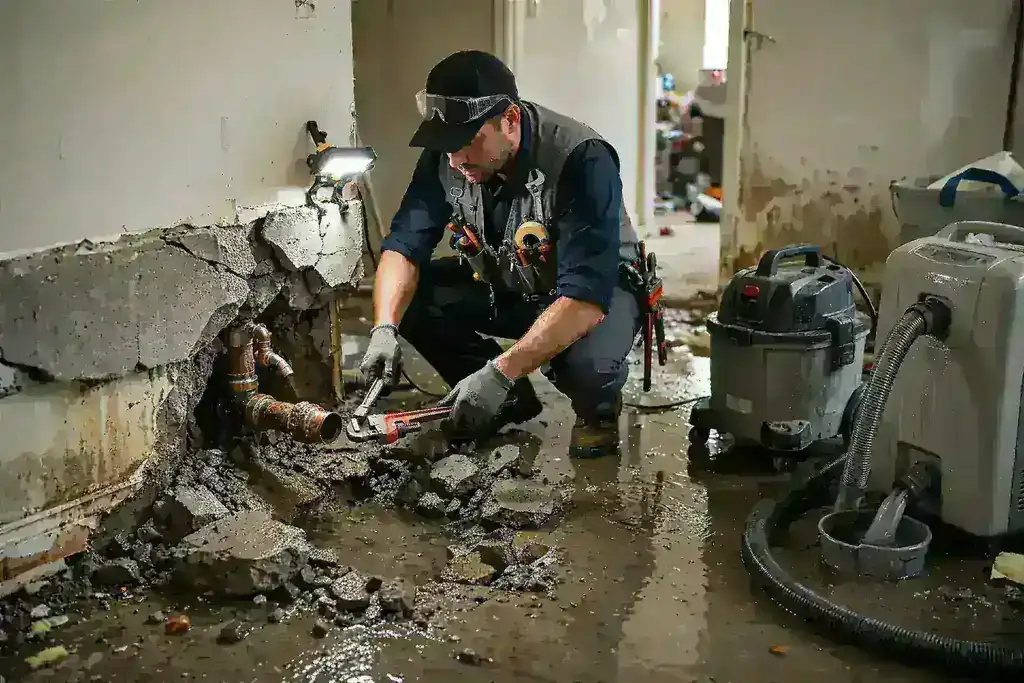
In Short
Emergency Slab Leak Repair in Hawthorne 90250, CA — urgent response for an active under-slab leak — guided shutoff help, damage control, and fast stabilization of the failed line. Serving the 90250 ZIP: guided shutoff help, damage control, priority visits. First step on your call: we walk you to the main shutoff.
What the Emergency Visit Looks Like in Hawthorne (90250)
An emergency visit in Hawthorne runs on a different clock than a scheduled detection — the first goal is always to stop the water, the second is to stop the damage, and the repair plan comes third. Here's the sequence.
What Happens After the Water Is Stopped
Before we arrive: get the main water off (we'll guide you), move valuables and rugs away from the wet area, and take phone photos of everything — the flooring, the walls, the meter. Those photos are gold later, whether for your own records or an insurance conversation. multifamily visits need the manager and building access arranged ahead — the diagnostic can't start at a locked door
Expect the water to stay off until the failed line is isolated or repaired — that's non-negotiable for safety and for stopping the damage. We'll restore service to the rest of the house as fast as the plumbing allows, and we'll tell you plainly what "fast" means for your specific layout. Still unsure whether it's a slab leak? That's exactly what the call is for: (833) 713-2101.
Local Notes for Hawthorne 90250
The 90250 ZIP covers Hawthorne's 1950s tract grids along Hawthorne Boulevard, Crenshaw Boulevard, and Inglewood Avenue, between the I-105 and I-405 corridors. The SpaceX headquarters and Hawthorne Municipal Airport (Jack Northrop Field) mark the industrial edge; Hollyglen and Del Aire are the named residential pockets. Housing is predominantly 1950s single-family slab tracts with dense multifamily infill — copper-and-galvanized pipe mix, cast-iron drains — on flat coastal-plain alluvium. The pre-1950 raised-foundation pockets hide among the tracts.
Hawthorne's one non-negotiable: verify the foundation type before anything else. If your home is 1940s or earlier, check for a crawlspace — a 1944 home with a floor furnace is almost certainly raised, not slab, and the 'slab leak' is really an under-floor leak with easier access and a smaller bill. Tract homeowners: 1950s copper at peak age means the standard vigilance — meter checks, warm floors, quick calls to (833) 713-2101. Multifamily managers: keep the shutoff map and our number together; coordination is the job here.
How this works: you call our line, we match you with a slab-leak specialist who serves 90250 — no fee for the call itself. Questions about emergency slab leak repair in the 90250 ZIP? Call (833) 713-2101.
Confirm the Foundation First: Hawthorne's Mixed-Era Emergency Calls
Hawthorne's 1950s slab tracts are at peak failure age and produce the classic emergency — warm floor, spinning meter, seventy-year-old copper. But pockets of pre-1950 stock, like the 1940s homes with raised foundations and floor furnaces, still stand among them, and a slab-leak call on a raised-foundation home is a different emergency entirely: under-floor leaks are visible, accessible, and usually cheaper to fix. We confirm foundation type before quoting anything, because the wrong assumption here is expensive.
Your first 30 minutes: shut the main, then carefully look for crawlspace access — a vent or hatch around the foundation perimeter. If you can see under the house and spot active dripping, tell us; the emergency just changed from slab work to accessible pipe repair and the timeline shortens dramatically. No crawlspace and a warm slab area? That is the 1950s copper signature, and we roll with detection gear.
Dense multifamily across Hawthorne adds the shared-line question from the Harbor City playbook: in multi-unit buildings we map which unit's branch is failing before authorizing any repair work, because one leak affecting several units needs one clear owner of the repair. Report the build year and unit count when you call — with those two facts we arrive with the right plan instead of discovering it at your front door.
Suspect a Slab Leak? Talk to a Specialist Today
One call connects you with a local slab leak professional serving Rancho Palos Verdes, CA — day or night.
Call (833) 713-2101Frequently Asked Questions
How do I know if my Hawthorne home is on a raised foundation?
Look for the signs: a visible crawlspace access, the house sitting above grade on a stem wall, or a floor furnace — the 1940s Hawthorne homes with floor furnaces are the classic raised-foundation profile. If the walls meet the ground with no crawlspace, it's slab. Emergency Slab Leak Repair starts here because the jobs diverge completely: under-floor leaks are accessed from the crawlspace, slab leaks from above. Call (833) 713-2101 with your best guess and we'll confirm before dispatching the right approach.
Why does the foundation type change the cost so much?
Access. A raised-foundation leak is reached through a crawlspace — no concrete cutting, no flooring restoration, often a straightforward pipe fix with simpler access. A slab leak needs detection, pinpointing, concrete work, and patching. Same symptom (water where it shouldn't be), very different jobs. That's why Emergency Slab Leak Repair in 90250 always establishes the foundation first: quoting a slab repair for a crawlspace leak — or vice versa — is the most expensive mistake in this ZIP.
How do multifamily slab leaks work in Hawthorne?
One break, several affected units: water follows structure, not leases. The diagnostic has to map shared versus dedicated lines and establish which unit's run actually failed — the wettest unit isn't always the source unit. Emergency Slab Leak Repair includes that mapping, and the written findings go to whoever authorizes building work. Unit shutoffs versus building mains get sorted before any conclusions. It's coordination-heavy work, but the method is the same: meter, pressure, sound, heat.
Are the 1950s tracts in Hawthorne at the same risk as Torrance's?
Essentially identical — same decade, same copper-and-galvanized mix, same flat coastal plain, same 70-year corrosion math. Hawthorne's 1950s tracts are at peak failure age right now, full stop. The differentiators are the multifamily density (more shared-line complexity) and the pre-1950 pockets (the foundation trap). For a standard 1950s tract home, Emergency Slab Leak Repair here is the same straightforward, high-value visit it is in Torrance.
What should I do in the first ten minutes of a suspected emergency slab leak?
Shut the main water off — that's the whole list that matters. Then move rugs, electronics, and anything absorbent away from the wet area, and photograph everything before you touch it. In Hawthorne, tract homes: standard meter or house valve; multifamily: know the unit-versus-building shutoff split before you need it Call (833) 713-2101 once the water is off; we'll take it from there.
Will my water be off for the whole emergency visit?
Until the failed line is isolated or repaired, yes — running water through a broken under-slab line just feeds the damage. The good news: once we isolate the failed run, the rest of the house usually gets water back the same visit. 1950s slab tracts at peak failure age, plus dense multifamily — with pre-1950 raised-foundation pockets still present, so isolation is typically straightforward once we've found the break.
Can an emergency slab leak wait until morning?
Pressurized water under a slab doesn't pause overnight — it keeps wicking into flooring and framing, and every hour adds to the restoration scope. in multifamily buildings, check adjacent and below units — the damage map and the leak map are drawn separately If the meter is spinning with fixtures off or water is surfacing, treat it as now, not morning. The call costs nothing; the overnight damage doesn't.