Copper Corrosion Under the Slab: Why Mid-Century Pipes Fail
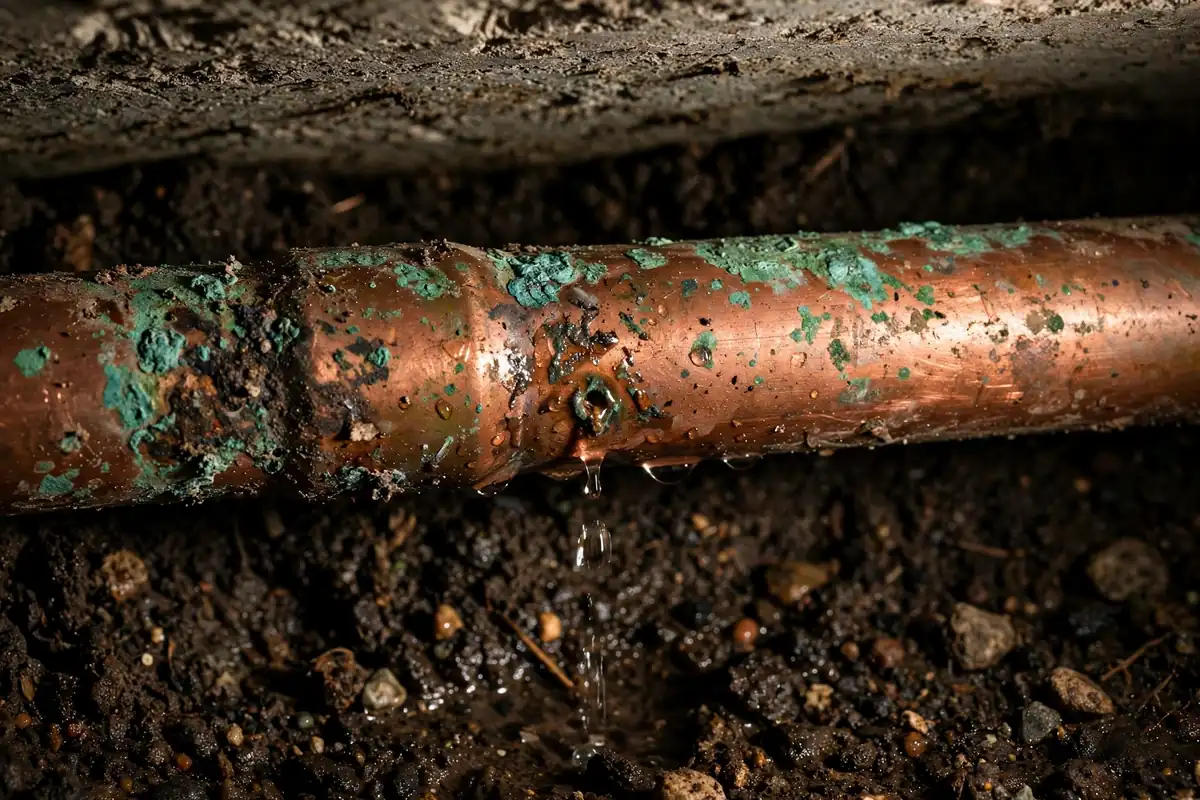
Copper has an excellent reputation as a plumbing material, and deservedly so, but copper water lines buried under a concrete slab live in a harsh environment. Soil chemistry, moisture, electrical currents, and installation details all attack copper from the outside while water chemistry works from the inside. In Rancho Palos Verdes, where many homes still run on original 1950s to 1970s copper under-slab lines, corrosion is the single most common reason those lines eventually fail. Understanding how copper corrodes helps you recognize the risk in your own home and decide what to do about aging pipe before it fails.
Pitting Corrosion: How Pinholes Begin
The classic under-slab copper failure is the pinhole leak, and it starts with pitting corrosion. Tiny localized spots on the pipe's exterior lose their protective oxide layer, and once bare copper is exposed to moist, mineral-rich soil, an electrochemical cell forms that eats steadily into the pipe wall. The pit deepens over years while the surrounding pipe looks fine, until one day the wall is breached and pressurized water jets into the soil. From the surface, nothing looks wrong until the leak has run long enough to show symptoms. This is why a single pinhole is rarely a solitary event; the soil conditions that created one pit are usually creating others along the same run.
Soil Chemistry on the Palos Verdes Peninsula
Not all soil attacks copper equally. Soils high in chlorides, sulfates, or with low resistivity are more aggressive toward buried copper, and the Peninsula's geology includes marine-influenced soils in some areas that can be particularly corrosive. Moisture is the great accelerator: copper in consistently damp soil corrodes far faster than copper in soil that drains and dries. Homes where downspouts dump near the foundation, where irrigation oversprays the slab edge, or where drainage is poor keep the surrounding soil wetter and drive faster exterior corrosion. Local soil and drainage conditions are a genuine factor in how long under-slab copper lasts.
Electrolysis and Stray Electrical Currents
A less obvious enemy is electricity. When dissimilar metals meet in the presence of moisture, such as copper pipe touching a steel rebar tie, a galvanized strap, or an old iron fitting, galvanic corrosion attacks the more vulnerable metal. Stray currents from grounding systems, nearby utilities, or even a neighbor's electrical work can also accelerate copper loss along the pipe. During {slab leak detection, /slab-leak-detection/} and repair planning, specialists look for these conditions because a line failing from electrolysis will keep failing at every contact point unless the cause is addressed, not just the current pinhole.
Water Chemistry Attacks From Inside
Corrosion is not only an outside job. Aggressive water chemistry, particularly water that is acidic, low in minerals, or high in chlorides, can erode copper from the interior. Interior erosion often shows up first at elbows and tees where turbulence is highest, thinning the pipe wall from within. Homeowners sometimes notice blue-green staining in fixtures or a metallic taste as early hints of interior copper corrosion. While municipal water in the South Bay is treated to be non-aggressive, individual homes with water softeners set incorrectly or with long stagnant runs can still develop interior corrosion conditions.
Installation Defects That Haunt Old Lines
Some corrosion failures trace back to the day the pipe was installed. Copper laid directly against concrete without proper wrapping can suffer from the alkalinity of curing concrete. Kinked tubing creates stress points where corrosion concentrates. Excessive flux left inside joints during soldering causes interior pitting near every fitting. In the tract-building boom that created much of Rancho Palos Verdes, speed sometimes beat craftsmanship, and the shortcuts of sixty years ago become the pinholes of today. When one joint fails from a workmanship issue, neighboring joints from the same installer deserve scrutiny.
Why One Pinhole Usually Means More Are Coming
This is the hard truth about corroded copper: the conditions are systemic. The same soil bathes the entire run, the same water flows through it, and the same installer built it. Finding one pinhole leak in a 1960s copper line is strong evidence that the line has entered its failure phase, and spot-repairing a single hole often buys only months before the next one appears. This reality shapes repair strategy. A {copper pipe repair, /copper-pipe-slab-leak-repair/} makes sense for an isolated failure in otherwise sound pipe, but widespread corrosion usually points toward {rerouting the line, /slab-leak-pipe-rerouting/} out from under the slab or {lining it, /epoxy-pipe-lining/} so the whole run is addressed at once.
Assessing Your Own Home's Risk
Consider the age of your plumbing, the soil drainage around your foundation, and any history of pinhole leaks. A home with original 1960s copper, poor drainage on one side, and one prior pinhole repair is a strong candidate for proactive evaluation. {Electronic detection, /electronic-slab-leak-location/} can check the condition of your lines and find active seeps before they become damaging leaks. For an honest assessment of where your pipe stands, (833) 713-2101 will connect you with an independent local slab leak specialist serving Rancho Palos Verdes who can assess your pipe's condition honestly and explain whether your situation calls for monitoring, a targeted repair, or a whole-line solution.
Suspect a Slab Leak? Talk to a Specialist Today
One call connects you with a local slab leak professional serving Rancho Palos Verdes, CA — day or night.
Call (833) 713-2101Frequently Asked Questions
What causes copper pipes to fail under a slab?
Pitting corrosion, where small localized spots on the pipe exterior lose their protective layer and corrode through. Soil moisture, aggressive soil chemistry, and stray electrical currents drive it. The result is the classic pinhole leak, and because soil conditions affect the whole run, one pinhole often predicts more.
How long does buried copper pipe typically last?
Exterior lifespan depends heavily on soil conditions, commonly several decades, but aggressive or constantly wet soil shortens it significantly. Interior corrosion from water chemistry is a separate factor. In Rancho Palos Verdes homes with original mid-century copper, age plus local soil conditions make evaluation worthwhile even without symptoms.
Is a spot repair enough for a corroded copper line?
It can be, as a short-term fix for a single isolated pinhole in otherwise sound pipe. But if corrosion is systemic, which is common in aging lines, spot repairs tend to become a repeating cycle. A specialist can assess whether the failure looks isolated or line-wide before you decide.
What are the early signs of copper corrosion?
Watch for blue-green staining at fixtures, a metallic taste, unexplained water bill increases, and any history of pinhole leaks. From the outside, poor drainage around the foundation and constantly damp soil near the slab edge accelerate exterior corrosion.
Can copper corrosion under a slab be prevented?
Properly installed dielectric separation from dissimilar metals, good foundation drainage that keeps soil from staying saturated, and correct water chemistry all help. For lines already showing systemic corrosion, rerouting or lining addresses the whole run rather than chasing individual pinholes.